|
Autographs, Covers, Letters & Postcards ͏ ͏ ͏ ͏ ͏ ͏ ͏ ͏ ͏ ͏ ͏ ͏ ͏ ͏ ͏ ͏ ͏ ͏ ͏ ͏ ͏ ͏ ͏ ͏ ͏ ͏ ͏ ͏ ͏ ͏ ͏ ͏ ͏ ͏ ͏ ͏ ͏ ͏ ͏ ͏ ͏ ͏ ͏ ͏ ͏ ͏ ͏ ͏ ͏ ͏ ͏ ͏ ͏ ͏ ͏ ͏ ͏ ͏ ͏ ͏ ͏ ͏ ͏ ͏ ͏ ͏ ͏ ͏ ͏ ͏ ͏ ͏ ͏ ͏ ͏ ͏ ͏ ͏ ͏ ͏ ͏ ͏ ͏ ͏ ͏ ͏ ͏ ͏ ͏ ͏ ͏ ͏ ͏ ͏ ͏ ͏ ͏ ͏ ͏ ͏ ͏ ͏ ͏ ͏ ͏ ͏ ͏ ͏ ͏ ͏ ͏ ͏ ͏ ͏ ͏ ͏ ͏ ͏ ͏ ͏ ͏ ͏ ͏ ͏ ͏ ͏ ͏ ͏ ͏ ͏ ͏ ͏ ͏ ͏ ͏ ͏ ͏ ͏ ͏ ͏ ͏ ͏ ͏ ͏ ͏ ͏ ͏ ͏ ͏ ͏ ͏ ͏ ͏ ͏ ͏ ͏ ͏ ͏ ͏ ͏ ͏ ͏ ͏ ͏ ͏ ͏ ͏ ͏ ͏ ͏ ͏ ͏ ͏ ͏ ͏ ͏ ͏ ͏ ͏ ͏ ͏ ͏ ͏ ͏ ͏ ͏ ͏ ͏ ͏ ͏ ͏ ͏ ͏ ͏ ͏ ͏ ͏ ͏ ͏ ͏ ͏ ͏ ͏ ͏ ͏ ͏ ͏ ͏ ͏ ͏ ͏ ͏ ͏ ͏ ͏ ͏ ͏ ͏ ͏ ͏ ͏ ͏ ͏ ͏ ͏ ͏ ͏ ͏ ͏ ͏ ͏ ͏ ͏ ͏ ͏ ͏ ͏ ͏ ͏ ͏ ͏ ͏ ͏ ͏ ͏ ͏ ͏ ͏ ͏ ͏ ͏ ͏ ͏ ͏ ͏
|
Letter from General Joubert to President Kruger (1881)
R25,000
Dated 22 February 1881. Headquarters. Written five days before The Battle of Majuba Hill on 27 February 1881. At this time the Boers were encamped at the foot of Majuba. The letter mentions a requirement for more supply wagons, men and horses.
For more details and images, go to the website: https://jamesfindlaycollectablebooks.com/boer-war/letter-from-general-joubert-to-president-kruger-1881 See more on The Boer War on the website.
|
|
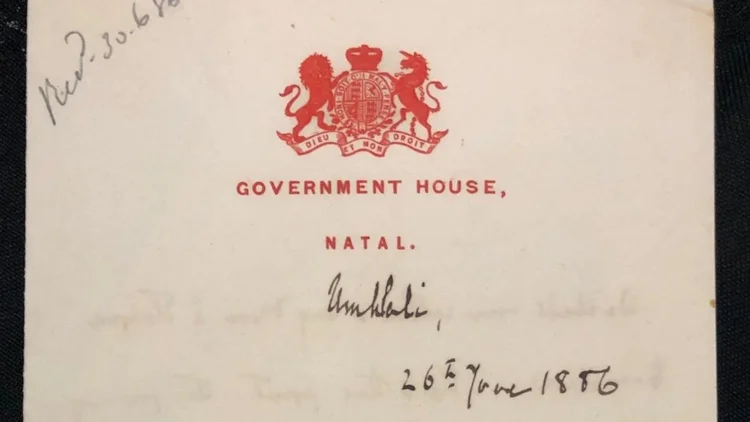
Letter Regarding Hut Tax from the Governor of Natal (1886)
R8,000
This is a historical letter written by Sir Arthur Elibank Havelock, who served as the Governor of Natal from 1886 to 1889 to Sir Theophilus Shepstone, the highly influential Secretary for Native Affairs who essentially architected the "Shepstone System" of indirect rule in Natal. The letter is particularly significant because it captures a moment of colonial policy debate regarding the "Hut Tax," a key mechanism used by the British to fund administration and compel local African labor.
For more details and images, go to the website: https://jamesfindlaycollectablebooks.com/kwazulu-natal/huttax1886 See more on Kwa-Zulu Natal on the website.
|
|
Autograph: Col. John Graham (c.1814)
R4,000
John Graham (1778-1821) took part as a Major in the occupation of the Cape in 1806 and participated at the battle of Blaauwberg. In 1811, together with British regulars, and burghers, Graham fought the Xhosa under the command of Chief Ndlambe. As a result of this campaign, Grahamstown was named in his honour. While on leave in the U.K. Graham was reassigned as the pay master to the 2nd Battalion 91st Regiment of Foot. They were then deployed to the United Provinces of Holland. This Napoleonic war document is signed by Graham in that capacity. After that campaign Graham returned to the Cape. For more details and images, go to the website: https://jamesfindlaycollectablebooks.com/militaria/autograph-col-john-graham-c1814 See more Militaria on the website
|
|
Manuscript Letter: English landscape and genre painter Thomas Barker of Bath (1838)
R2,500
The cover is an artifact of the Pre-Uniform Penny Post era with a hand-stamped "N Bathurst" / "№ 7" and the circular Bath postmarks dated September 28, 1838. Letters were folded up into their own envelopes (stampless covers), sealed with black wax (visible near the bottom), and heavily taxed based on the number of sheets and the distance traveled—a luxury reserved only for the wealthy, like successful artists and London lawyers.
For more details and images, go to the website: https://jamesfindlaycollectablebooks.com/autographs/thomas-barker-of-bath-1838
See more Autographs & Letters on the website (New)
|
|
Manuscript Letter: ‘The Cipher King’, Sir James Alfred Ewing (1931)
R2,000 In the letter, dated May 27, 1931, Sir James Alfred Ewing gently chides a collector for "prematurely" addressing him as the President of the British Association, noting that the office won't pass to him until the following year. He did indeed go on to serve as the President of the British Association for the Advancement of Science in 1932. Though his public profile was that of an elite academic and physicist, during World War I, Ewing was the mastermind behind Room 40—the Admiralty's ultra-secret codebreaking operation. As its director, he recruited a team of academics, linguists, and chess masters to intercept and decrypt German naval communications. Under his watch, Room 40 famously intercepted and decoded the Zimmermann Telegram in 1917, a crucial catalyst that helped draw the United States into World War I. His secret work earned him wartime nicknames like "The Cipher King" and "Eavesdropper Ewing." For more details and images, go to the website:
https://jamesfindlaycollectablebooks.com/science-maths/the-cipher-king
See more on Science & Maths on the website
|
|
Surrender of The Cape of Good Hope, Morning Chronicle (1795)
R1,500
The Morning Chronicle
London, Tuesday November 24, 1795 The Battle of Muizenberg in 1795 was a British invasion that resulted in the first British occupation of the Cape Colony, ending Dutch East India Company rule. British warships bombarded the Dutch fort at Muizenberg on August 7, 1795, and British troops advanced, pushing the Dutch forces back until they surrendered the colony on September 16, 1795.
For more details and images, go to the website: https://jamesfindlaycollectablebooks.com/the-cape/surrender-of-the-cape-of-good-hope-1795
See more on The Cape on the website.
|
|
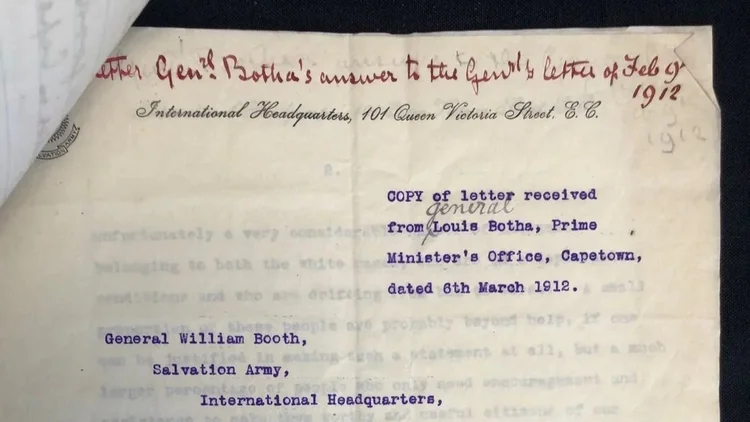
Clerical letters: Gen Louis Botha on Immigration (1910-1913)
R1,500 9 pages, clerical copies. Louis Botha (27 September 1862 – 27 August 1919) was a South African politician who was the first prime minister of the Union of South Africa, the forerunner of the modern South African state. A Boer war veteran during the Second Boer War, Botha eventually fought to have South Africa become a British Dominion.
Clerical copy, not in Botha’s hand. For more info and images, go to the website:
https://jamesfindlaycollectablebooks.com/politics/gen-louis-botha-letters-on-immigration-1910-1913 See more on Politics on the website
|
|
Letter from Thomas Huxley ("Darwin's Bulldog") to Captain Donnelly RE the "South Kensington" Vision (1867)
R1,250 This envelope features a rare piece of postal history: a crisp, circular "TOO-LATE / LONDON" handstamp dated AP 5 / 67 (April 5, 1867), alongside a classic Victorian One Penny Red stamp. Sent by Thomas Henry Huxley, one of the giants of 19th-century science. Famously nicknamed "Darwin's Bulldog" for his fierce, relentless public defense of Charles Darwin’s theory of evolution, Huxley was also an incredibly dedicated advocate for educational reform. For more details and images, go to the website: https://jamesfindlaycollectablebooks.com/autographs/huxley-darwins-bulldog-to-captain-donnelly See more Autographs & Letters on the website (New)
|
|
Two Letters From a Trainee: The East African Campaign (1940)
R1,250 Two letters and envelopes offering a firsthand glimpse into the rapid mobilization of the Union Defence Forces (UDF) during the opening stages of South Africa's involvement in World War II. July 1940: Private Mann is stationed at the M.T. (Motor Transport) Personnel Depot at Premier Mine (near Pretoria). He notes that he is "learning to drive" and mentions a new influx of recruits arriving from Cape Town ("C.T."). Premier Mine was transformed into a massive training hub during the war, churning out the technical and transport personnel required for a modern, mechanized army. December 1940: Just five months later, his rank shifts to Driver with the 1st S.A. Reserve M.T. Company, and his location is marked as "Somewhere in Kenya." South African troops had been dispatched to East Africa to counter the threat of Italian forces occupying Ethiopia and Italian Somaliland. For more details and images, go to the website: https://jamesfindlaycollectablebooks.com/philately/letters-from-a-trainee-1940 See more Philately on the website (New)
|
|
Dog Tax, Orange River Colony (1907)
R1,000 Dog Tax signed by the local Magistrate of the Orange River Colony. The Orange River Colony was the British colony created after Britain first occupied (1900) and then annexed (1902) the independent Orange Free State in the Second Boer War. The colony ceased to exist in 1910, when it was absorbed into the Union of South Africa as the Orange Free State Province. For more details and images, go to the website:
https://jamesfindlaycollectablebooks.com/documents/dog-tax-orange-river-colony-1907 See more Documents on the website
|
|
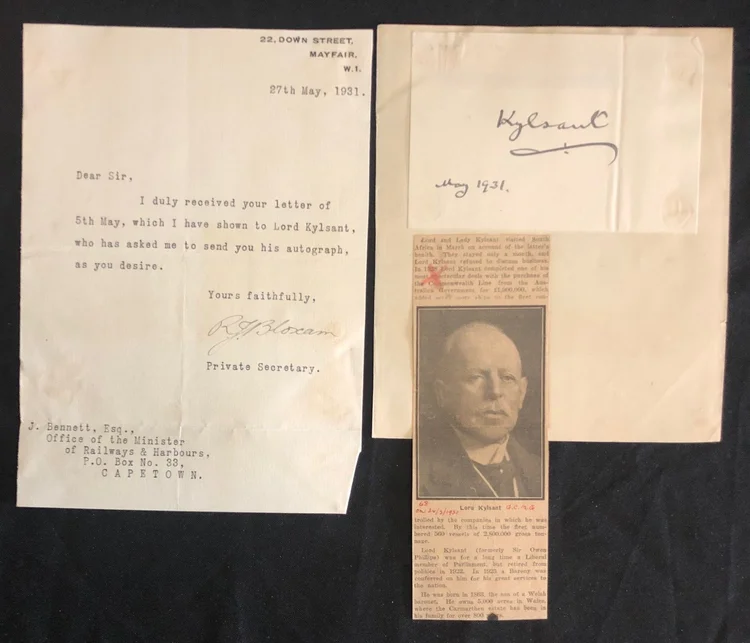
Autograph: Lord Kylsant, Head of the Royal Mail Steamship Company (1931)
R1,000 The letter is dated 27th May, 1931. It is written from a private residence in Mayfair by R.J. Bloxam, the private secretary to Owen Philipps, 1st Baron Kylsant. The secretary politely encloses Lord Kylsant’s autograph. To the unsuspecting recipient, J. Bennett in Cape Town’s Office of the Minister of Railways & Harbours, this was a routine piece of high-society correspondence from a legendary shipping magnate. In reality, the ground was opening up beneath Lord Kylsant's feet at this exact moment. For more details and images, go to the website:
https://jamesfindlaycollectablebooks.com/transport/autograph-lord-kylsant See more on Transport on the website
|
|
For more information contact
James Findlay
+27 (0) 79 779 4574
jamesfindlaycollectablebooks@gmail.com New Categories are being added to the website:
https://jamesfindlaycollectablebooks.com/categories
Join our Whatsapp Group for quick links to the monthly mailers.
|
|
|
|