"Kombuis Dutch" (Kitchen Dutch) - Clanwilliam Mutual Improvement Society (1875)
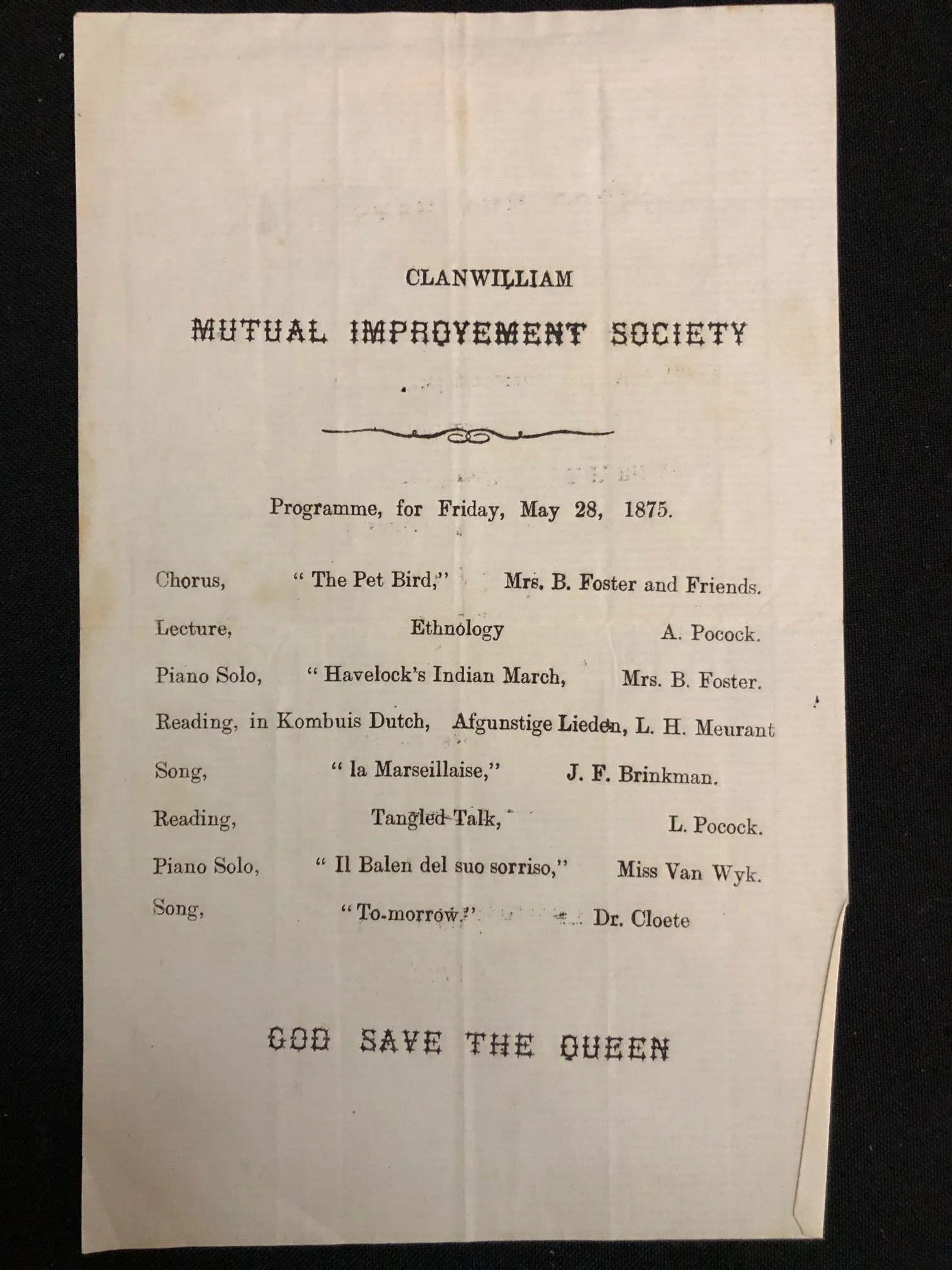
This modest looking program for the Clanwilliam Mutual Improvement Society, dated Friday, May 28, 1875, is a very interesting piece of Afrikaans history.
The Early Roots of the Afrikaans Language (The Meurant Connection)
The standout entry on this program is:
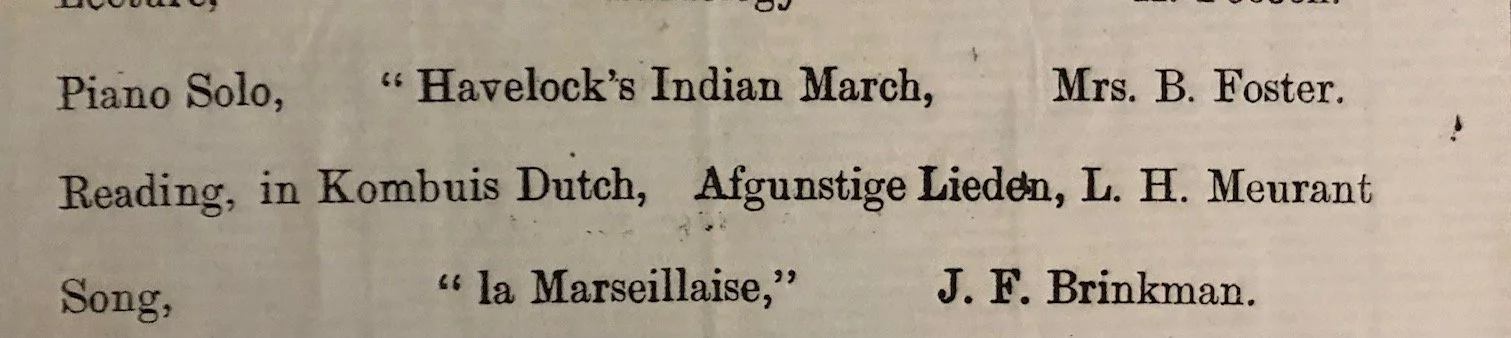
Reading, in Kombuis Dutch, Afgunstige Lieden, L. H. Meurant
This is an extraordinary artifact from the earliest days of the Afrikaans language movement.
"Kombuis Dutch" (Kitchen Dutch): Before it was recognized as a formal language, Afrikaans was often dismissively referred to by the British establishment and upper-class Dutch speakers as "Kombuis Dutch" or patois. To see it explicitly programmed for a public reading in 1875—and labeled as such—is incredibly rare.
Louis Henri Meurant (or his son): L.H. Meurant was a pivotal figure in South African history. He wrote Zamenspraak tusschen Klaas Waarzegger en Jan Twijfelaar (1861), which is widely recognized as one of the first books published in Afrikaans. Meurant served as the Magistrate of Clanwilliam contextually around this era. The reading of Afgunstige Lieden (Envious People) represents a bold, early public airing of the vernacular language just months before the formal founding of the Genootskap van Regte Afrikaners (Association of True Afrikaners) in August 1875.
The program beautifully illustrates the complex, hybridised identity of the late 19th-century Cape frontier. Look at how radically the items jump across cultural boundaries:
It begins with a polite Victorian chorus ("The Pet Bird").
Moves into an academic colonial lecture on Ethnology by A. Pocock.
Features an imperialistic piano piece celebrating British rule in India ("Havelock’s Indian March", likely a nod to Sir Henry Havelock of Indian Mutiny fame).
Dips into local "Kombuis Dutch" social satire (Afgunstige Lieden).
Pivots to a performance of the French revolutionary anthem, "la Marseillaise", sung by J.F. Brinkman (a family of Dutch/German descent).
Plays a classical Italian aria ("Il Balen del suo sorriso" from Verdi's Il Trovatore).
Concludes with a song by a member of the old Cape Dutch elite (Dr. Cloete).
Closes with a resolute, printed "GOD SAVE THE QUEEN".
This shows that rural intellectual life in places like Clanwilliam wasn't isolated or uniform; it was an eclectic mix of British imperial loyalty, European high culture, and emerging local identity.
The "Mutual Improvement Society" Movement
In the 19th century, before television, radio, or widespread libraries, towns relied on Mutual Improvement Societies for adult education and entertainment.
They were self-organized, middle-class hubs where locals pooled their talents to deliver lectures on science, history, and philosophy, interspersed with music. For a remote town like Clanwilliam in 1875, this society was the absolute epicenter of the town's intellectual and social life.
Notable Local Names
For anyone tracking Cape genealogy or regional history, the program is a directory of prominent Clanwilliam families of the era: The Pococks (well-known chemists, photographers, and journalists in the Cape), the Cloetes, the Brinkmans, and the Fosters.
Creased and worn. Brown stain on the back.
128mm x 200mm
Sold Sept' ‘26