East African Annual 1931-32
282mm x 410mm
Edges worn and dog-eared, some fishmothing, spine in need of repair.
R1,000
Box 5, no 23
The East African Annual (1931–1932) is a historically significant volume published in Nairobi by the East African Standard—one of the oldest press institutions in East Africa.
Key Historical Aspects
Snapshot of Interwar East Africa: The cover prominently highlights four key territories—Kenya, Tanganyika, Uganda, and Zanzibar. In 1931–1932, these territories represented a mosaic of British colonial governance: Kenya was a Crown Colony, Uganda a Protectorate, Zanzibar a Sultanate under British protection, and Tanganyika a League of Nations Mandate (taken over from Germany after WWI).
Early Visual Arts & Commercial Illustrators: The cover art—featuring a young East African figure seated in the foreground beneath eucalyptus and acacia trees watching livestock graze—is typical of early 1930s colonial graphic art. These annuals frequently commissioned artwork from prominent local European artists and illustrators living in Nairobi and the White Highlands, offering a idealized vision of the landscape alongside industrial and agricultural features inside.
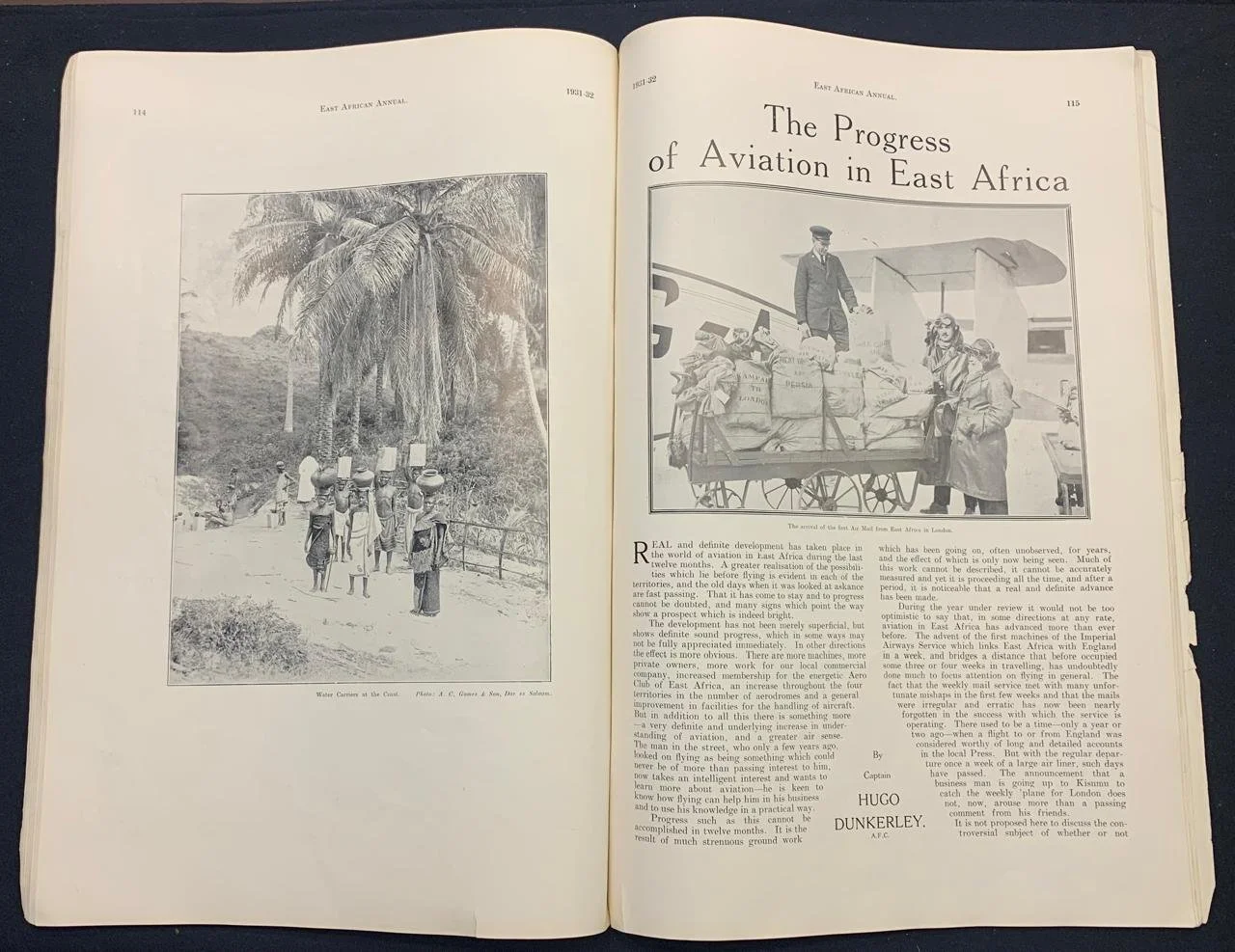
The Interwar Economic Pivot: Published during the onset of the Great Depression, the 1931–1932 edition documented the regional economic strain felt by coffee, tea, and sisal plantations, as well as the initial expansion of rail, road, and Imperial Airways air routes connecting East Africa to the rest of the British Empire.
The Precursor to East African Regional Integration: Grouping Kenya, Tanganyika, Uganda, and Zanzibar together reflected early efforts by the British Colonial Office in the late 1920s and early 1930s toward a "Closer Union" in East Africa. While political union was rejected at the time by local populations and traditional rulers, these economic publications paved the way for joint customs unions, postal services, and eventually the East African Community.