Suid -Afrika 1939-1940
365mm x 251mm
Some staining to the wrappers; spine splitting, corners creased.
R800
Box 3,no13
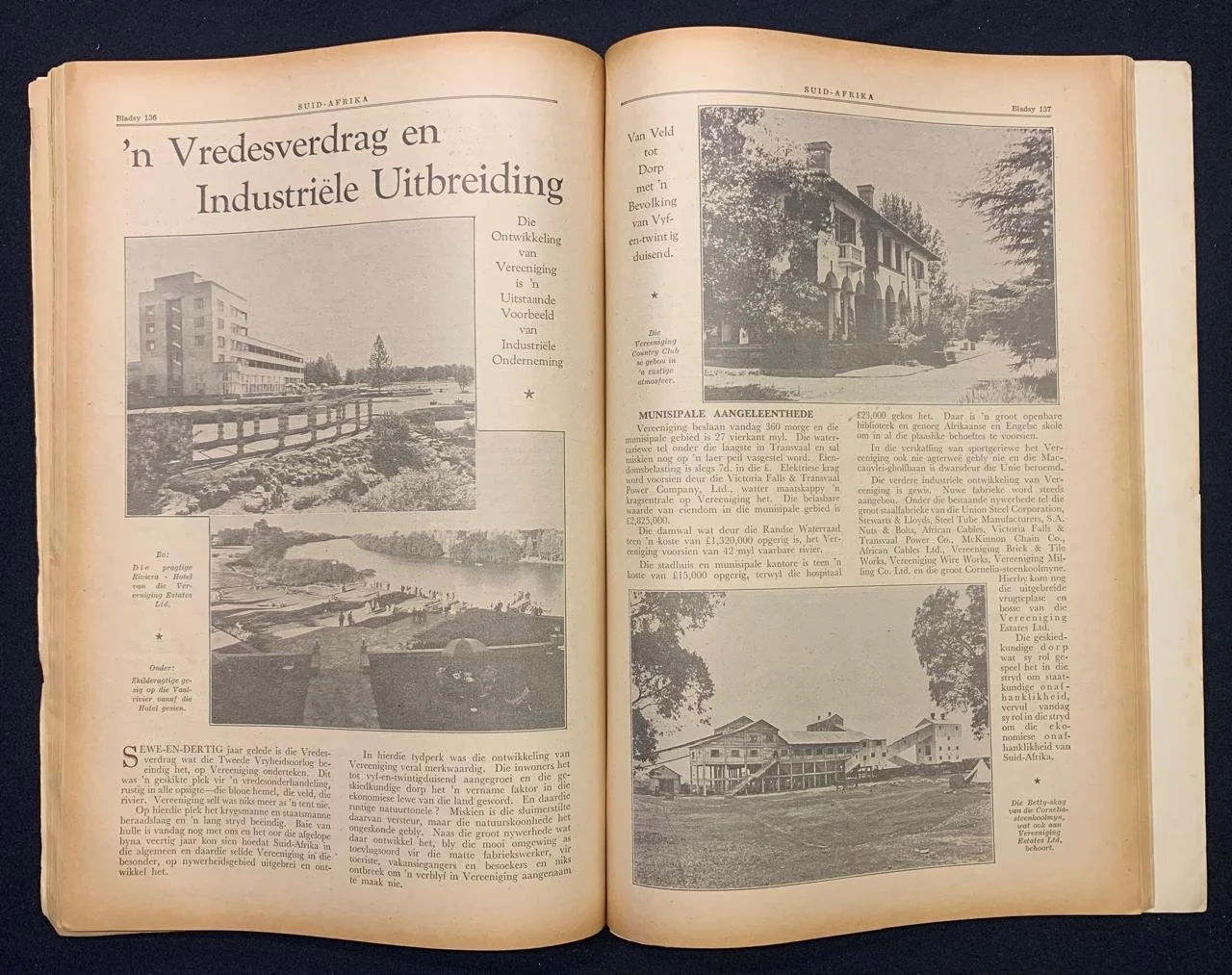
The Suid-Afrika Geïllustreerde Jaarboek 1939–40 (South Africa Illustrated Yearbook) captures a pivotal moment in Afrikaans cultural history and agrarian publishing at the outbreak of World War II.
Key Historical & Visual Aspects
Under the Auspices of the Vroue-Landbouvereniging (VLV): The bottom text explicitly notes it was published "onder beskerming van Die Vroue-Landbouvereniging" (under the patronage of the Women's Agricultural Union). The VLV was one of the most influential Afrikaans socio-cultural organizations of the 20th century, promoting rural community development, home economics, Afrikaans literature, and national heritage among farming families across South Africa.
Symbolism of the Platteland & Ox-Plow: The striking duo-tone cover artwork depicts a farmer guiding a plow pulled by a team of horses or oxen against a Highveld or Karoo landscape. This rural imagery directly reflected the economic backbone of Afrikaans family life during the late 1930s, romanticizing the ties between the land, agriculture, and heritage.
The 1939–1940 Political Fracture: Published during the 1939–1940 period, this volume coincided with severe political division within South Africa. In September 1939, Prime Minister J.B.M. Hertzog resigned after losing a parliamentary vote over South Africa's entry into World War II. While General Jan Smuts led the country into the war alongside the Allies, much of the rural Afrikaans population (the primary readership of VLV publications) favored neutrality or opposed participation, making cultural yearbooks like this crucial anchors for community solidarity.
Afrikaans Media Expansion: The late 1930s marked a golden age for the expansion of Afrikaans-language publishing, following the 1938 Voortrekker Centenary celebrations. Yearbooks produced by organizations like the VLV provided a mix of cultural essays, household instruction, poetry, and regional photography tailored specifically for Afrikaans households.