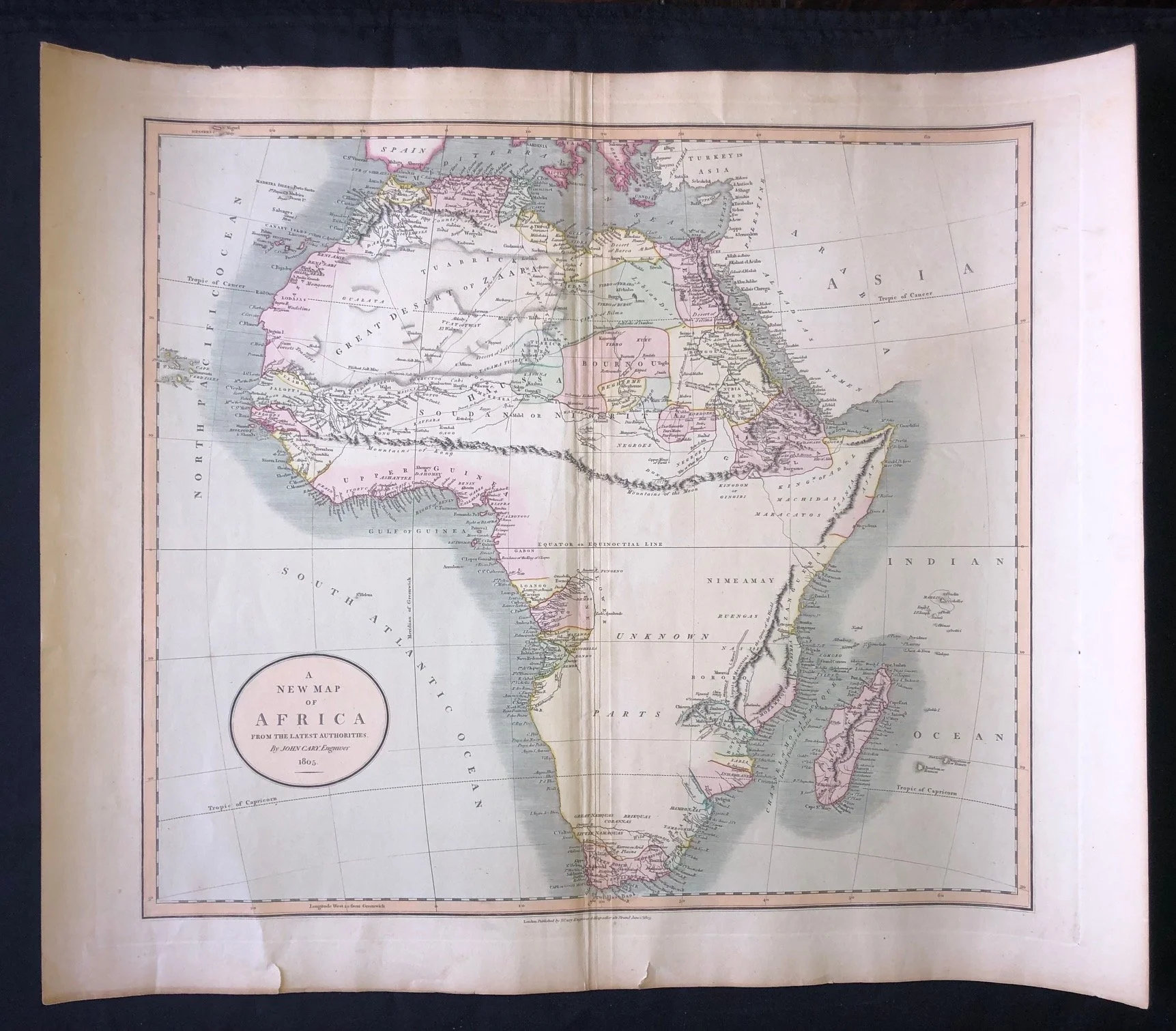
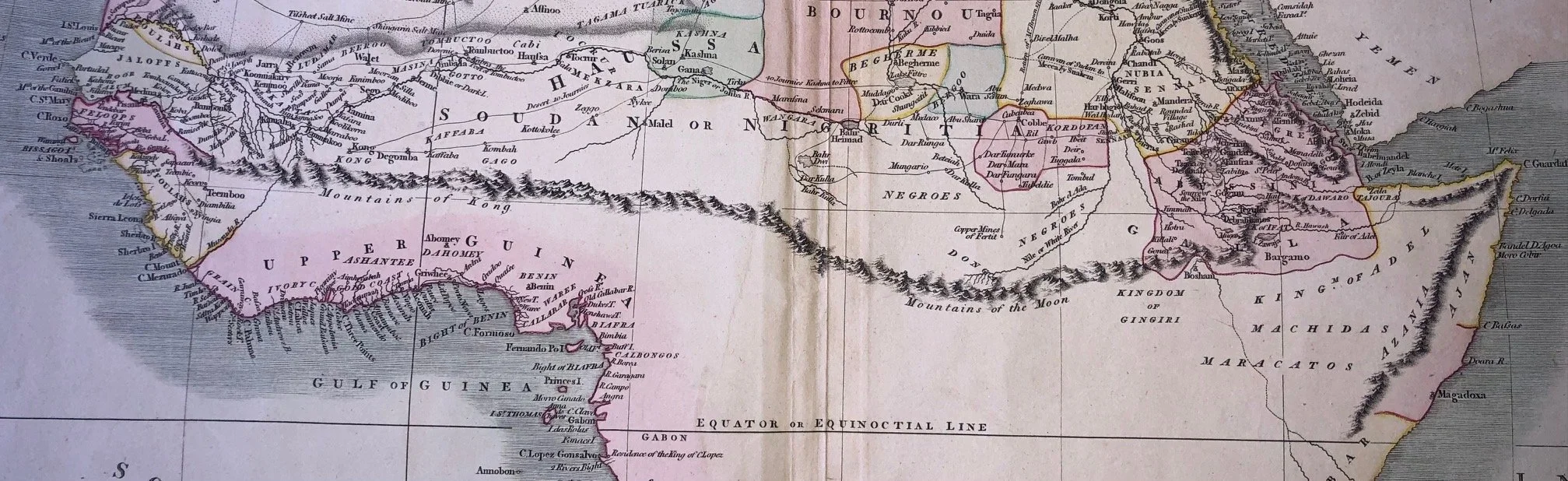
A New Map of Africa by John Cary (1805)
Hand coloured copperplate engraving
This 1805 engraving by John Cary, titled "A New Map of Africa from the Latest Authorities," captures European geography at a critical crossroads. It sits precisely on the divide between speculative, myth-heavy mapmaking and the rigorous, empirical exploration of the 19th century.
The Great Cartographic Myth: The Mountains of Kong
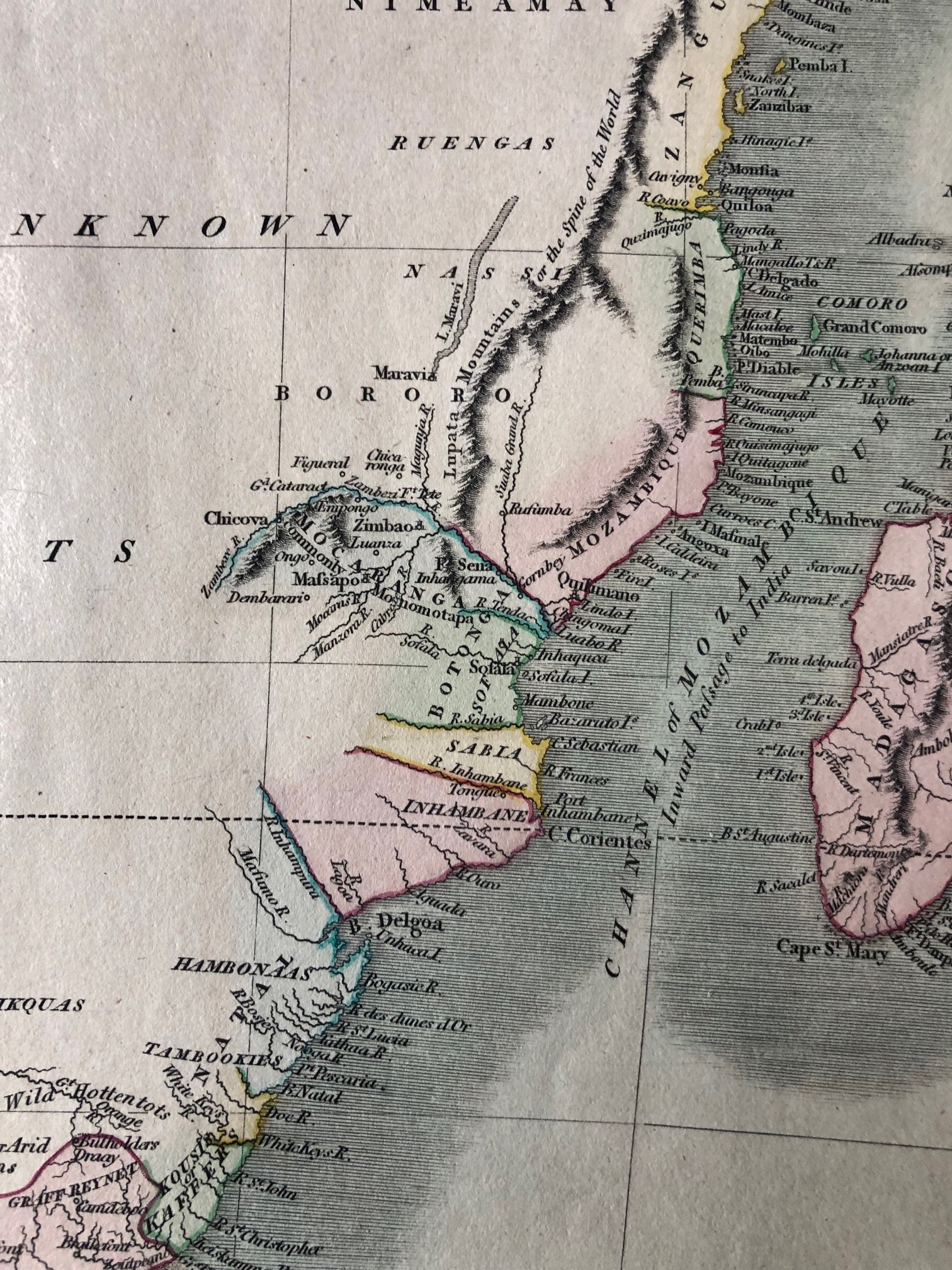
If you look closely at the central belt of the continent, a colossal, unbroken mountain chain spans thousands of kilometers from West Africa all the way to East Africa, where it links with the legendary "Mountains of the Moon."
This feature—the Mountains of Kong—was completely fictional. Invented by English geographer James Rennell in 1798 to explain the path of the Niger River, it was accepted as absolute geographical fact by European cartographers. Cary faithfully engraved them here. This phantom range was reprinted on commercial maps for nearly a century until French explorer Louis-Gustave Binger finally proved in 1889 that they didn't exist.
The Rise of Scientific Cartography ("Unknown Parts")
During the 17th and 18th centuries, mapmakers hated empty spaces, famously filling the African interior with speculative kingdoms, decorative elephants, or mythological lakes.
John Cary was a pioneer of the British "empirical" school of cartography. Rather than inventing data, he left the entire center of Southern and Central Africa completely blank, boldly labeling it "UNKNOWN PARTS." This honest mapping style served as a direct visual challenge to the era's explorers, functioning almost like a literal "fill-in-the-blanks" blueprint for the upcoming age of expedition.
A Geopolitical Snapshot of the South African Frontier
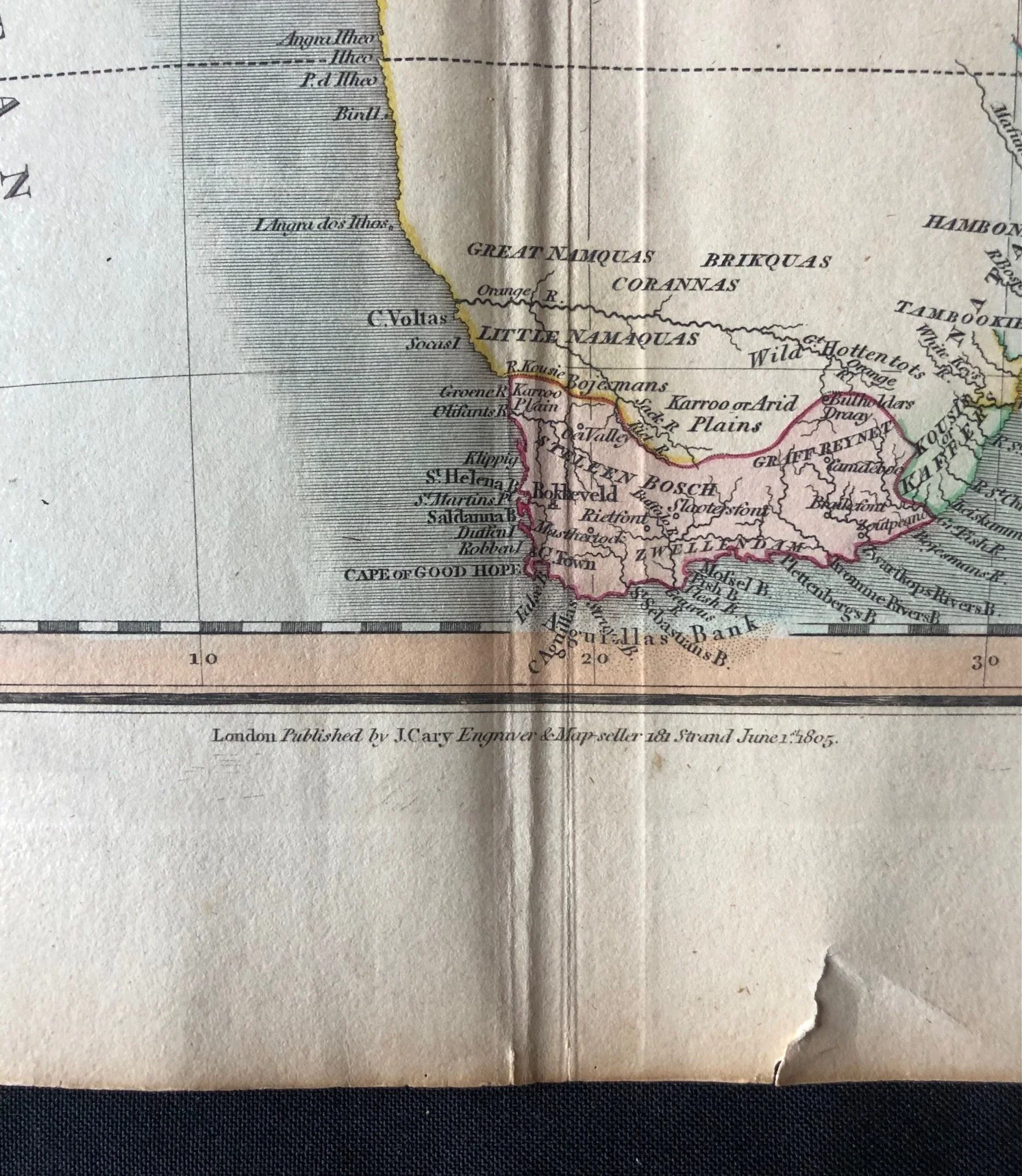
The lower portion of the map, captures the Cape of Good Hope during a brief, volatile geopolitical window. Published in June 1805, the map shows the Cape during the temporary period of Batavian (Dutch) Republic rule (1803–1806), just months before the British permanently seized control of the colony at the Battle of Blaauwberg in January 1806.
The map outlines the sprawling, early administrative districts of the VOC era:
Stellenbosch
Zwellendam (Swellendam)
Graff Reynet (Graaff-Reinet)
Bordering these districts are the homelands of indigenous groups, carefully noted by Cary as the Great Namaquas, Little Namaquas, Brikquas, Corannas, and Tambookies (Thembu), providing a vivid record of the shifting colonial frontier lines of the early 1800s.
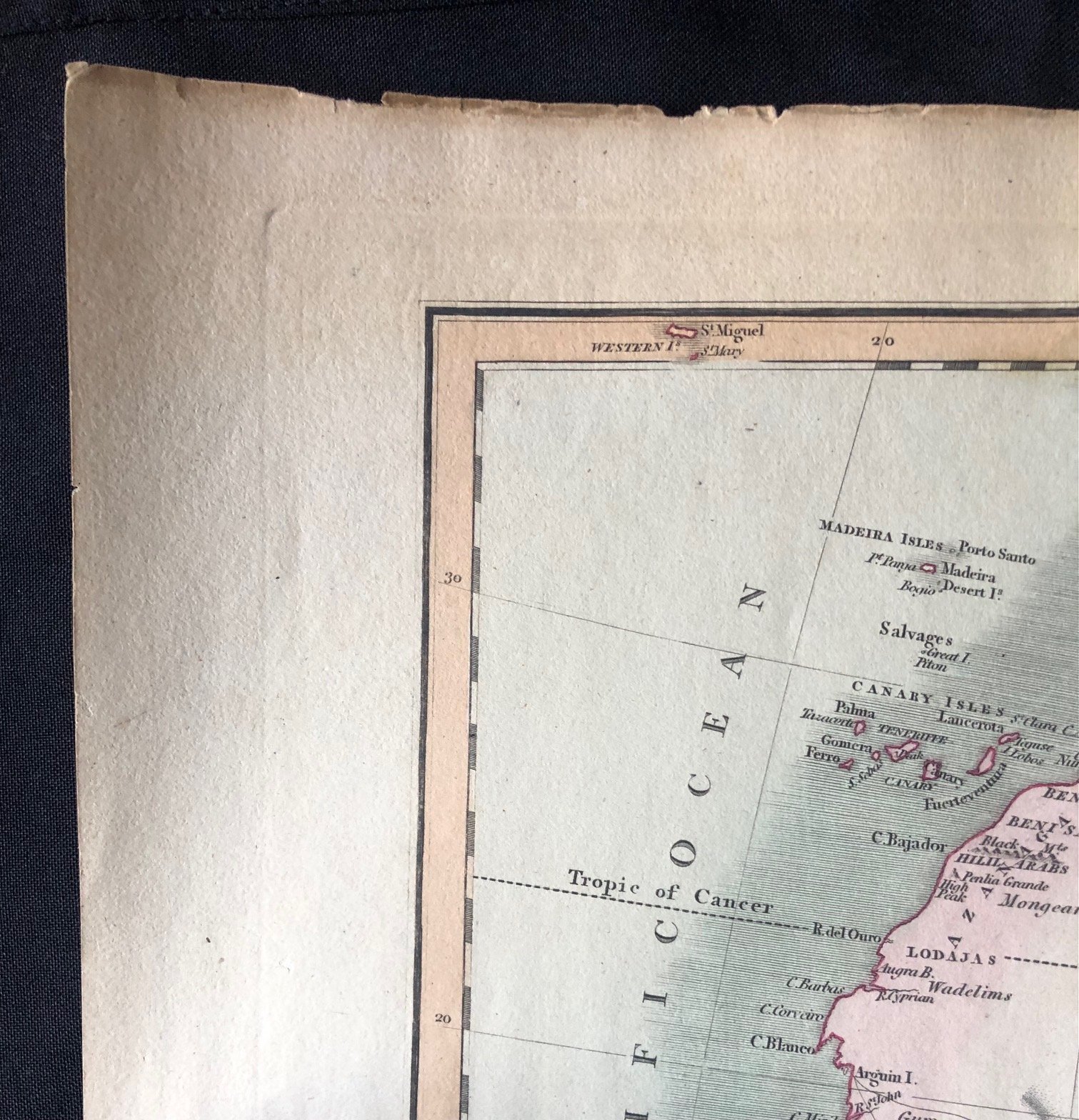
Some offsetting; torn at the edges; minor wear.
Page size: 640mm x 550mm
R8,000