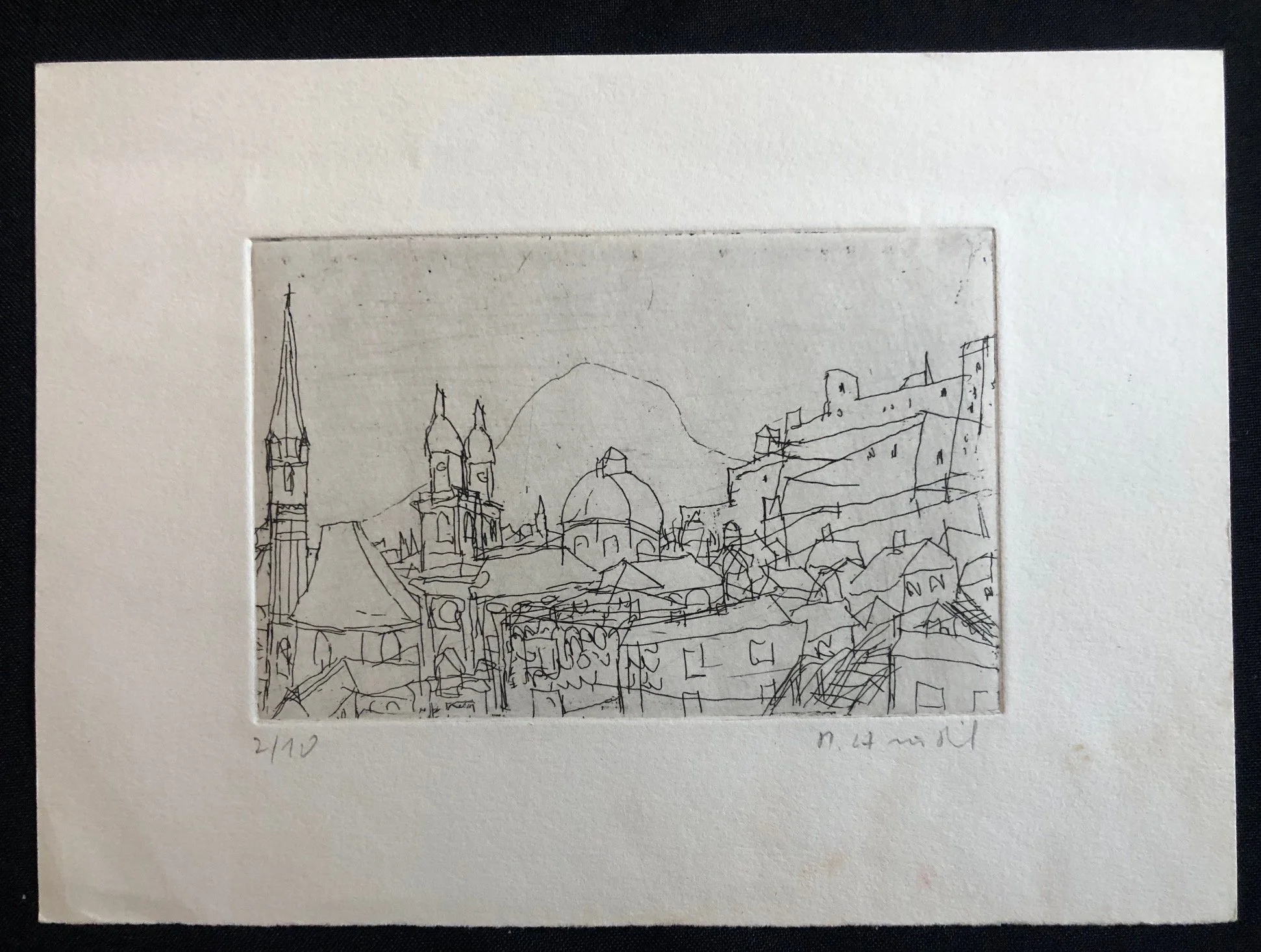
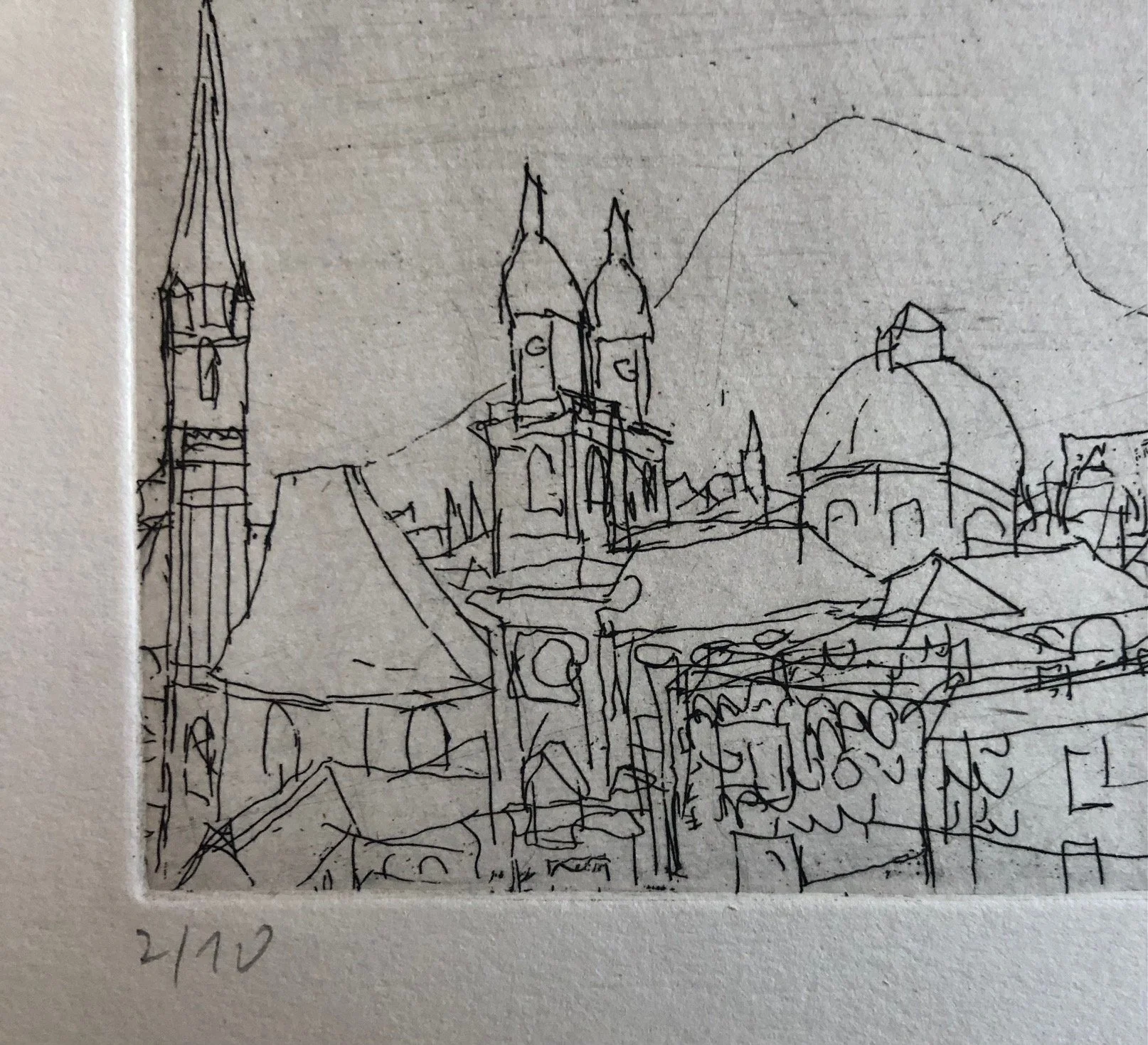
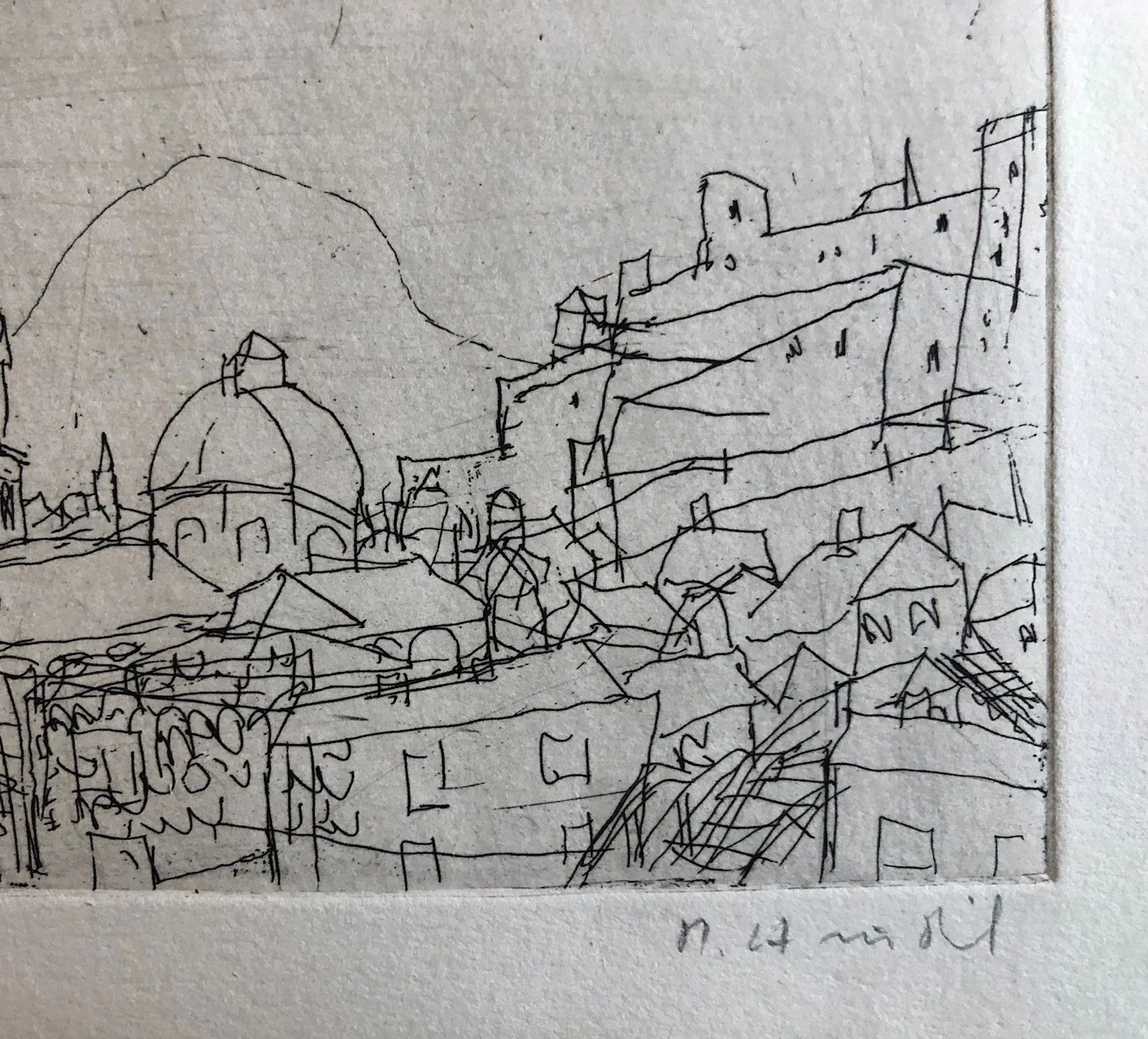
Salzburg Churches and Fortress by Rudolf Hradil c.1970
Original etching, number two of ten.
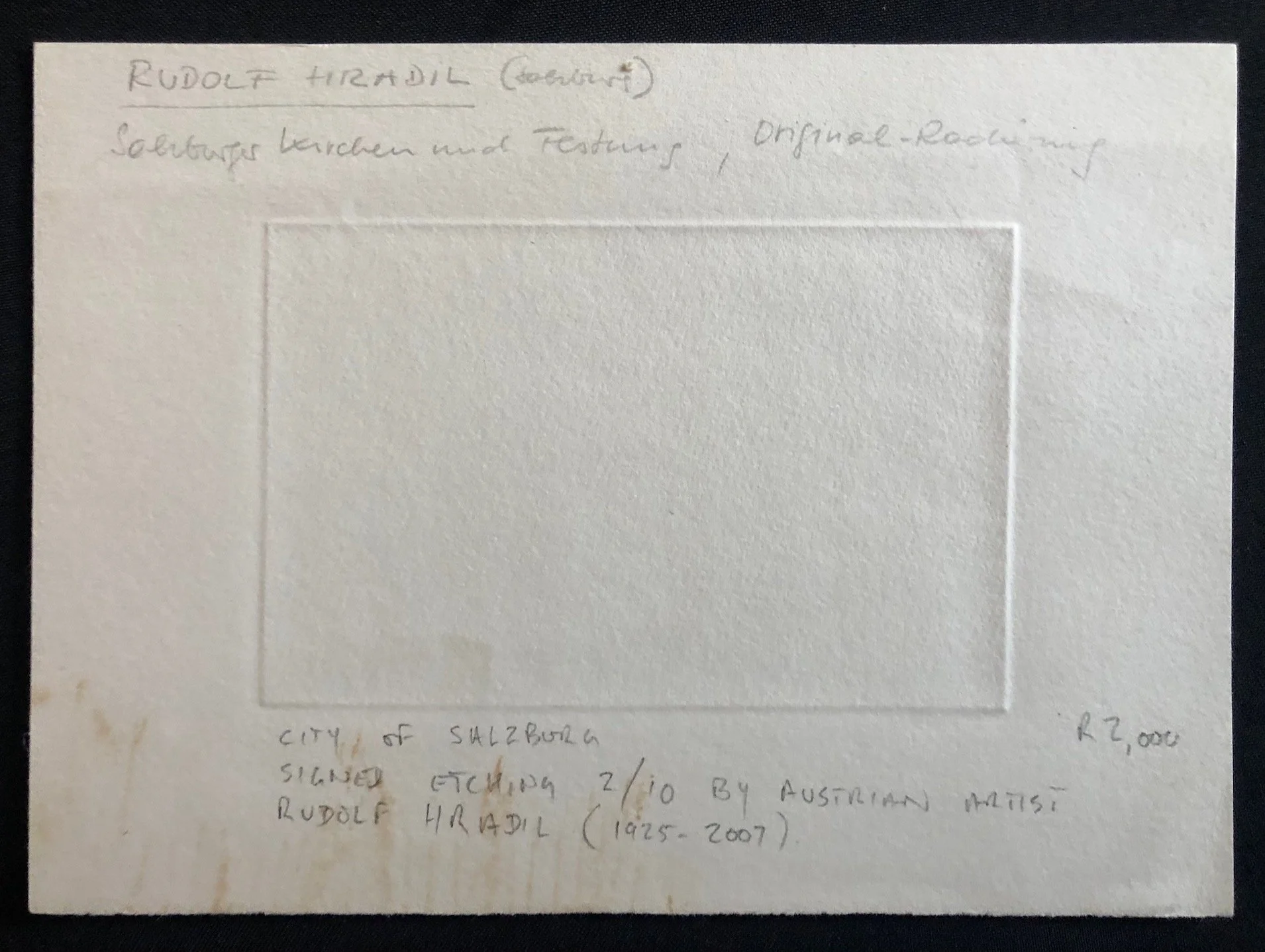
By the Austrian master printmaker Rudolf Hradil (1925–2007).
The German inscription reads: “Salzburger Kirchen und Festung, Original-Radierung” (Salzburg Churches and Fortress, Original Etching).
Rudolf Hradil is one of Austria's definitive post-war graphic artists. Born in Salzburg, he studied in Vienna, Paris (under the legendary cubist Fernand Léger), and London. Hradil was famous for rejecting the stiff, postcard-perfect topographical views of Salzburg. Instead, he preferred a nervous, energetic line that captured the psychological "vibe" and architectural rhythm of a city. He didn't want it to look pretty; he wanted it to look alive.
Decoding the Skyline: Salzburg, Not the Mediterranean
The Towers & Dome: The structures on the left and center are the iconic spires and green dome of the Salzburg Cathedral (Salzburger Dom), a masterpiece of Baroque architecture.
The "Mountain" on the Right: That isn't just a hillside; those blocky, geometric shapes climbing up the right side of the plate represent the massive walls of the Hohensalzburg Fortress (Festung Hohensalzburg), one of the largest medieval castles in Europe, which dominates the Salzburg ridge.
The Peak: The peak faintly outlined in the background is the Gaisberg or the Untersberg mountain.
The Kokoschka Connection
In the 1950s, Hradil attended the famous Schule des Sehens ("School of Seeing") founded in Salzburg by the great Expressionist master Oskar Kokoschka.
Kokoschka taught his students to abandon academic precision and instead use rapid, intuitive draftsmanship to capture the immediate sensory impression of a place before the brain could over-rationalize it. You can see Kokoschka's direct DNA in the hyper-spontaneous, skeletal lines of this 2/10 proof.
Slight browning to the paper, bottom right.
Paper size: 220mm x 160mm
R2,000