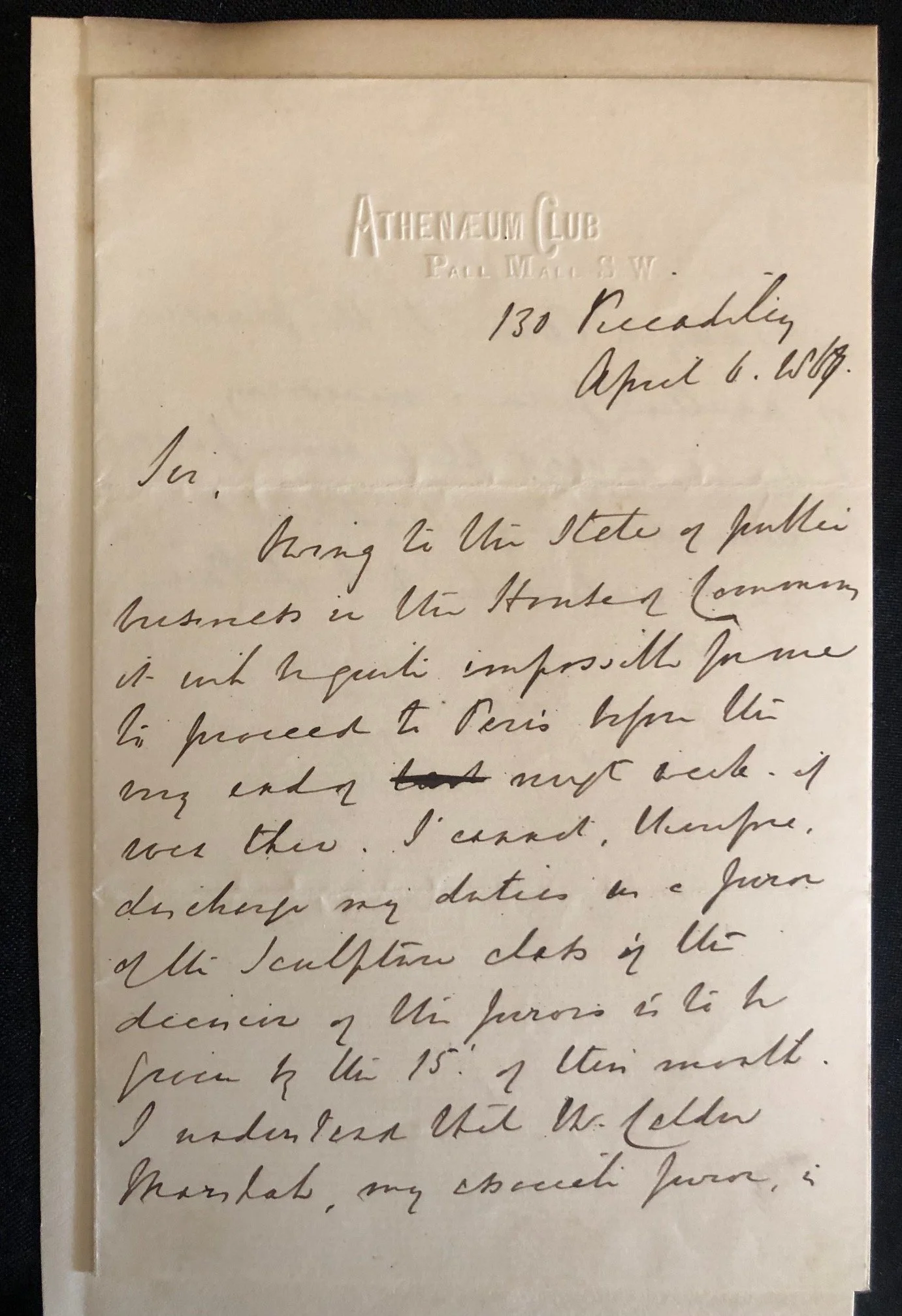
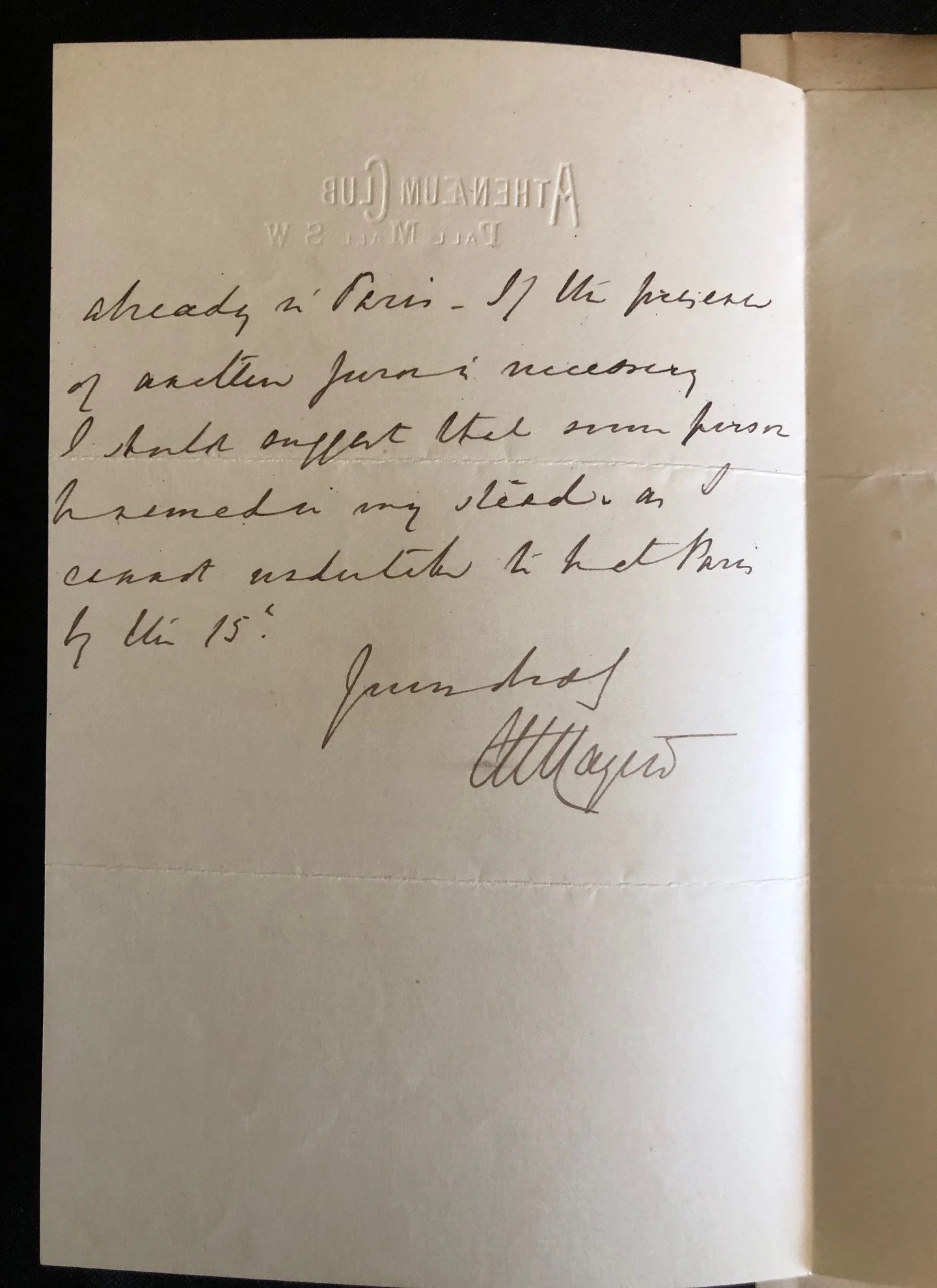
Manuscript Letter by Victorian polymath, Austen Henry Layard (1867)
This handwritten letter captures a fascinating intersection between Victorian politics, archaeology, and the grand theater of 19th-century World's Fairs.
The Author: A Famous Explorer and Politician
The letter is written and signed by Austen Henry Layard (1817–1894). Layard was a true Victorian polymath—most famous to history as the pioneering archaeologist who discovered the ancient Assyrian ruins of Nineveh and Nimrud, sending their magnificent winged-bull sculptures to the British Museum. By the time he wrote this letter on April 6, 1867, he was a prominent Liberal Member of Parliament (MP) in the House of Commons and a major authority on the international art scene.
The Conflict: The 1867 Paris Exposition Universelle
Layard writes to apologize that he cannot travel to France to fulfill his prestigious appointment as an art juror for the Sculpture class at the landmark 1867 Paris Universal Exposition.
The 1867 Exposition was a massive geopolitical statement orchestrated by Emperor Napoleon III to showcase the zenith of French imperial power and global industrial progress. Layard was caught between his dedication to cultural diplomacy and his civil duties, stating that "the state of public business in the House of Commons" made it impossible to depart for Paris in time for the jurors' April 15th deadline.
The Co-Juror: A Master Victorian Sculptor
In the letter, Layard mentions his associate juror: Mr. Calder Marshall (William Calder Marshall, RA), noting that Marshall is "already in Paris." Marshall was one of the most celebrated Scottish classical sculptors of the Victorian era. While Layard was stuck handling parliamentary debates in London, Marshall was left on-site in Paris to judge the world's finest modern sculptures.
Marshall would later go on to execute major public monuments in the British Empire, including pieces for London's iconic Albert Memorial.
High-Society Stationery
The letter reveals a glimpse into the elite circles of Victorian London. It is written on the embossed stationery of the prestigious Athenaeum Club on Pall Mall—the ultimate intellectual hub for the nineteenth-century British establishment, whose members included scientists, artists, and politicians.
115mm x 177mm
2 page manuscript letter. Laid down onto card.
R1,500