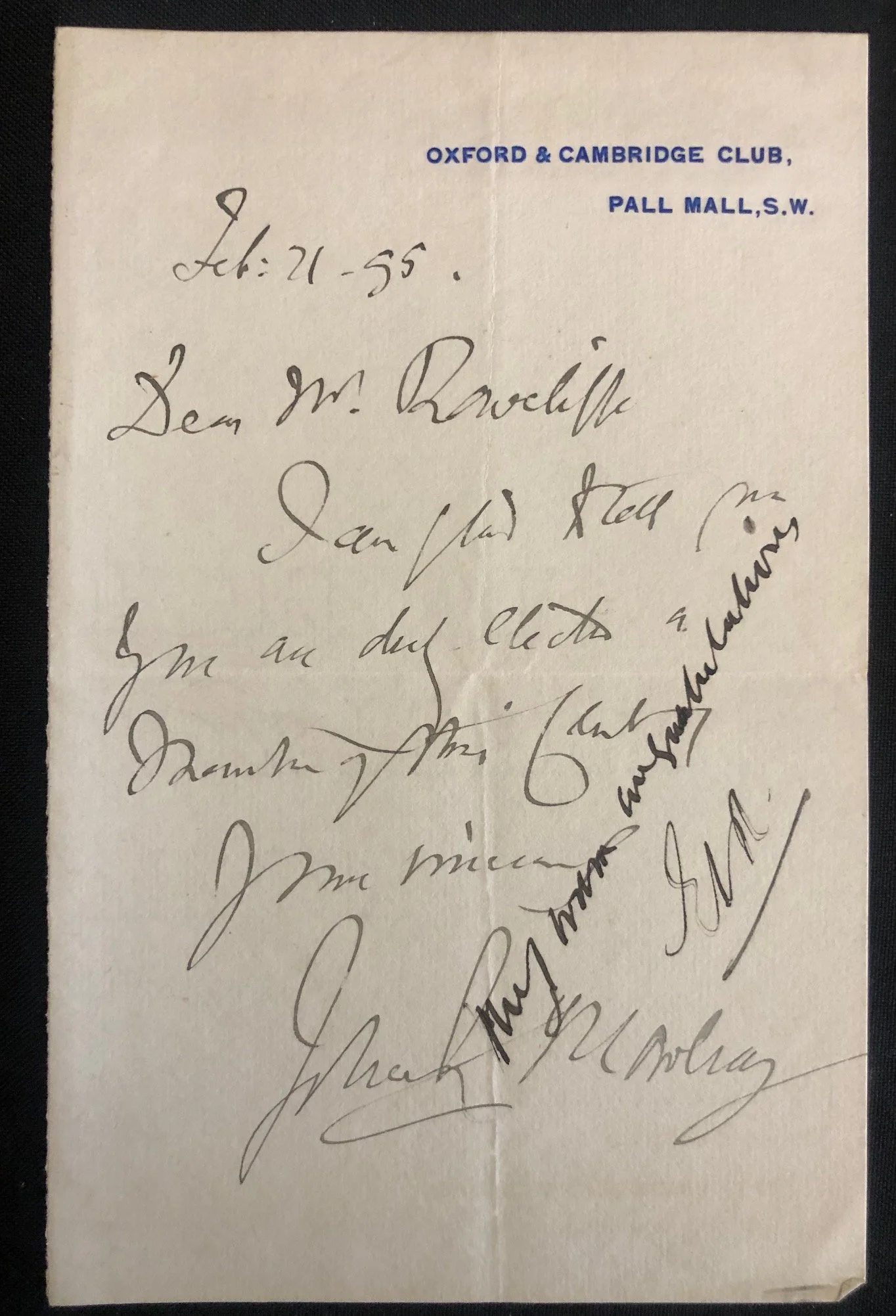
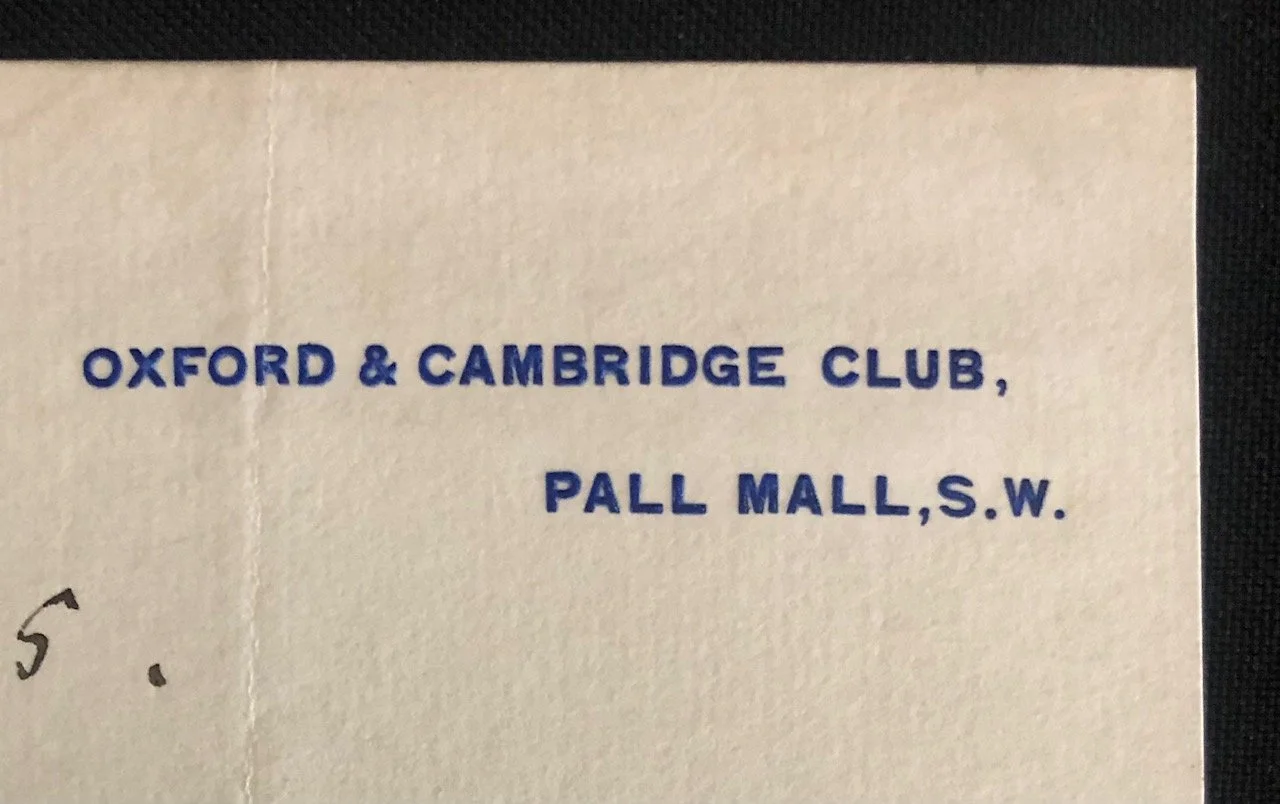
Letter of Acceptance to The Oxford & Cambridge Club on Pall Mall (1895)
This brief, elegant note written on February 21, 1895, at the Oxford & Cambridge Club on Pall Mall, represents an essential rite of passage for the British professional and intellectual elite of the interwar era.
The Recipient: The Continuity of the Legal Elite
The note is addressed to "Dear Mr. Rowcliffe," informing him that he has been "duly elected a member of this Club." The Rowcliffes were a prominent family of upper-class London solicitors (most famously associated with the elite firm Gregory, Rowcliffe & Co.).
This card demonstrates a deep, generational pattern within London's clubland. Elite families routinely put younger generations forward for election to the same prestigious clubs where their fathers, uncles, and professional mentors (such as High Court Judge Sir Arthur Moseley Channell, who corresponded with the family decades earlier) already held influence.
The Strict Mechanics of Interwar "Clubland"
To become a member of a prestigious Traditional Gentlemen's Club on Pall Mall in 1935, an applicant couldn't simply pay a fee and join. The word "elected" carries immense historical weight:
The Process: A candidate had to be formally proposed by an existing member, seconded by another, and then have their name and credentials posted on a candidate book inside the club morning room for weeks.
The Blackball: The committee would then vote using a box of white and black balls. A single black ball (hence the term "blackballed") from an anonymous, disapproving committee member could instantly ruin a candidate's chances.
Receiving a handwritten congratulatory note like this from an inside member or committee representative was a major social relief, confirming that the applicant had successfully passed the rigorous, often exclusionary social screening.
The Interwar Peak of Pall Mall Culture
The Oxford & Cambridge Club—originally founded in 1830 for members of both universities—was at a fascinating historical crossroads. The mid-1930s represented the final twilight of the classic, unyielding British "Clubland" ecosystem before World War II and subsequent economic shifts permanently changed the staff-to-member ratios and the mandatory dress codes of Pall Mall.
The club served as an extension of the university common rooms, acting as an informal powerhouse where judges, bishops, politicians, and top-tier lawyers met over lunches and whiskey to subtly steer British public and legal life.
115mm x 180mm
Edge wear.
R1,000