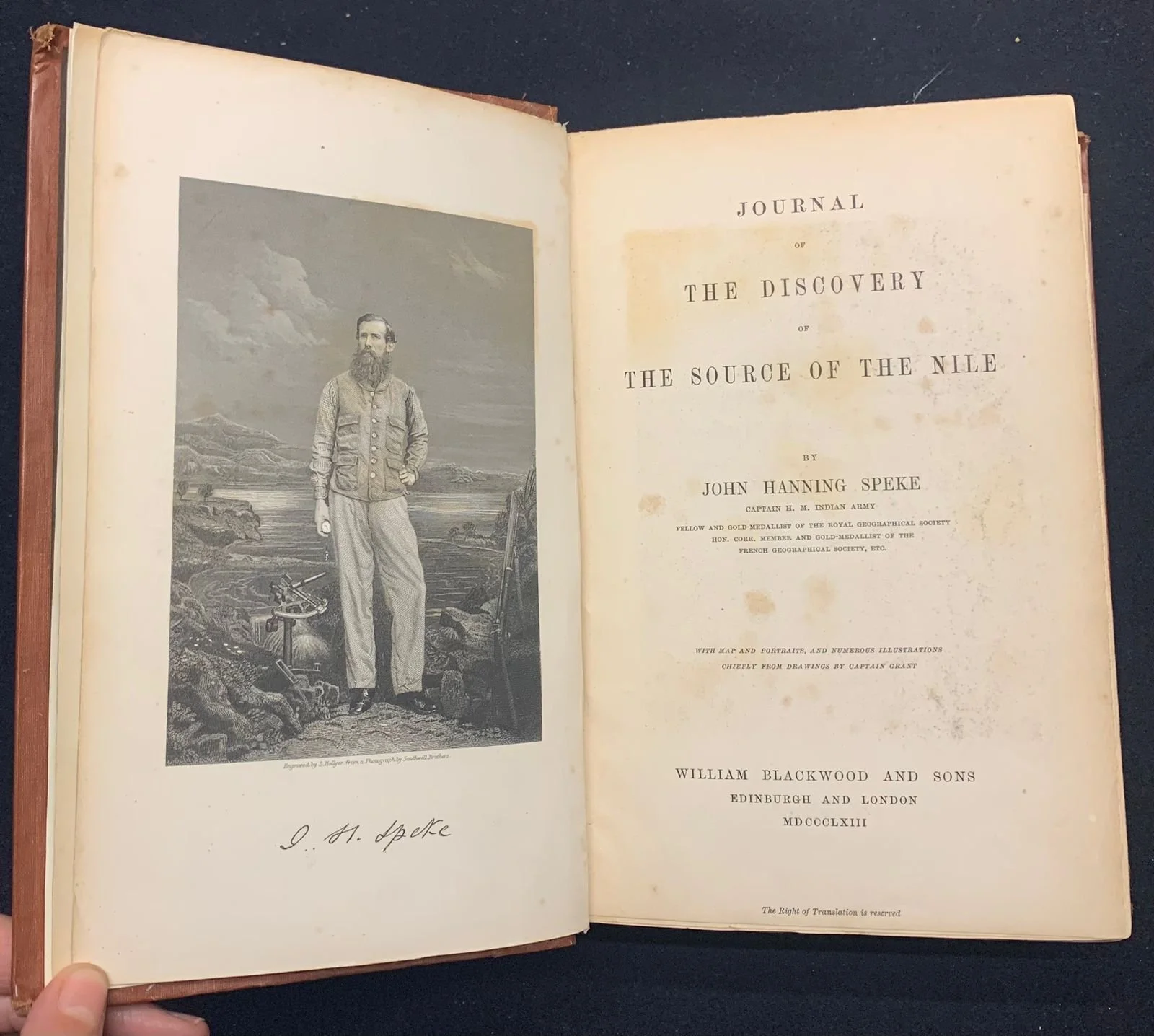
Journal of the Discovery of the Source of the Nile
By John Hanning Speke, Captain H. M. Indian Army
First Edition
1863
Inscription not by Speke.
New end papers.
All woodcuts and maps present.
Captain John Hanning Speke (4 May 1827 – 15 September 1864) was an English explorer and military officer who made three exploratory expeditions to Africa. He is most associated with the search for the source of the Nile and was the first European to reach Lake Victoria (known to locals as Nam Lolwe in Dholuo and Nnalubaale or Ukerewe in Luganda). Speke is also known for propounding the Hamitic hypothesis in 1863, in which he supposed that the Tutsi ethnic group were descendants of the biblical figure Ham, and had lighter skin and more Hamitic features than the Bantu Hutu over whom they ruled.
155mm x 232mm
R30,000
This volume is a first edition (1863) of Journal of the Discovery of the Source of the Nile by John Hanning Speke, published by William Blackwood and Sons.
Key Highlights & Historical Context
The Nile Controversy: This book documents Speke’s 1860–1863 expedition alongside James Augustus Grant, during which Speke identified Ripon Falls (where Lake Victoria flows into the Nile) as the primary source of the Nile River. His claim sparked intense debate with fellow explorer Richard Francis Burton, leading to a planned public debate in 1864—though Speke tragically died from a hunting gunshot wound the day before it could take place.
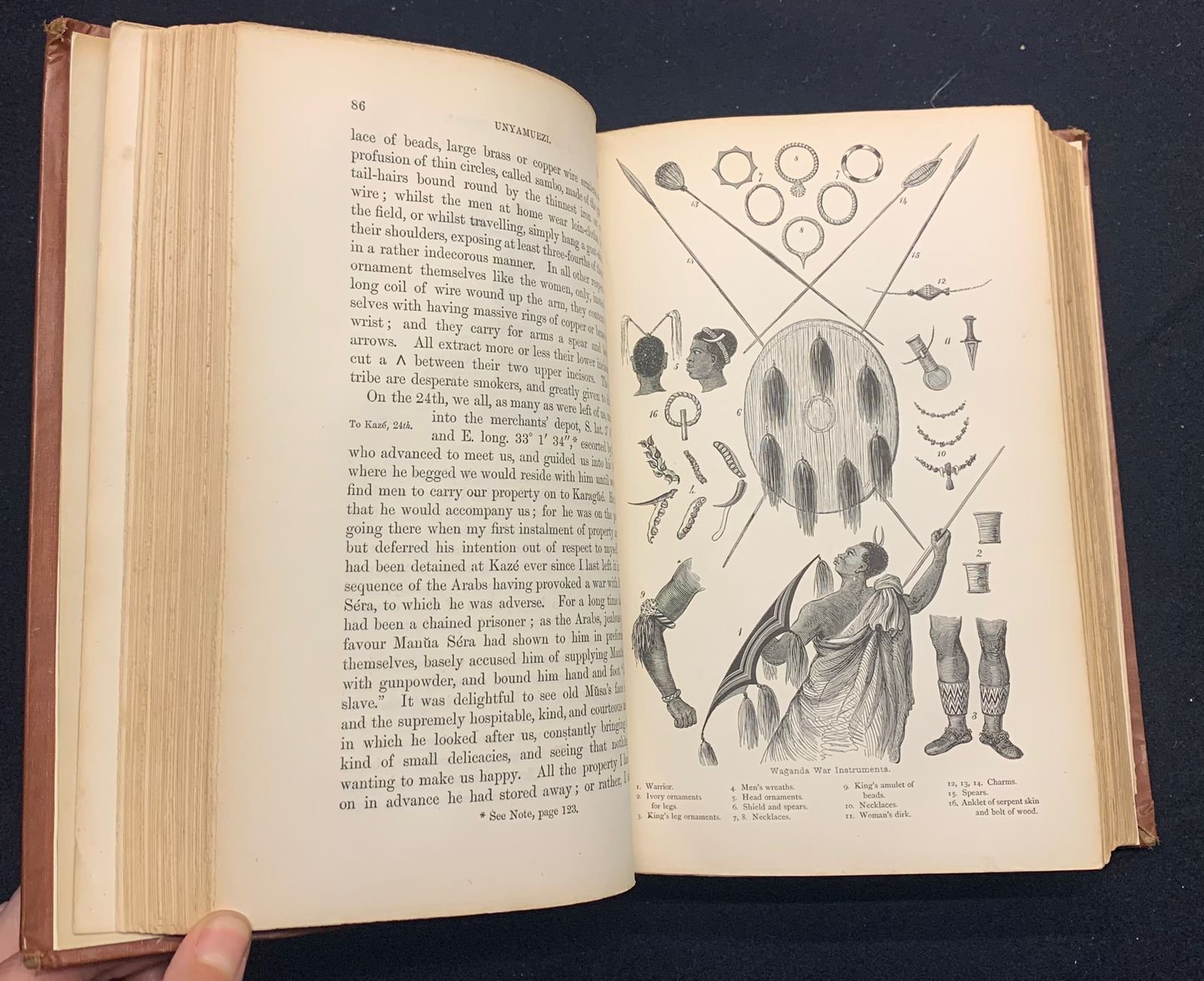
Illustrations & Maps: The work is notable for featuring numerous woodcut illustrations and maps based on original sketches by Captain Grant, capturing the landscapes, cultures, and wildlife encountered during their journey.
Price: R 30,000 (top right, indicating a price in South African Rand)
Publication Date: 1863
Edition: FIRST EDITION
Autograph Note: INSCRIPTION NOT BY SPEKE
Condition & Restoration: BINDING REPAIRED
Collation & Pagination: xxxi / 658 p. / 32 p. of ADVERTS (comprising 31 preliminary pages, 658 text pages, and 32 pages of publisher's advertisements at the back)
Endpapers: NEW END PAPERS (indicating re-casing or rebinding work)
Completeness: ALL WOODCUTS & MAPS PRESENT
Transcription of the Inscription
The handwritten presentation inscription on the flyleaf reads:
Frederic Kinnaird
to
Maria Maphoter
In Memory of
their young friend
Speke
1865.
Analysis & Context of the Names
John Hanning Speke ("their young friend Speke")
The inscription directly references the author, Captain John Hanning Speke.
The date 1865 holds poignant significance: Speke died suddenly on September 15, 1864, from an accidental gunshot wound while hunting at Neston Park in Wiltshire, aged just 37.
This presentation copy was given the following year as a memorial gift in honor of Speke's untimely death.
Frederic Kinnaird & Maria Maphoter (or Mapother). Below are the likely characters linked to this book, but I can’t be sure.
Frederic Kinnaird: Likely connected to the prominent Scottish Kinnaird family (Barons Kinnaird), who were heavily active in 19th-century British political, geographical, and evangelical societies (such as the Royal Geographical Society, which sponsored Speke’s Nile expedition).
Maria Maphoter (Mapother): The surname Mapother is a well-established gentry family of Anglo-Irish origins (associated with Kilteevan House, Roscommon). The phonetic variant/spelling Maphoter reflects a common 19th-century scribal spelling variation for the Mapother family name.