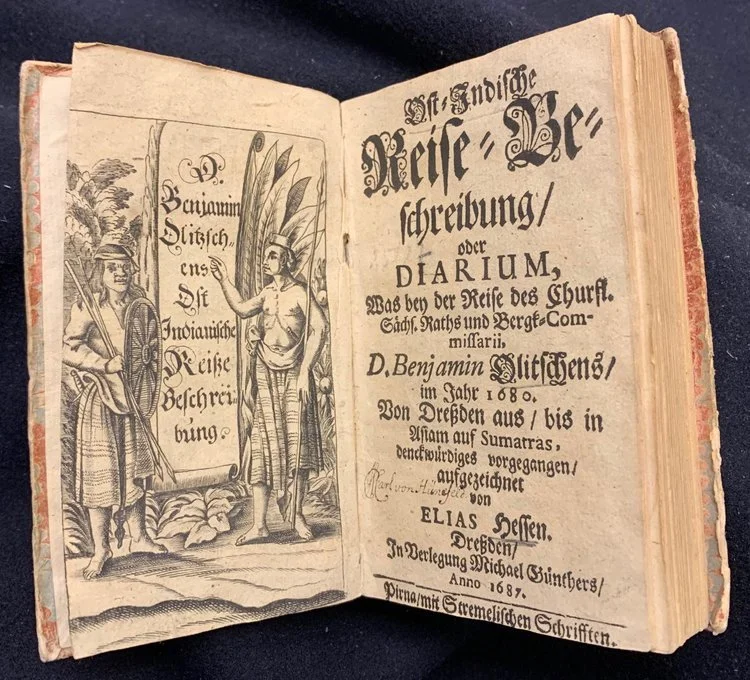
East Indian Travel Description (German)
Or diary of what happened during the journey in 1680 from Dresden to the island of Sumatra (English translation).
By Elias Hessen
Rare first edition
1687
The remarkable life and travels of Jacobi de Roy, a former captain in the East Indies, containing his flight from Batavia, which he undertook in 1691 to the island of Borneo and the Kingdom of Atchin on the island of Sumatra, as well as a true account of strange adventures, such as the robbery of his sailors and goods, and the hunger and thirst he suffered.
Rare travelogue describing the mining operations of the VOC (Dutch East India Company), especially on Sumatra. Elias Hessen accompanied Benjamin Olitzsch and 20 miners on this gruelling expedition to the gold mines of Sillida (Sumatra). After three years, the mining commissioner Olitzsch and 15 of the miners were dead.
Hesse and the other survivors then returned to Europe. This was a huge financial loss for the VOC.
100mm x 150mm solander box. Binding worn beginning to break; the left side of the fold-out frontis is missing; general wear and thumbing to the rest of the text block.
R80,000
This is a rare 1687 first edition of the Ost-Indianische Reise-Beschreibung, oder Diarium (East Indian Travel Description or Diary), written by the Saxon mining official Elias Hesse.
It details the 1680 expedition led by the mining commissioner Dr. Benjamin Olitzsch from Dresden to the East Indies, specifically focusing on gold and silver mining operations on the island of Sumatra.
Key Historical & Bibliographical Highlights
The German Quest for Sumatran Gold:
In the late 17th century, the Dutch East India Company (VOC) contracted Saxon mining experts—led by Dr. Benjamin Olitzsch—to evaluate and manage the gold mining operations at Salido (Sillida) in West Sumatra. Elias Hesse served as the expedition's mine clerk (Bergschreiber).
A Tragic Expedition:
The expedition suffered heavy casualties due to tropical diseases and harsh equatorial conditions. Dr. Olitzsch himself died in Sumatra shortly after arrival. Hesse survived the venture and returned to Saxony, publishing this eye-witness account of the voyage and the mining operations in Dresden (1687).
Iconic Frontispiece Detail:
The engraved frontispiece shown on the left of your volume depicts an idealized European view of Southeast Asia: a miner's coat-of-arms flanked by indigenous Sumatran figures, tropical foliage, and mining implements, reflecting the dual interest in exotic ethnography and mineral wealth.
Historical Significance:
Hesse’s text is considered one of the earliest and most detailed 17th-century European accounts of early colonial mining technology and conditions in Southeast Asia, alongside the accounts of his contemporary Johann Wilhelm Vogel.
The 1687 Dresden first edition of Elias Hesse's Ost-Indianische Reise-Beschreibung is exceptionally rare—a scarce item in both institutional holdings and the international antiquarian trade.
Rarity & Market Dynamics
Institutional Holdings: Only a small handful of copies are recorded in institutional collections worldwide (such as the British Library, the Saxon State and University Library Dresden, and select major university archives in Europe). Outside of Europe, institutional copies are virtually nonexistent.
Auction & Trade History: Complete copies with the engraved frontispiece intact rarely surface on the market. Over the last several decades, it has appeared in specialized European auction catalogues (such as Reiss & Sohn or Ketterer Kunst) only once or twice a generation, typically fetching significant interest from collectors of 17th-century travelogues, early Sumatran/East Indies imprints, and historic mining literature (Bergbauliteratur).
Condition Factors: Because it was printed as a small octavo volume on 17th-century paper, many surviving copies were either rebound in later utility bindings or lost the folding frontispiece/plates to damage or separation. Having the original engraved frontispiece clean, bound in, and well-preserved elevates a copy into the top tier of desirability for regional travel and exploration collections.