ZAR: Document to formalize farm boundaries - measured by how far a man could ride a horse in a set amount of time.
c.1894, although this is speculation.
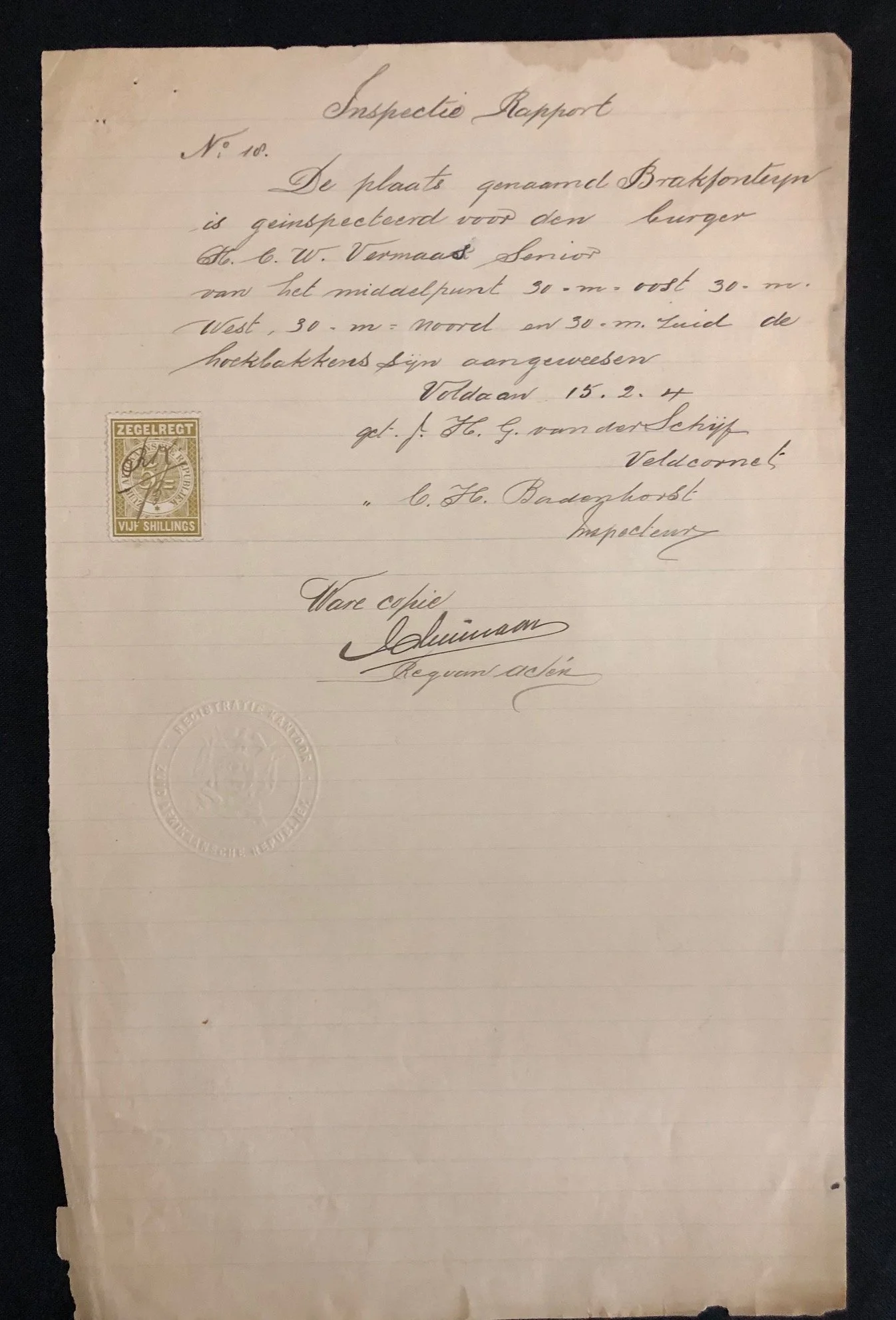
This document is a fascinating piece of late 19th-century South African history. It is a certified "Inspectie Rapport" (Inspection Report) for a farm, written in High Dutch—the official language of the Boer republics at the time.
The document dates to the era of the Zuid-Afrikaansche Republiek (ZAR)—commonly known as the Transvaal Republic—prior to its annexation by the British after the Anglo-Boer War (1899–1902).
Transcription & Translation
The document is a land survey and beacon inspection report, a critical legal document used in the Boer republics to formalize farm boundaries before a formal title deed (grondbrief) was issued.
Heading: Inspectie Rapport No. 10 (Inspection Report No. 10)
The Text: > "De plaats genaamd Brakfontein is geinspecteerd voor den burger H. C. W. Vermaas Senior..."
Translation: "The farm named Brakfontein has been inspected for the citizen [burgher] H. C. W. Vermaas Senior..."
The Measurements: It notes that from a central point (middelpunt), measurements of 30 minutes (expressed here as 30-m.) were taken East, West, North, and South to point out the corner beacons (hoekbakken zijn aangewezen). In the old Boer system, farm sizes were often measured by how far a man could ride a horse in a set amount of time (usually a 30-minute ride in each direction from a central point, creating a standard farm of roughly 3,000 morgen).
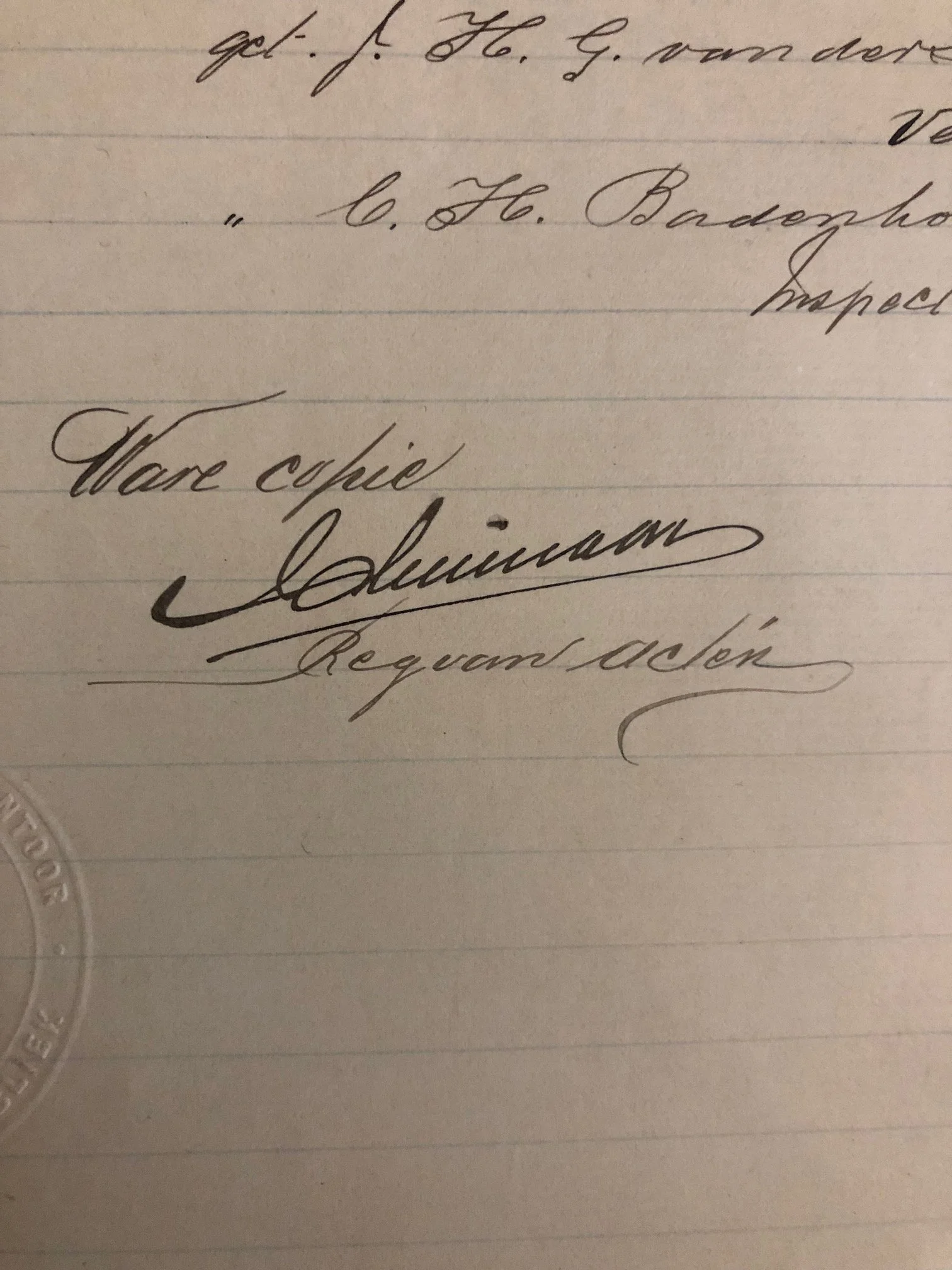
Signatures: * Signed by J. H. G. van der Schijff, acting as the Veldcornet (Field Cornet, a local military and administrative official).
Signed by C. H. Badenhorst, acting as the Inspecteur (Inspector).
Certification: At the bottom, it is marked "Ware copie" (True copy) and signed by a government official (Registrateur or clerk) to certify it as an official record.
The Vermaas Family & The Boer War
Hendrik Cornelis Wilhelmus Vermaas Senior (1851–1927) was a prominent Boer burgher.
His son, H.C.W. Vermaas Junior (1872–1928), went on to become a famous Boer Kommandant during the Second Anglo-Boer War. Serving under General Piet Cronjé and General Koos de la Rey, the younger Vermaas fought in major battles like Magersfontein and Kraaipan. He was one of the bitter-ender (bittereinder) officers who only surrendered his commando in June 1902 after the Treaty of Vereeniging.
After the war, the Vermaas family remained highly influential, and the younger Vermaas served as a politician for Louis Botha’s Het Volk party.
The Revenue Stamp & Government Seal
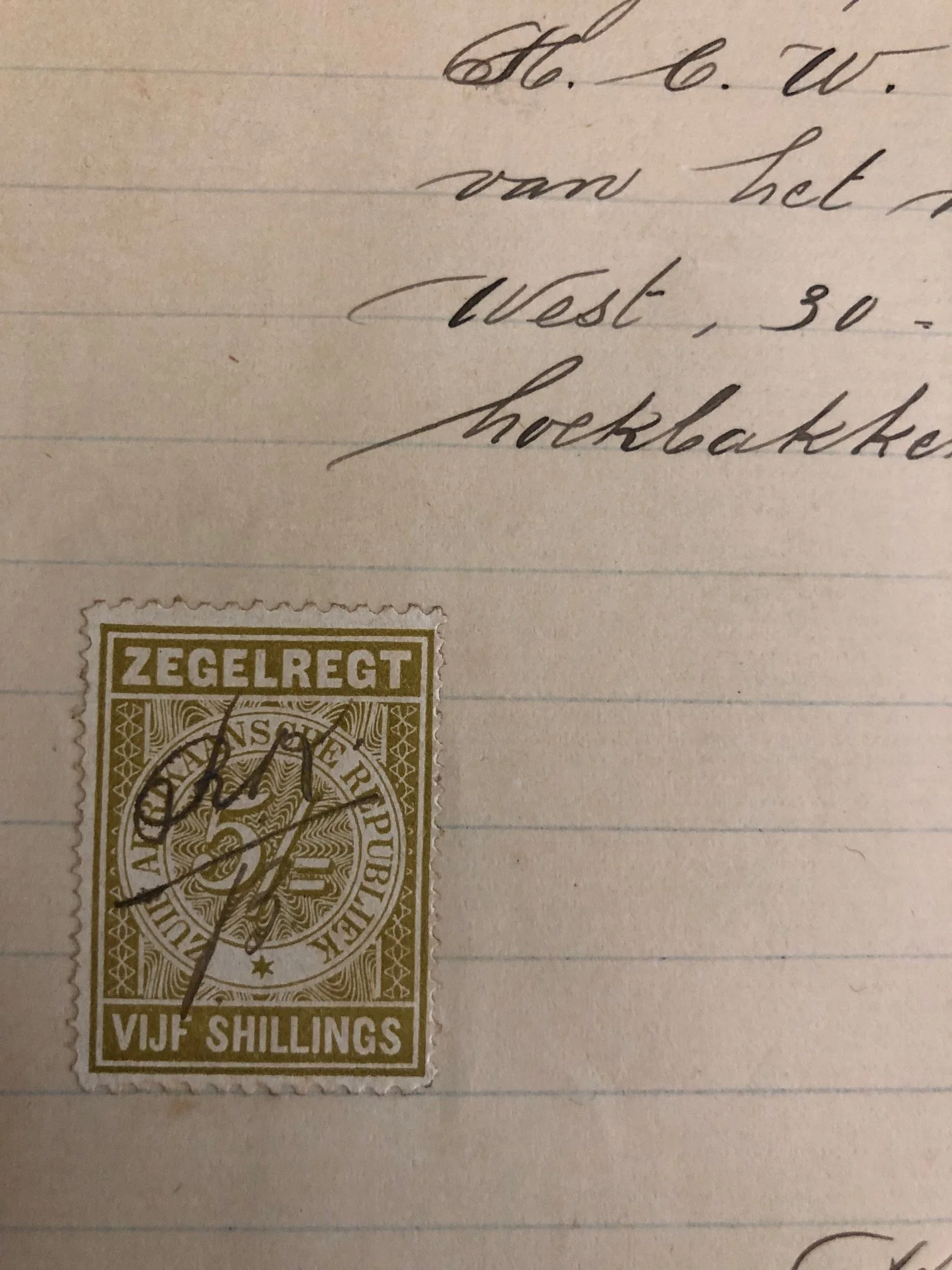
Note the official ZAR revenue stamp (Zegelregt), valued at "VIJF SHILLINGS" (Five Shillings). Because the ZAR was deeply tied to both Dutch heritage and British economic influence in Southern Africa, its currency used the British Pound/Shilling system, but the stamp itself features the ZAR Coat of Arms.
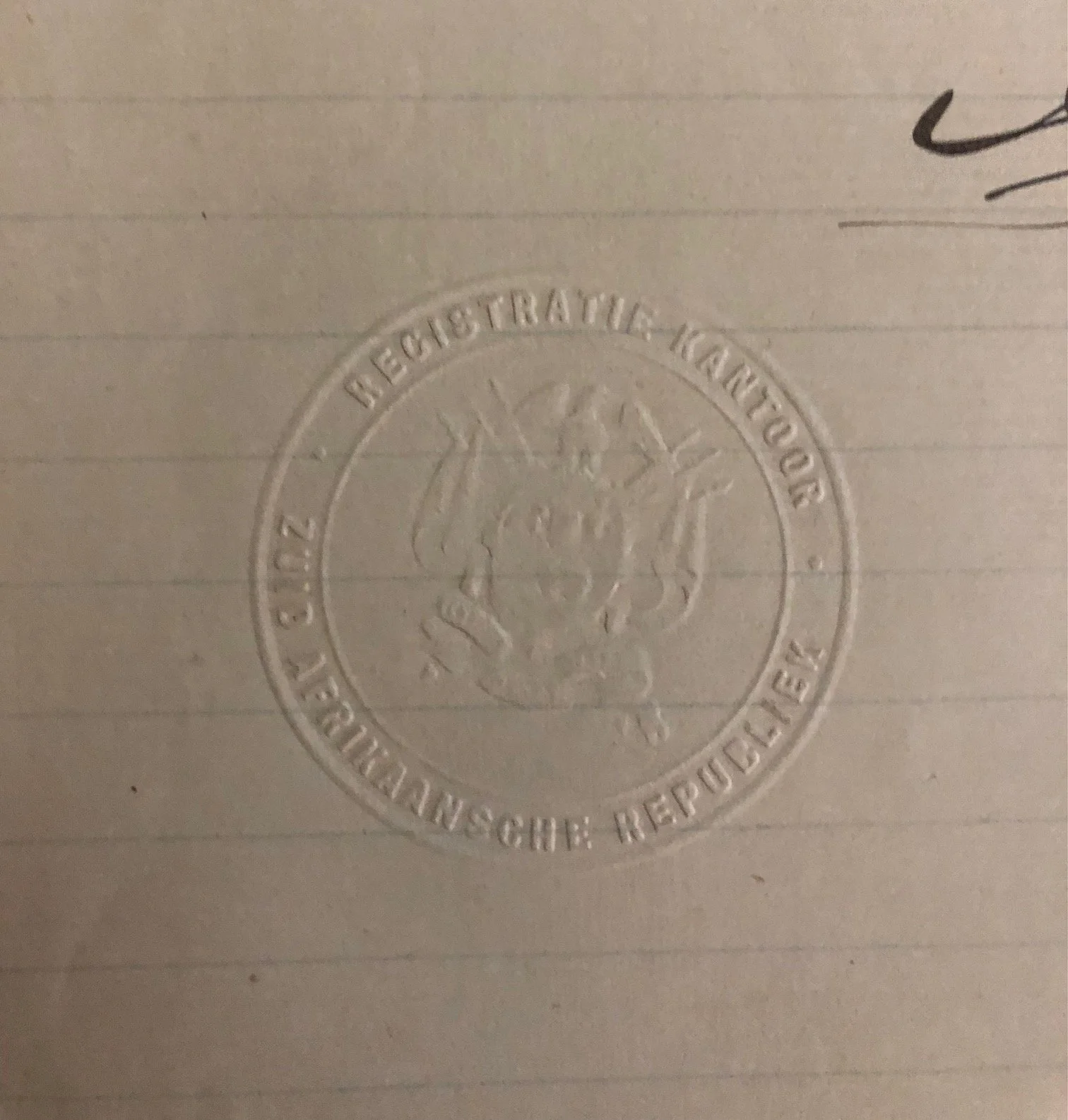
The Embossed Seal: On the bottom left, you can see a beautiful, colorless embossed stamp. If you look closely, the text reads "REGISTRATIE KANTOOR - ZUID AFRIKAANSCHE REPUBLIEK" (Registration Office - South African Republic).
Why this is a rare find?
Documents like this are vital pieces of South African archival history. During the Anglo-Boer War, British forces carried out a "Scorched Earth" policy, burning down thousands of Boer homesteads. Family bibles, land registries, and farm documents were frequently destroyed or taken as war souvenirs by British soldiers. The fact that this specific land inspection report survived intact—complete with its original revenue stamp and official embossing—makes it a wonderful piece of Transvaal history!
205mm x 325mm
Edge wear and some minor staining.
R1,000