Carl Gustav Jung - The Undiscovered Self, German First Edition (1957)
1957 First edition.
This is a significant work by the Swiss psychiatrist and psychoanalyst Carl Gustav Jung. Originally published in 1957, this German edition titled Gegenwart und Zukunft is best known in the English-speaking world as The Undiscovered Self.
The book is a socio-political and psychological critique written during the height of the Cold War. It addresses the vulnerability of the individual within mass society and the dangers of totalitarianism.
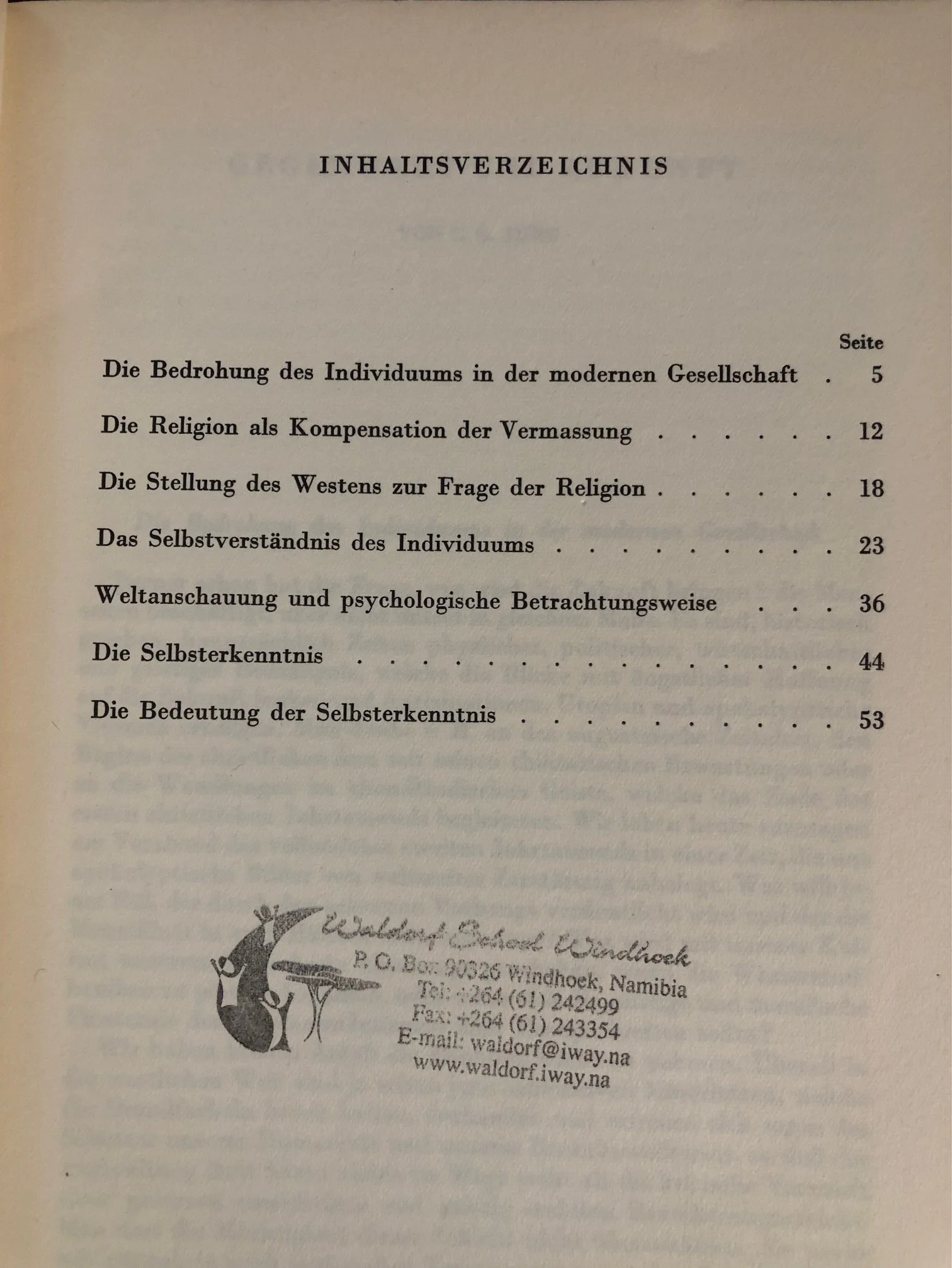
The subtitle and the listed chapters on the cover provide a roadmap of Jung's arguments:
• The Threat to the Individual: Jung argues that as society becomes more "mass-minded," the unique individual is suppressed by the state and large institutions.
• Religion vs. Mass Society: He explores religion not just as a dogma, but as a vital psychological "counter-pole" to the influence of the state.
• Self-Knowledge (Selbsterkenntnis): The final chapters emphasize that the only true defense against mass suggestion and political upheaval is the individual’s journey toward understanding their own psyche—both the conscious and the "shadow" elements.
Publisher: Rascher-Verlag (Zürich and Stuttgart). This was Jung’s long-time primary publisher for his German-language works.
While many of Jung’s works are dense and clinical, this is considered one of his most accessible books, written for a general audience concerned with the moral and mental state of the modern world.
Why It Matters Today: The book remains a staple in analytical psychology because it moves beyond the clinic and into the world. It poses a fundamental question: How can a person remain an individual when the world demands they become a statistic?
3 bookseller stamps in various places.
Paper wrappers worn and marked slightly at the edges.
155mm x 223mm x 10mm
R1,000