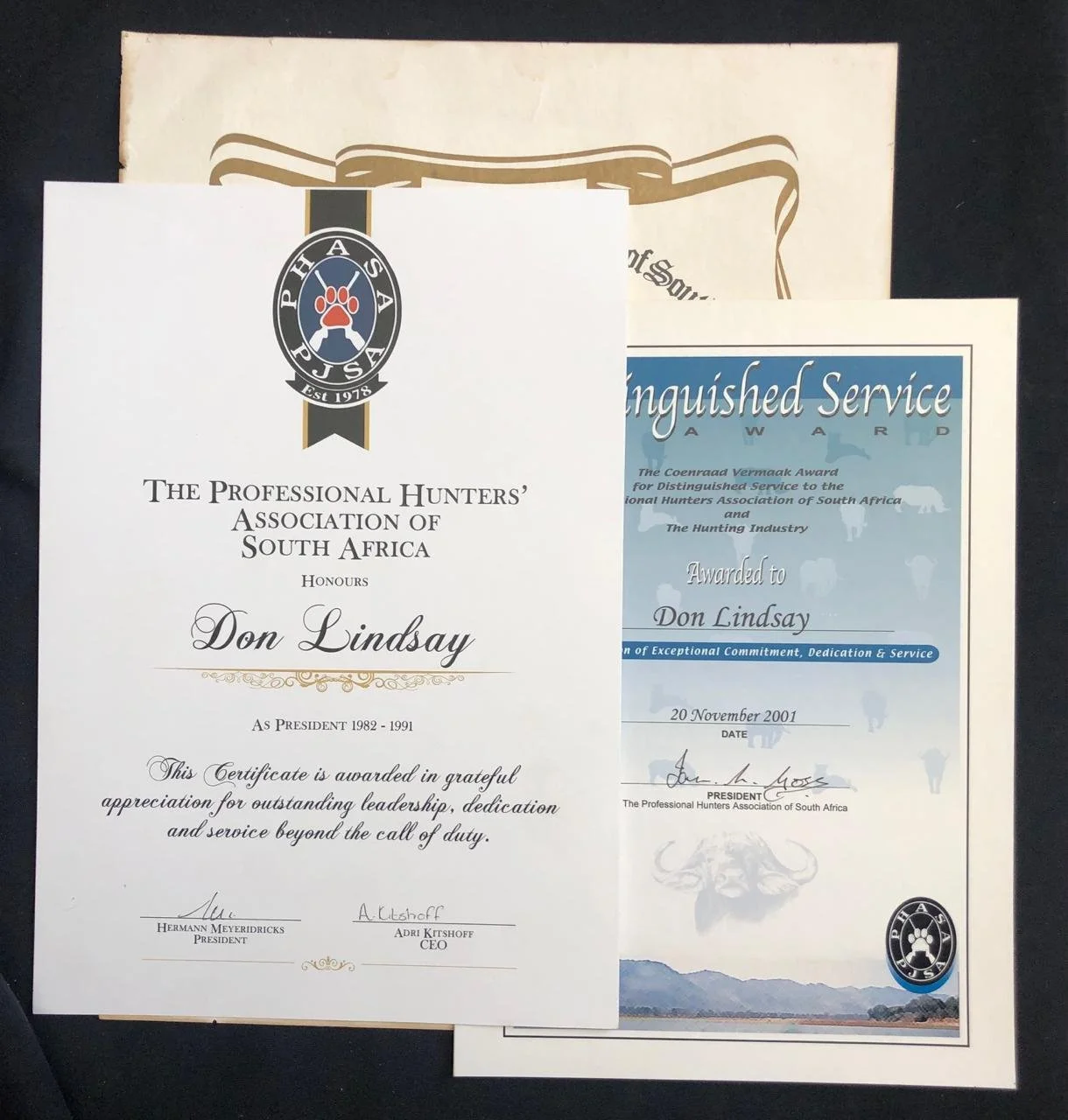
Collection of Three Don Lindsay Certificates
Don Lindsay was a founding member of the Professional Hunters’ Association of South Africa (PHASA) and served PHASA almost a decade as president. He exhibited the profoundest belief that sustainable and regulated hunting was an important conservation tool in Africa. He was also one of the founding members and long-time president of the International Professional Hunters’ Association (IPHA) as well as an important contributor of expertise and knowledge and founding director of Conservation Force, contributing to initiatives such as the Bontebok and the Black-faced Impala. Apart from his membership in professional associations he was a member of Shikar-Safari Club International, Safari Club International and numerous other hunting associations.
Don Lindsay was born in Johannesburg. In his formative years he spent much time in the veld as the youngest member of the Witwatersrand Bird Club and one of the youngest members of the Wildlife Society of South Africa. He studied pasture management and soil conservation at the University of Natal capping his studies with the thesis “Wildlife – A Crop Off The Land”. Don was a true pioneer and played a pivotal role in promoting the concept of science based sustainable use of wild natural resources, and that incentive-driven-conservation can contribute substantially to wildlife prospering and incentivizing rural people to preserving wildlife habitat.
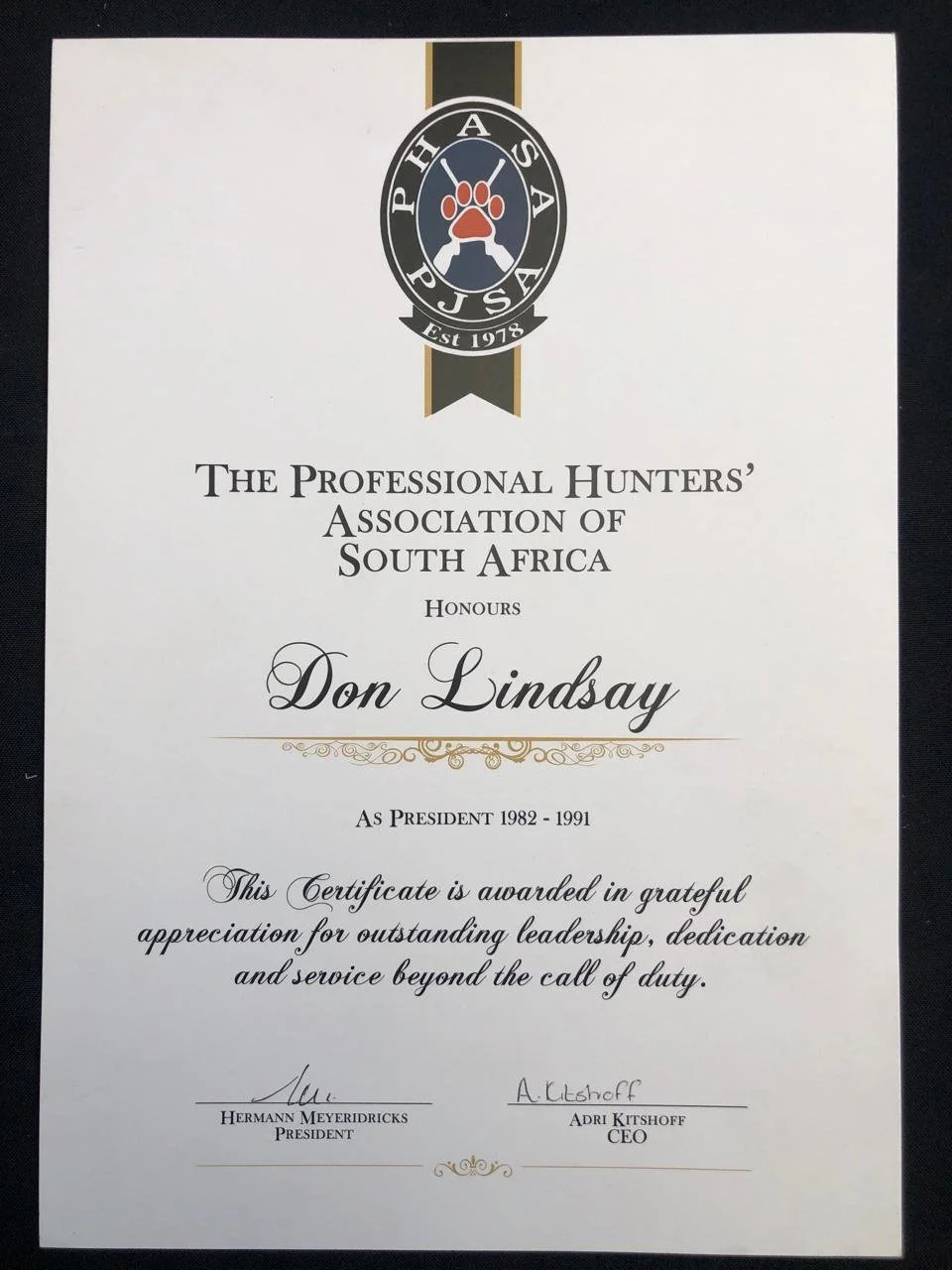
The certificates represent a timeline of his leadership within PHASA (The Professional Hunters’ Association of South Africa), an organization founded in 1978 to transition South African hunting into a highly regulated, economically viable conservation tool.
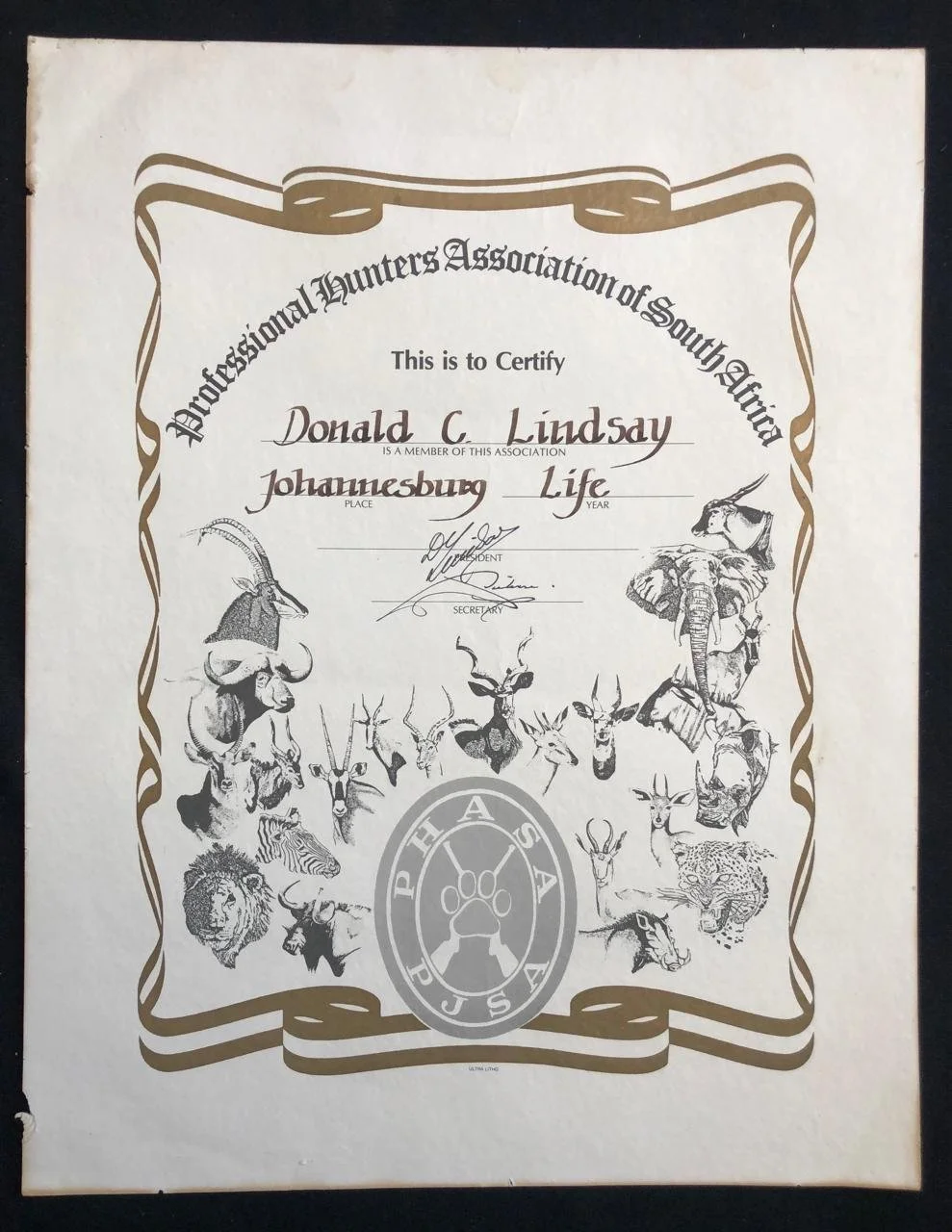
The Early Certificate: Establishment and Membership
The vintage certificate is a "Life Membership" document recognizing "Donald C. Lindsay" of Johannesburg.
Lindsay was a foundational pioneer of the modern game ranching model. Long before South Africa's sweeping private land conversions, his early academic thesis at St. John's College—conceptually titled "Wildlife – a crop off the land"—predated the massive legislative and ecological shift that saw cattle and livestock farms re-wilded back into natural bushveld.
The intricate pen-and-ink border framing the document features a taxonomy of South African game species (including the Big Five, alongside various plains game like kudu, gemsbok, and eland). It represents an era when the industry was still codifying its identity and establishing strict professional codes of conduct.
The Presidential Recognition (1982–1991)
The formal honours document commends Don Lindsay for his tenure as President of PHASA from 1982 to 1991.
Lindsay took the helm just four years after PHASA's founding. During this 9-year window, he grew the organization from a fledgling group of operators into a formidable global entity.
The Conservation Milestone: Under his presidential leadership, Lindsay successfully negotiated the importation protocols of the endangered Bontebok into the United States. This critical move established a sustainable, high-value financial incentive for private game ranchers to actively breed and preserve a species that had once been pushed to the absolute brink of extinction.
The Signatures: This retrospective certificate features the signatures of later institutional heads, including former PHASA President Hermann Meyeridricks.
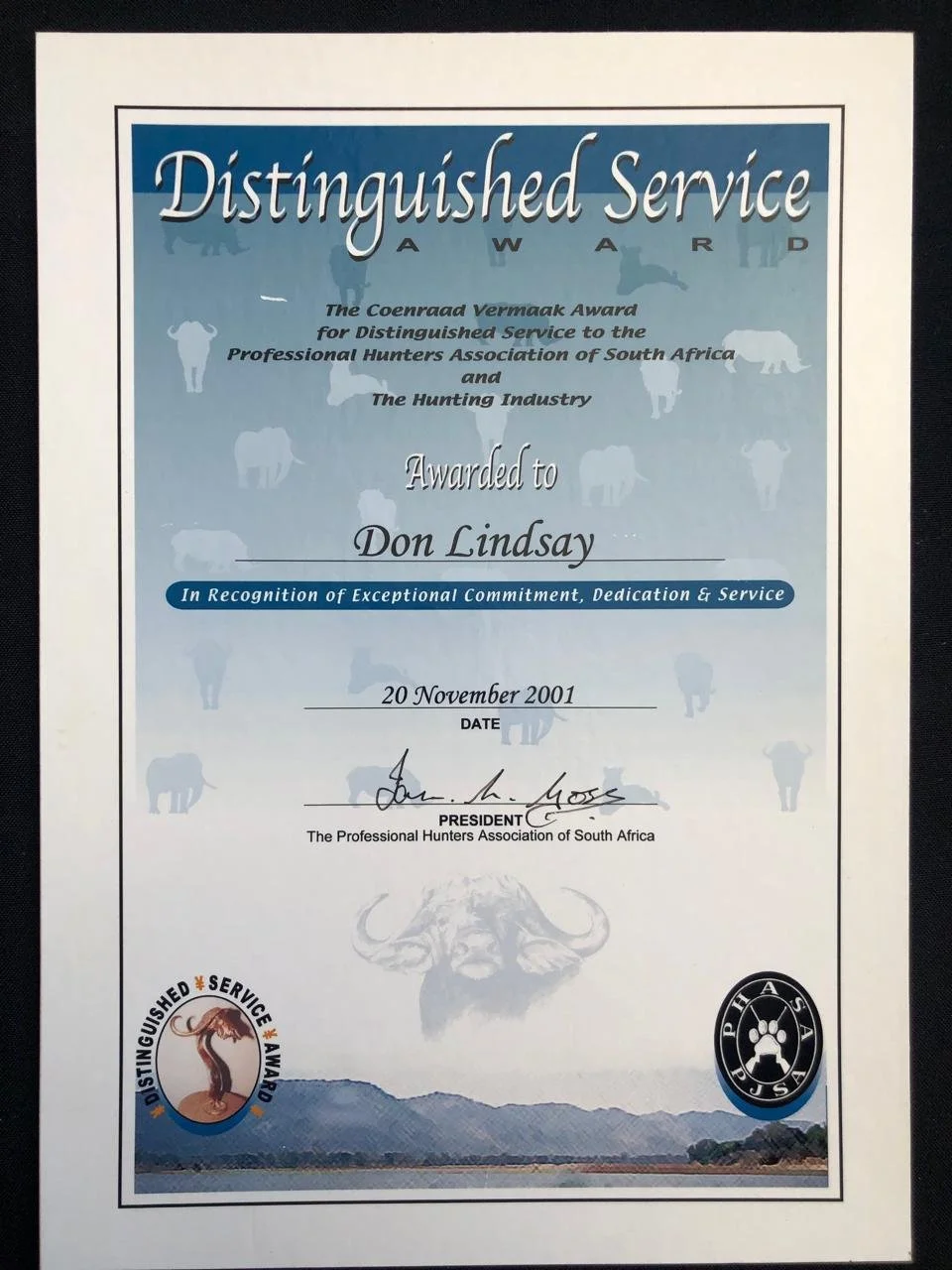
The Coenraad Vermaak Award (2001)
The modern document marks Lindsay receiving the Coenraad Vermaak Award for Distinguished Service on November 20, 2001.
Coenraad Vermaak was a legendary figure who registered the first professional hunting outfitter business in South Africa—this award is the highest honour bestowed within the South African hunting and sustainable-use industry.
By the time Lindsay received this award in 2001, his influence had expanded far past South African borders. He went on to serve as the President of the International Professional Hunters Association (IPHA) for 14 years and was a founding board member of global wildlife stewardship bodies like Conservation Force.
Archival & Physical Observations
Largest certificate: 300mm x 380mm
R1,250