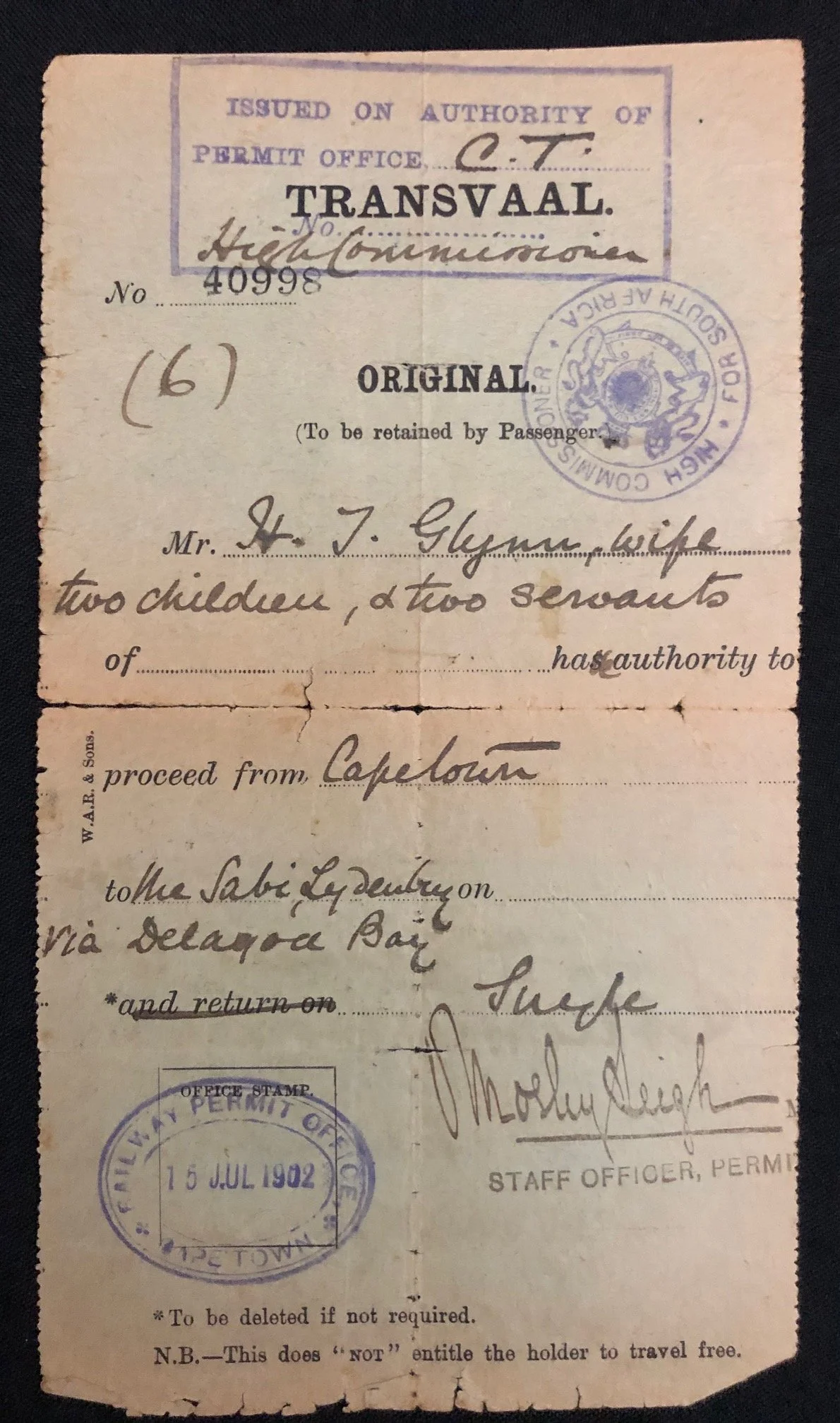
Travel permit issued to Mr. H. T. Glynn, Eastern Transvaal (1902)
This is almost certainly Henry Thomas Glynn (known as Harry Glynn), big-game hunter. A post-Second Anglo-Boer War travel permit issued in July and August 1902, just weeks after the signing of the Treaty of Vereeniging (which ended the war on May 31, 1902).
During this transition period, the British military and colonial authorities tightly regulated movement into the newly annexed Transvaal Colony to control the influx of refugees, corporate prospectors, and citizens.
The permit is issued to "Mr. H. T. Glynn, wife, two children, & two servants." A highly prominent pioneer, big-game hunter, and entrepreneur in the Eastern Transvaal (now Mpumalanga).
Glyn is famously known as the founder of the town of Sabie. In 1895, during a picnic on his farm Klein Sabie, a stray bullet fired by a friend chipped a rock and revealed a rich vein of gold. This led to the establishment of the Glynn’s Lydenburg Gold Mining Company.
Because of the Boer War, many prominent mine owners and residents had evacuated to the British-controlled Cape Colony. This permit marks the moment Harry Glynn and his family were allowed to return home to rebuild their lives and resume mining operations after years of exile.
The Journey: A Massive Detour
Note the route authorized on the permit: "proceed from Cape Town to the Sabi, Lydenburg on via Delagoa Bay"
In 1902, traveling from Cape Town to the Eastern Transvaal via Delagoa Bay (now Maputo, Mozambique) was an enormous, circuitous journey.
Why this route? The direct domestic rail lines through the Orange River Colony and central Transvaal were severely damaged, congested with returning military forces, or still heavily restricted under martial law.
The Glynn family took a ship from Cape Town all the way around the South African coast to the Portuguese-controlled port of Delagoa Bay, planning to take the eastern rail line inland from there.
The Portuguese Gate
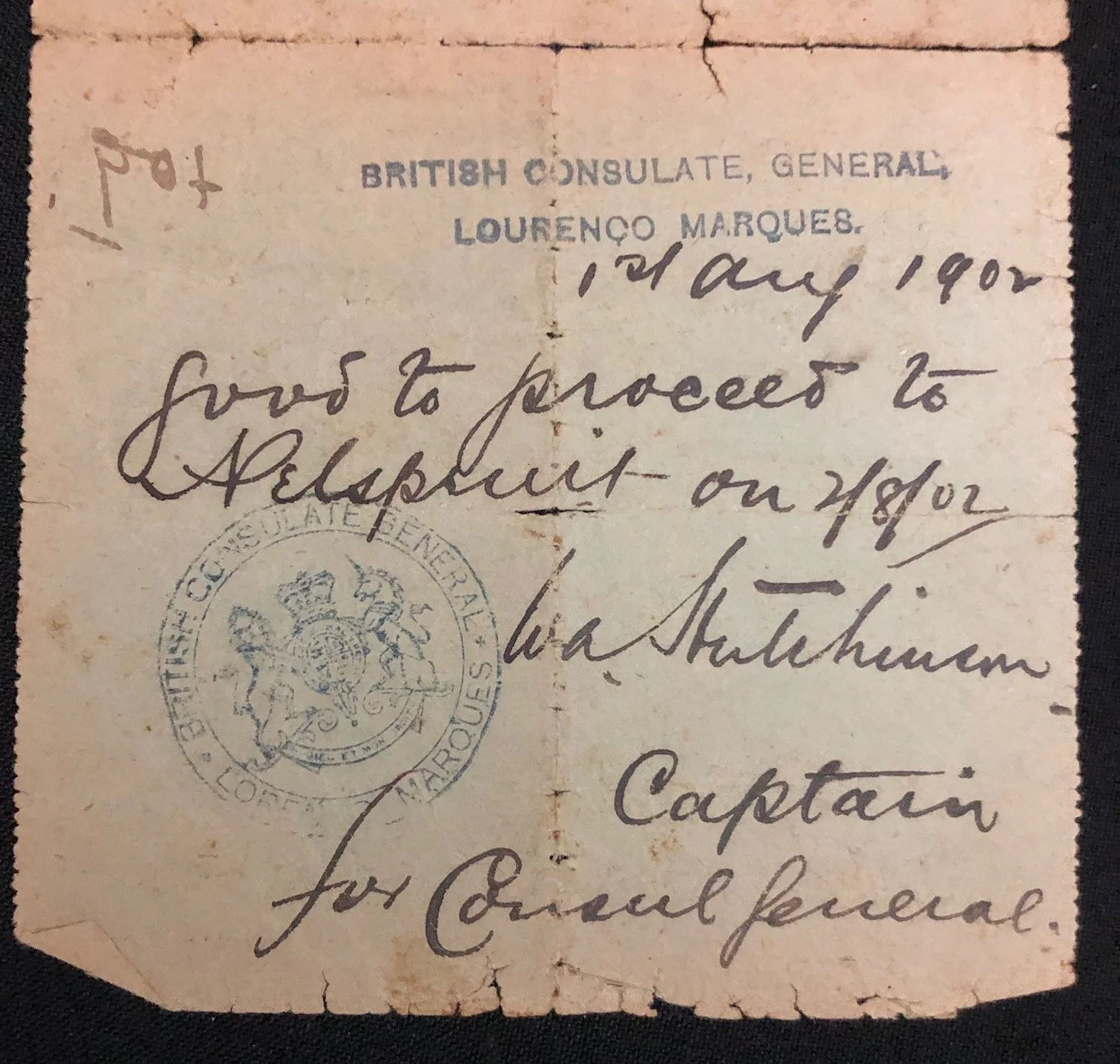
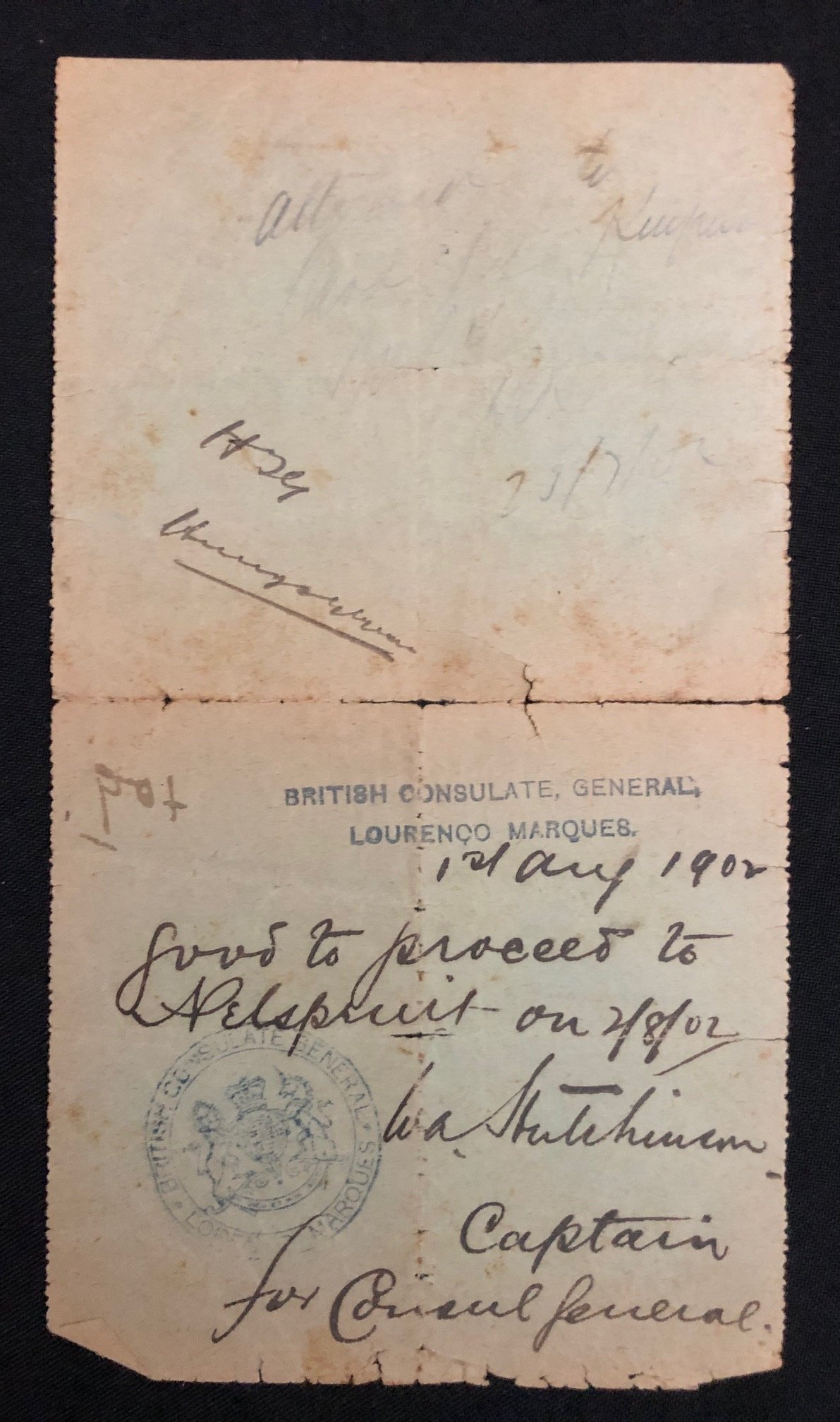
The reverse side of the document is stamped by the British Consulate General in Lourenço Marques (the colonial name for Maputo).
Because they travelled through Portuguese East Africa to get back into British territory, they had to clear the British consulate at the port.
Dated 1st Aug 1902 and reads: "Good to proceed to Nelspruit on 2/8/02".
Signed by a Captain on behalf of the Consul General. At this time, the British Consul General in Lourenço Marques was heavily involved in intelligence and regulating traffic moving toward the goldfields.
The Date: The front stamp reads 15 JUL 1902 from the Railway Permit Office, Capetown. This is less than two months after the war officially ended.
It was issued under the authority of the High Commissioner for South Africa (at the time, Lord Alfred Milner, who was tasked with the reconstruction of the shattered Boer republics).
It is signed by a Staff Officer for Permits, Mosley Leigh (Major Henry Mosley Leigh), who handled the logistical nightmare of thousands of people trying to return to the Transvaal.
115mm x 205mm
Wear and chips to the edges. Very fragile.
R12,500