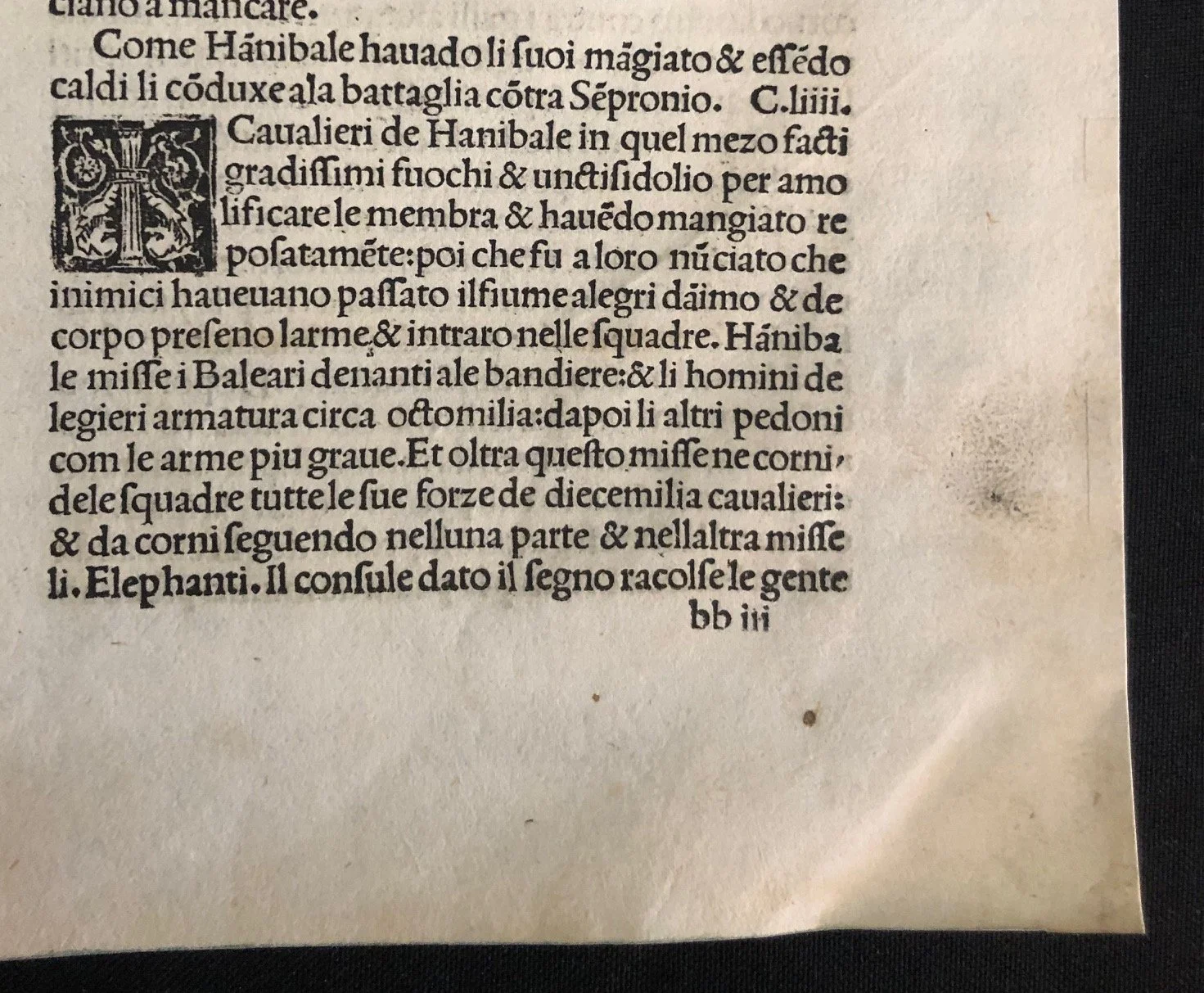
A leaf from Livy’s Ab Urbe Condita (History of Rome) Hannibal at the Battle of the Trebia c.1500
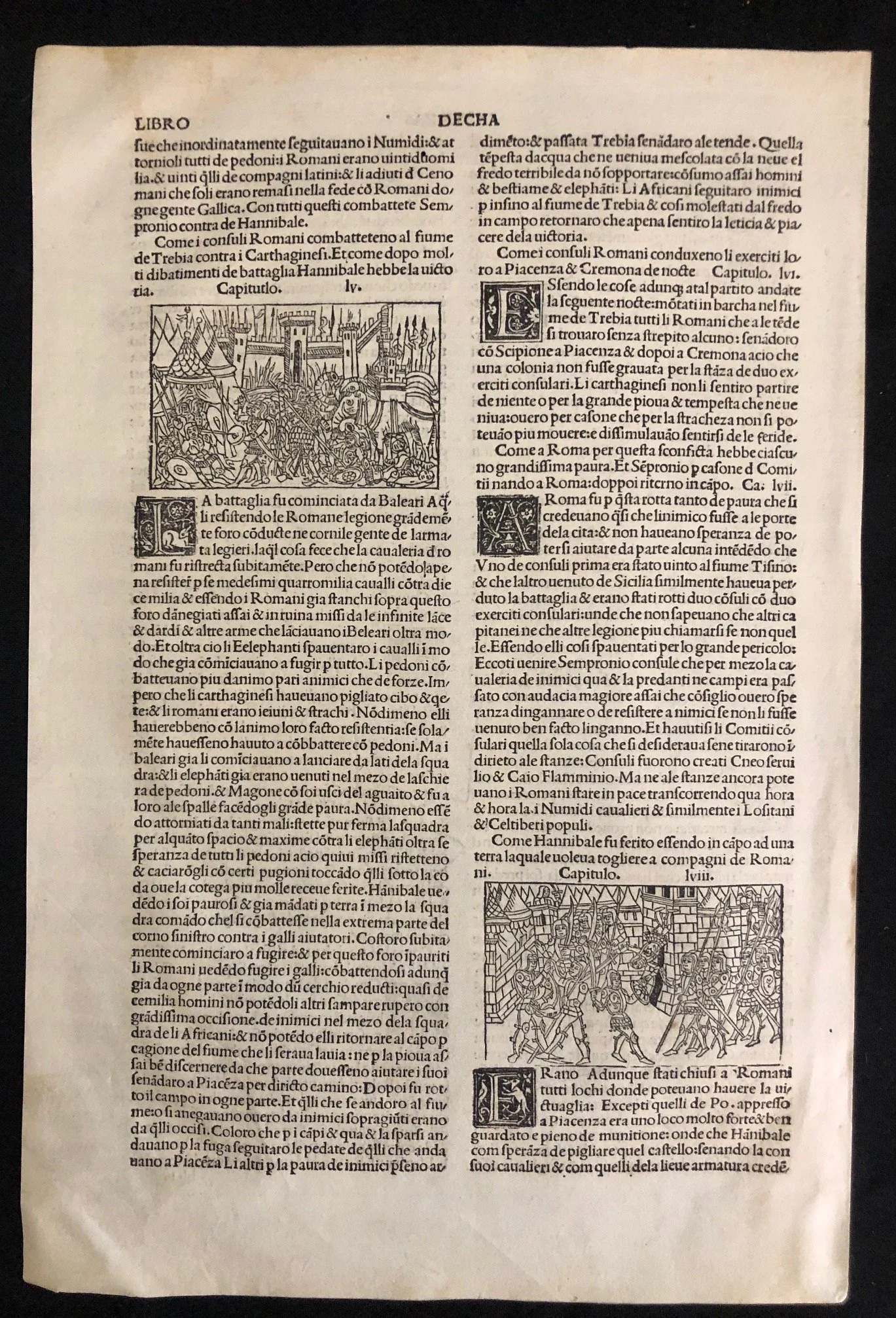
A leaf from an early Italian edition of Livy’s Ab Urbe Condita (History of Rome); The Second Punic War and the Roman defeat by Hannibal at the Battle of the Trebia (218 BC).
The typography and woodcut style suggest this is from a late 15th-century or early 16th-century "incunabulum" or post-incunabulum, likely the popular Venetian editions printed around the 1490s or early 1500s.
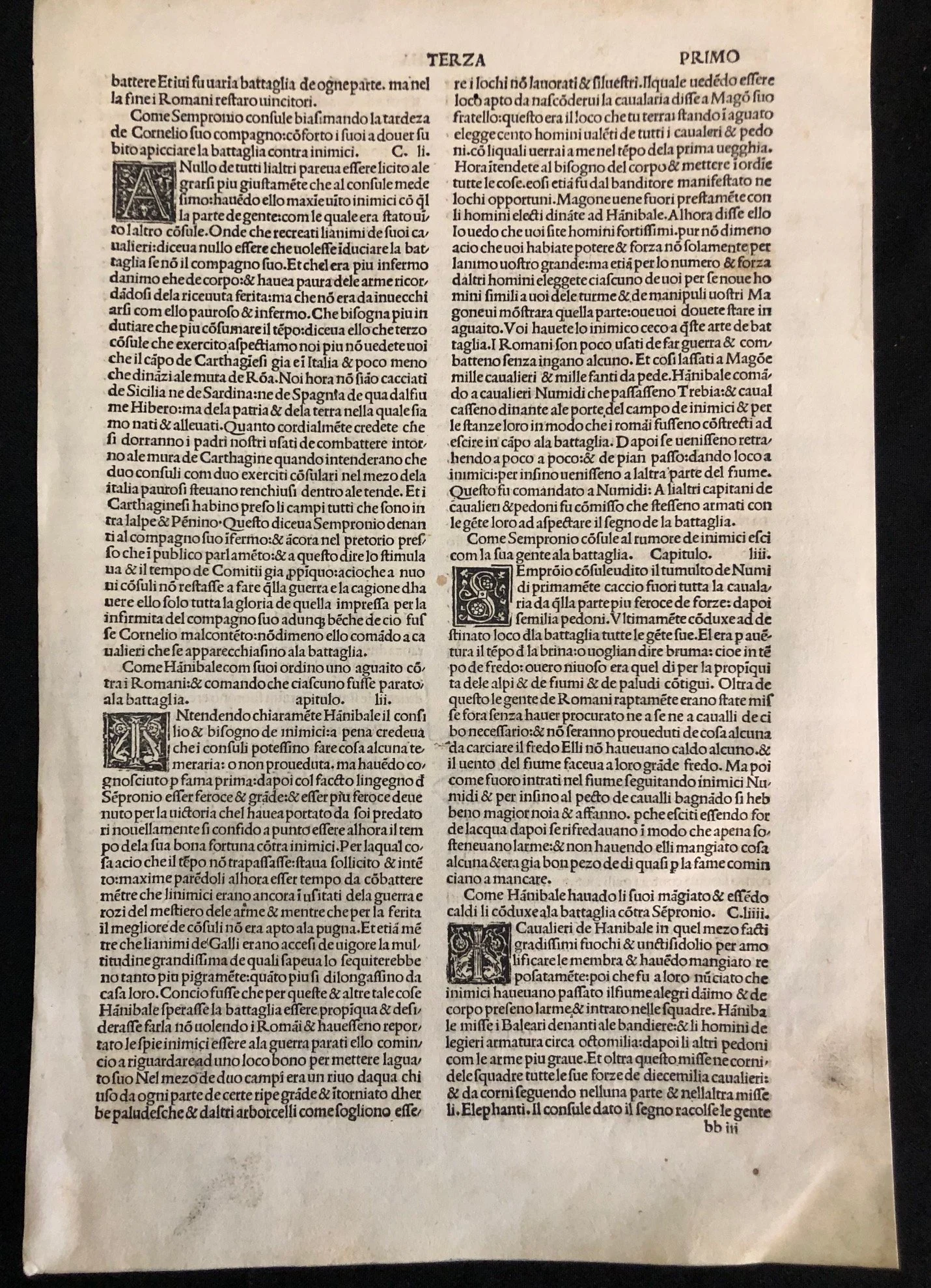
The Front / Recto: This page focuses on the buildup to the Battle of the Trebia.
The top right corner is marked "PRIMO" and "TERZA", referring to the Third Decade (the books covering the Punic Wars), Book One.
The chapters (marked Capitulo lii, liii, liiii) describe the tactical maneuvers. It mentions Sempronio (Tiberius Sempronius Longus), the Roman consul, and his eagerness to fight despite the caution of his colleague, Scipio.
Hannibal's Ambush: The text describes Hannibal setting an ambush in the marshy, reed-filled banks of the Trebia river.
The Numidians: It details the role of the Numidian cavalry in provoking the Romans into crossing the freezing river.
Signature Mark: At the very bottom right, you can see the signature "bb iii", which was used by binders to ensure the pages were assembled in the correct order.
(The Back / Verso)
This page depicts the climax of the battle and the Roman retreat.
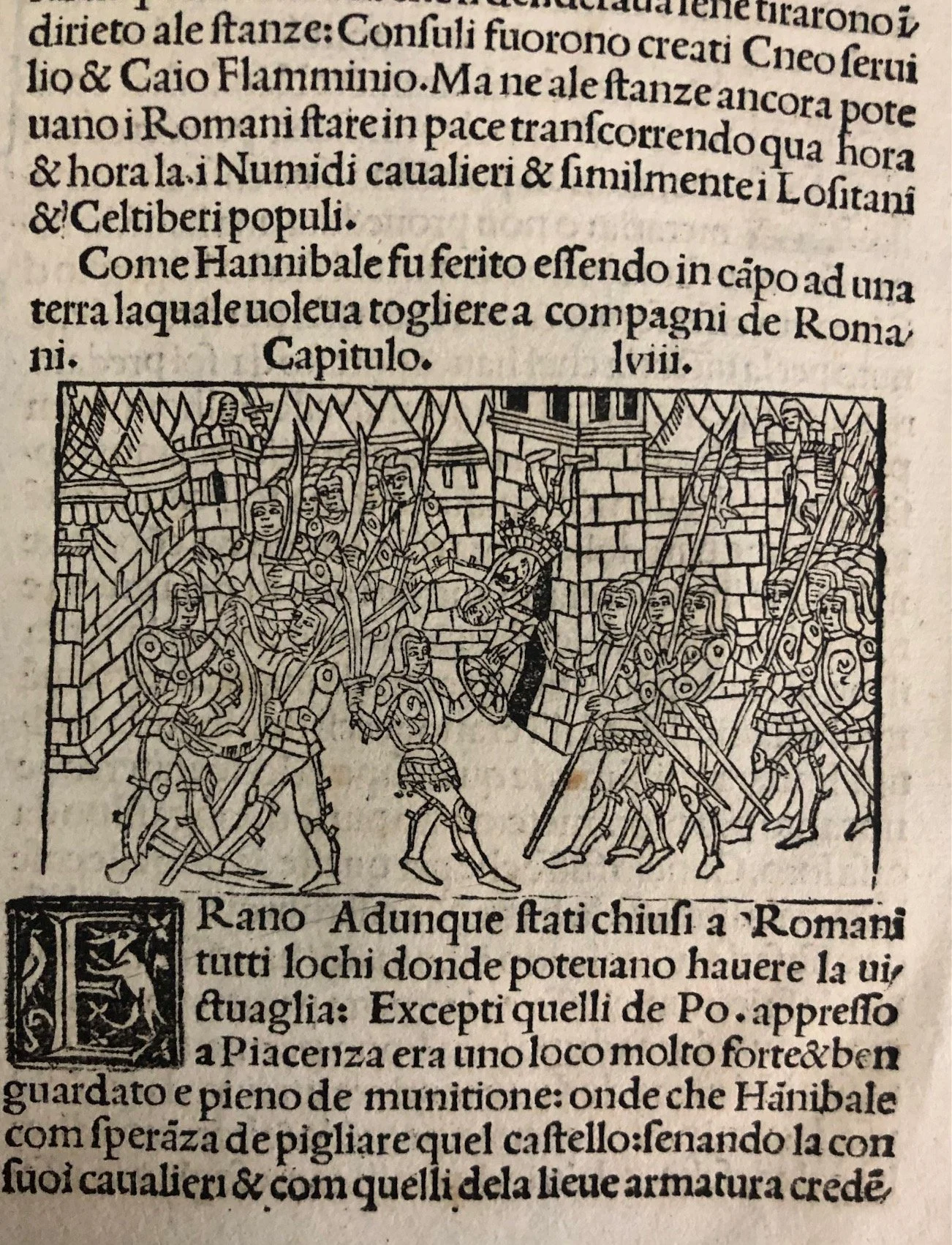
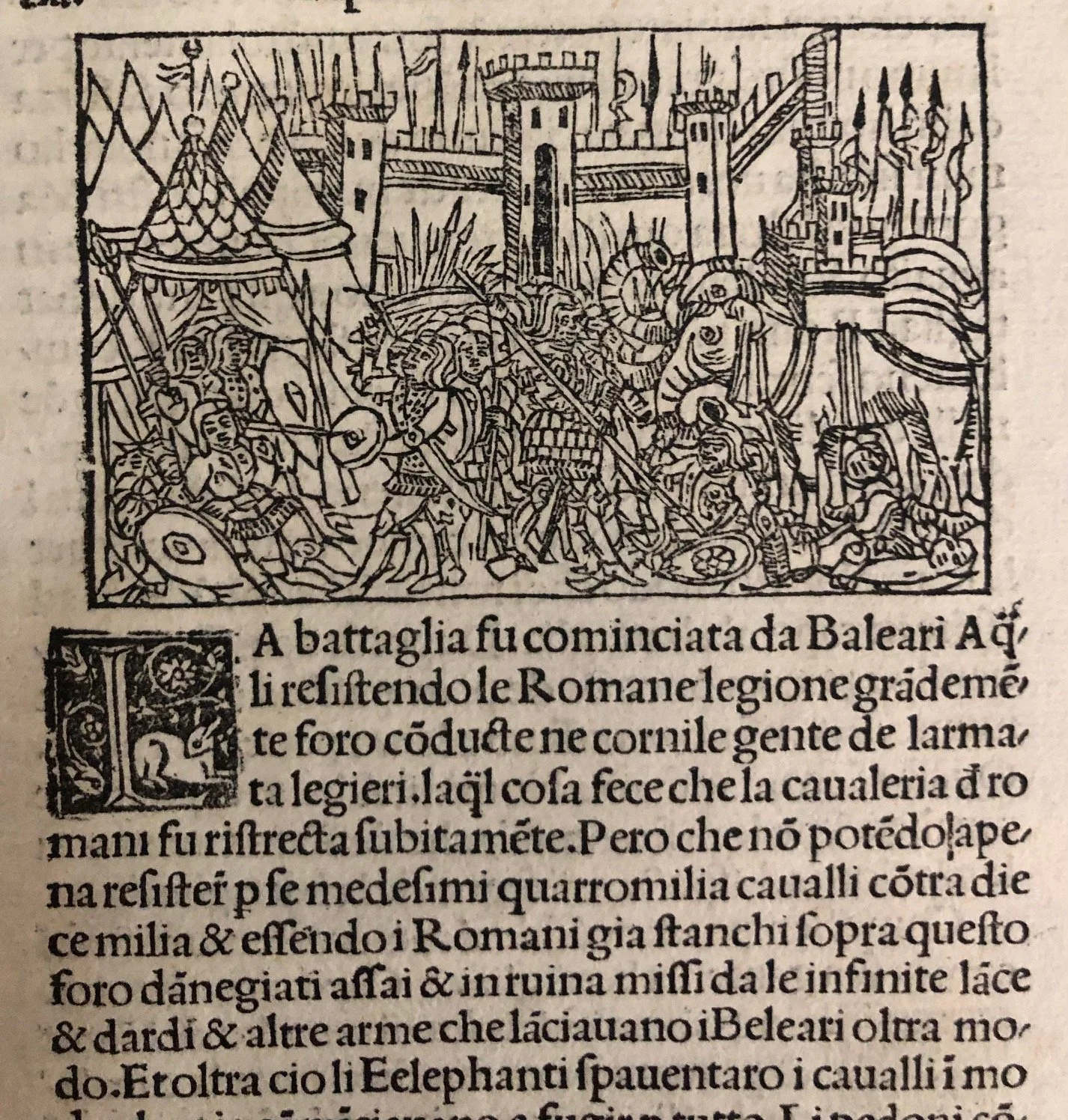
Woodcut Illustrations:
The Battle Scene (Left): This woodcut shows the chaos of the engagement. You can see soldiers in classical-style armor and, notably, an elephant in the background—a hallmark of Hannibal’s Italian campaign.
Hannibal Wounded (Right): The woodcut for Capitulo lviii shows a scene of encampment and military order, illustrating the aftermath and the Roman retreat toward Piacenza.
The Narrative:
The Defeat: The text describes the Roman infantry struggling against the cold, hunger, and the flanking maneuvers of Mago (Hannibal’s brother).
The Aftermath: It mentions the Romans fleeing toward Piacenza and Cremona to seek refuge from the Carthaginian forces.
Running Header: The top of the page reads "LIBRO ... DECHA", continuing the identification of the "Third Decade."
Language: The text is in Volgare (Renaissance Italian), not Latin. This made the histories accessible to a broader merchant class in cities like Venice or Florence.
Condition: The leaf shows typical signs of age, including some light staining (foxing) and minor "chipping" at the edges, but the woodcuts remain crisp and the ink is dark, which is excellent for a document over 500 years old.
Initial Letters: The decorative woodcut initials (like the 'A', 'N', and 'E') are characteristic of the Venetian style, often influenced by the work of printers like Lucantonio Giunta.
Printed c. 1500 (incunabulum)
210mm x 320mm
R4,000