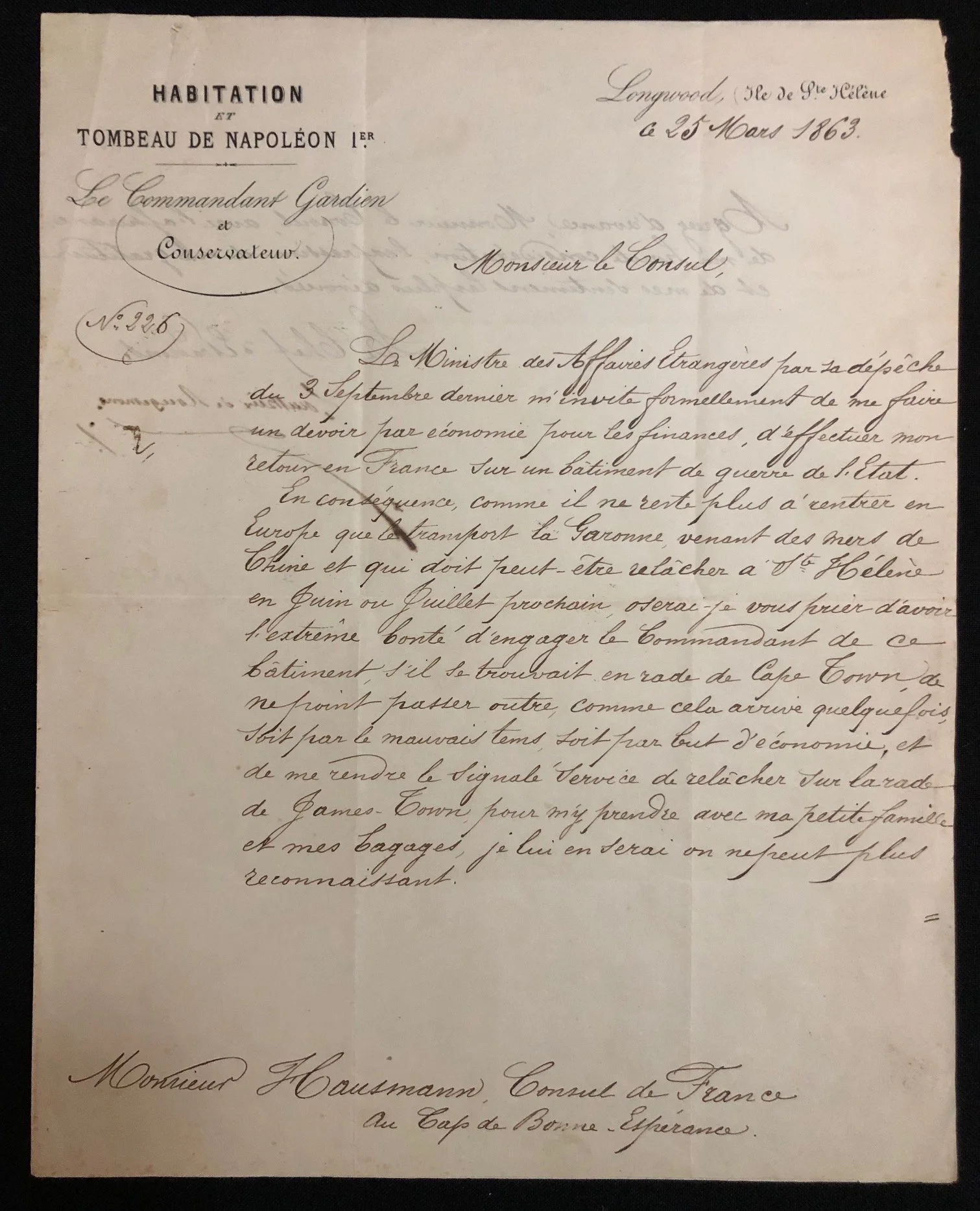
Letter: St. Helena; Tomb of Napoleon I
Letter written on the official stationery of the "Habitation et Tombeau de Napoléon 1er" (The House and Tomb of Napoleon I) on the island of Saint Helena.
This document is a wonderful piece of primary source history connecting the French administration of Saint Helena with the diplomatic outpost in South Africa. It highlights the logistical difficulties of mid-19th-century maritime travel and the mundane administrative concerns (like travel costs and family luggage) that went into maintaining one of history's most famous exile sites.
• Origin: Longwood, Saint Helena.
• Date: March 25, 1863.
• Sender: The "Commandant Gardien et Conservateur" (Commandant Guardian and Curator) of the Napoleonic properties on the island.
• Recipient: Monsieur F. Hausmann, the French Consul at the Cape of Good Hope (Cape Town).
In the letter, the writer explains that he has received a formal order from the Minister of Foreign Affairs (dated the previous September) to return to France. For reasons of financial "economy," he is instructed to travel back on a state warship rather than a private vessel.
The writer notes that the only ship remaining that could transport him back to Europe is the Garonne, which is currently returning from the "seas of China." He anticipates the ship will stop at Saint Helena in June or July.
The writer asks the Consul in Cape Town to intervene. He is concerned that the Captain of the Garonne might bypass Saint Helena—either due to bad weather or to save money—and head straight for Europe. He asks the Consul to "engage" (urge) the Captain, should the ship be in the Cape Town harbor, to ensure it stops at James Town to collect him, his small family, and their luggage.
• The Site: Longwood House was where Napoleon Bonaparte lived in exile from 1815 until his death in 1821. In 1858, Napoleon III (Napoleon’s nephew) purchased Longwood House and the Valley of the Tomb from the British government to be maintained as French property.
• The Writer: In 1863, the Curator was likely Godefroy de Rougemont or a high-ranking officer appointed by the French state to oversee the restoration and maintenance of the site after it was officially handed over to France.
• The Garonne: This was a French transport vessel known for serving long-distance colonial routes. Its journey from the "Seas of China" reflects the global naval movements of the Second French Empire.
This document is a wonderful piece of primary source history connecting the French administration of Saint Helena with the diplomatic outpost in South Africa. It highlights the logistical difficulties of mid-19th-century maritime travel and the mundane administrative concerns (like travel costs and family luggage) that went into maintaining one of history's most famous exile sites.
210mm x 265mm
(Sold May '26)