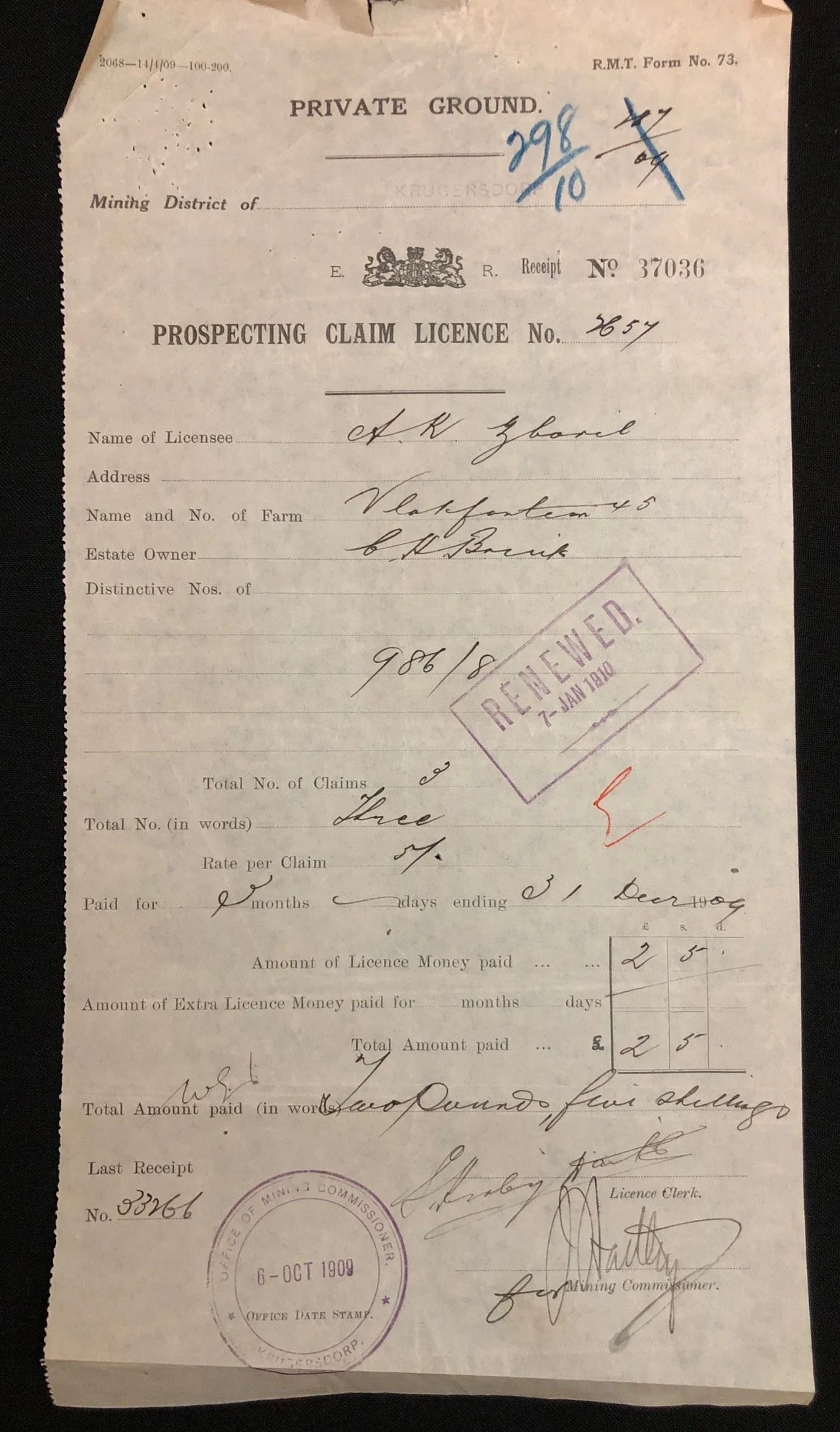
Prospecting Claim Licence issued in the Witwatersrand area (1910).
This is a remarkable piece of South African mining history, an original Prospecting Claim Licence issued in the Witwatersrand area during a pivotal era, just before the unification of South Africa in 1910.
The Shadow of the Anglo-Boer War
The letters E. R. flanking the British Royal Coat of Arms, stands for Edwardius Rex (King Edward VII), who reigned from 1901 to 1910.
The document is dated 6-OCT 1909 (with a renewal stamp for 7-JAN 1910). This places it in the closing months of the Transvaal Colony as a separate British possession, just before it was integrated into the Union of South Africa in May 1910. The area was still reeling from and rebuilding after the devastating Second Anglo-Boer War (1899–1902), and gold mining was the engine driving the entire region's economy.
The West Rand Goldfields
Faintly stamped in blue ink under "Mining District of" is KRUGERSDORP.
The Farm location is listed as Vlakfontein 45.
Krugersdorp (named after Paul Kruger) was the hub of the West Rand. In the late 19th and early 20th centuries, original Boer farms like Vlakfontein, Paardekraal, and Luipaardsvlei were subdivided or leased out as gold was discovered snaking beneath the soil. "Vlakfontein" in particular became synonymous with deep-level gold mining. By holding a license here, the licensee was hunting for a piece of the richest gold reef in human history.
The Licensee and the Landowner
Name of Licensee: Looks to be written as A. R. Zboril (or similar historical script). He wasn't a massive mining conglomerate (like Rand Mines); he was an individual prospector or a small syndicate representative staking a personal claim.
Estate Owner: The land itself belonged to C. H. Barrett (or Badrick). This highlights how the early gold rush worked: private citizens owned the surface farmland ("PRIVATE GROUND"), but the government controlled the mineral rights and regulated who could dig for them via these licenses.
Old British Currency
The document gives a great snapshot of pre-decimal economy:
Number of Claims: The licensee paid for 3 ("Three") claims.
Duration: Paid for 3 months, ending on 31 Decr 1909.
The Cost: The total paid was £2 5s (Two Pounds, five shillings).
Under the old system, a pound was worth 20 shillings. So, 5 shillings was a quarter of a pound. While £2 and 5s doesn't sound like much today, in 1909, that was a significant amount of money, roughly equivalent to a couple of weeks' wages for a skilled laborer at the time. Staking claims was a financial gamble.
Official Bureaucracy & Authentication
The document is a beautiful example of Edwardian-era bureaucracy:
The Stamp: The purple circular stamp from the Office of the Mining Commissioner, Krugersdorp officially validated the document on 6-OCT 1909.
The Renewal: A large rectangular stamp shows it was quickly renewed on 7-JAN 1910, meaning the prospector either found something promising or wasn't ready to give up on his three claims just yet.
The Signatures: It is signed off by a Licence Clerk and "for the" Mining Commissioner (whose bold, sweeping signature dominates the bottom right).
Documents like this are survivors. Because they were printed on relatively sturdy paper to withstand being carried around in a prospector's pocket or a dusty mining office, a few have made it through the last 115+ years intact, serving as a paper trail for the great South African gold rush.
170mm x 330mm
Creased and dog-eared.
R1,000