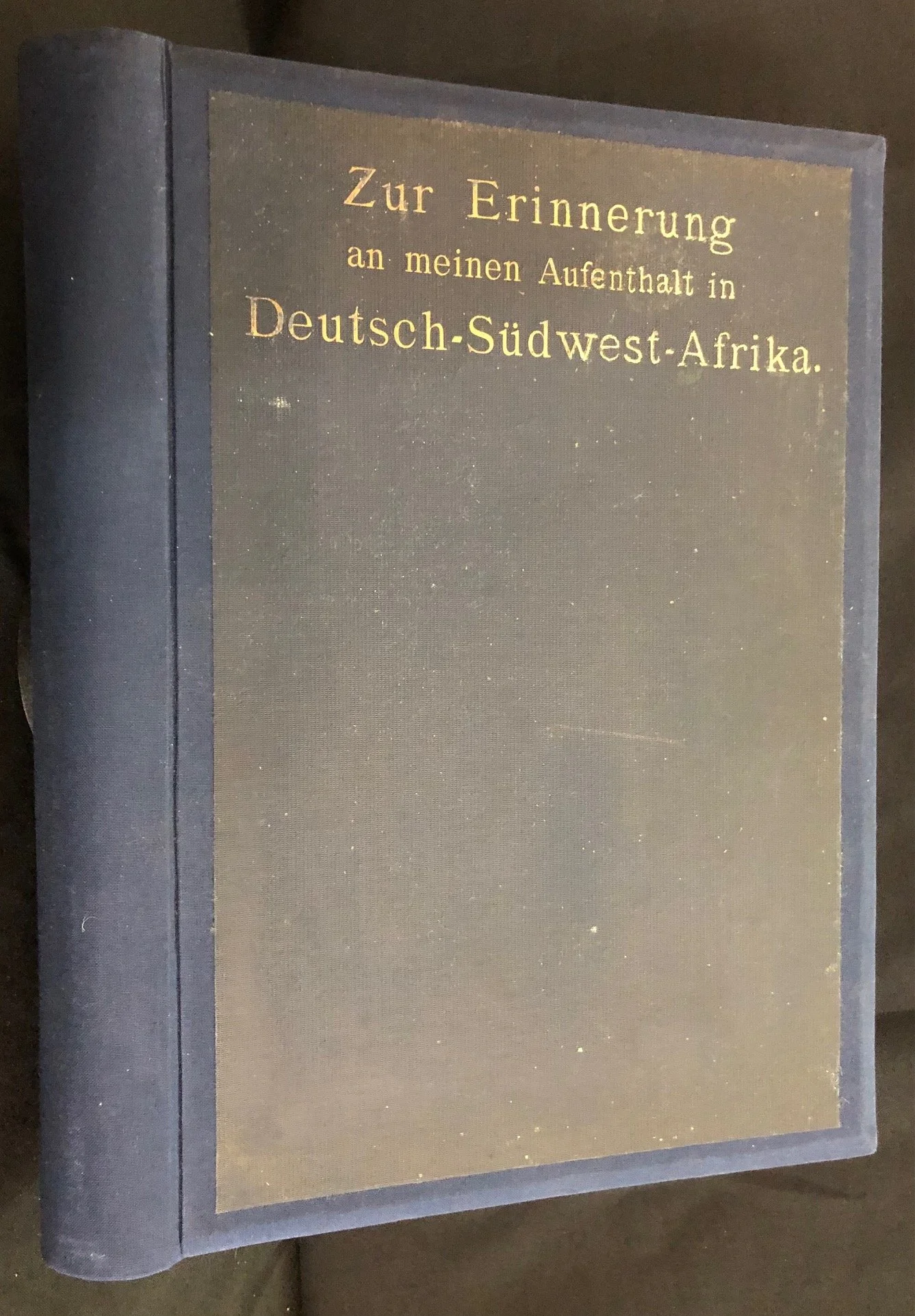
"Zur Erinnerung an meinen Aufenthalt in Deutsch-Südwest-Afrika" (In memory of my stay in German South West Africa) c.1908
96 original photographs.
A classic example of a German colonial commemorative photo album or souvenir book, dating from the late 19th or early 20th century (most frequently between 1904 and 1910).
The "Schutztruppe" Souvenir Culture
These albums were primarily produced for and purchased by officers, soldiers (Schutztruppe), and administrative officials returning to Germany. They served as a personal record of their deployment in the colony (modern-day Namibia). Because commercial photography was in its infancy in the region, specialized publishers or local photographers compiled these bound volumes containing high-quality platinum prints or photogravures to sell to the departing troops.
Crucial Historical Window (1904–1908)
The peak production period for these specific commemorative volumes directly coincided with the Herero and Namaqua War and the subsequent genocide. Consequently, the photographs inside these albums typically offer a stark, propaganda-infused look at the infrastructure of the colonial campaign:
Military Logistics: Images commonly feature the construction of the Otavi railway, camel transports, field encampments, and official military parades at remote outposts.
Colonial Landscape: They document early settlements like Windhoek, Swakopmund, and Lüderitzbucht before extensive modern development.
Propaganda vs. Reality
Historically, these albums are highly valued by modern researchers because they capture the duality of colonial reporting. While intended to project an idealized, heroic image of German "civilizing" efforts and military dominance back home, the candid backgrounds of the photographs often accidentally documented the severe realities of the conflict, prisoner-of-war conditions, and the stark devastation of the local population.
With 96 original photographs, this isn't just a generic souvenir volume; it is a comprehensive, firsthand photographic record of a Schutztruppe soldier’s deployment.
Several specific historical insights stand out from these images:
The "Parole Heimat" Banner: The Psychology of Deployment
The large banner in the group photograph reads "PAROLE HEIMAT" (Slogan: Home or Homeland), surrounding the Imperial German Eagle. This captures a crucial psychological element of the German colonial forces. Troops were often deployed on grueling, multi-year tours in highly isolated, arid terrain. "Parole Heimat" was a common rallying cry and sentimental theme among soldiers nearing the end of their service, celebrating their impending repatriation to Europe.
The Kamelreiter (Camel Corps) Logistics
Images that feature soldiers on camels document one of the most distinctive tactical adaptations of the southern African colonial theater. Traditional cavalry horses struggled immensely with the regional water scarcity and rampant African horse sickness. To combat this, the German military established specialized Camel Riding Companies (Kamelreiter-Kompanien), importing dromedaries primarily from the Canary Islands and North Africa to patrol the vast expanses of the Kalahari and Namib deserts.
Desert Technological Warfare: Early Automobiles
The photograph of the military automobile captures a fascinating technological crossroads. German South West Africa was an early proving ground for mechanical transport. Around 1908, the German General Staff began experimenting with heavy, customized motorized vehicles (most famously the Dernburg-Wagen developed by Daimler) to replace draft animals. However, the deep sand, lack of roads, and extreme heat meant these vehicles frequently broke down, making photographs of operating automobiles in the field during this era relatively uncommon.
Mission Culture and Colonial Paternalism
The final photograph shows local African children arranged to spell out "FROEHLICHE OSTERN" (Happy Easter) across their shirts. This is a classic depiction of colonial institutional life, likely taken at a Rhenish Missionary Society (Rheinische Missionsgesellschaft) school or a colonial station. In the aftermath of the 1904–1908 genocide, surviving indigenous populations were heavily subjected to forced labor, cultural assimilation, and religious conversion. Photographs like this were frequently staged to demonstrate the "civilizing mission" and religious instruction of the local population to audiences back home in Germany.
Album: 250mm x 360mm x 45mm
Average photograph: 75mm x 25mm
Album restored; some photographs faded and slightly torn; creased.
R12,500