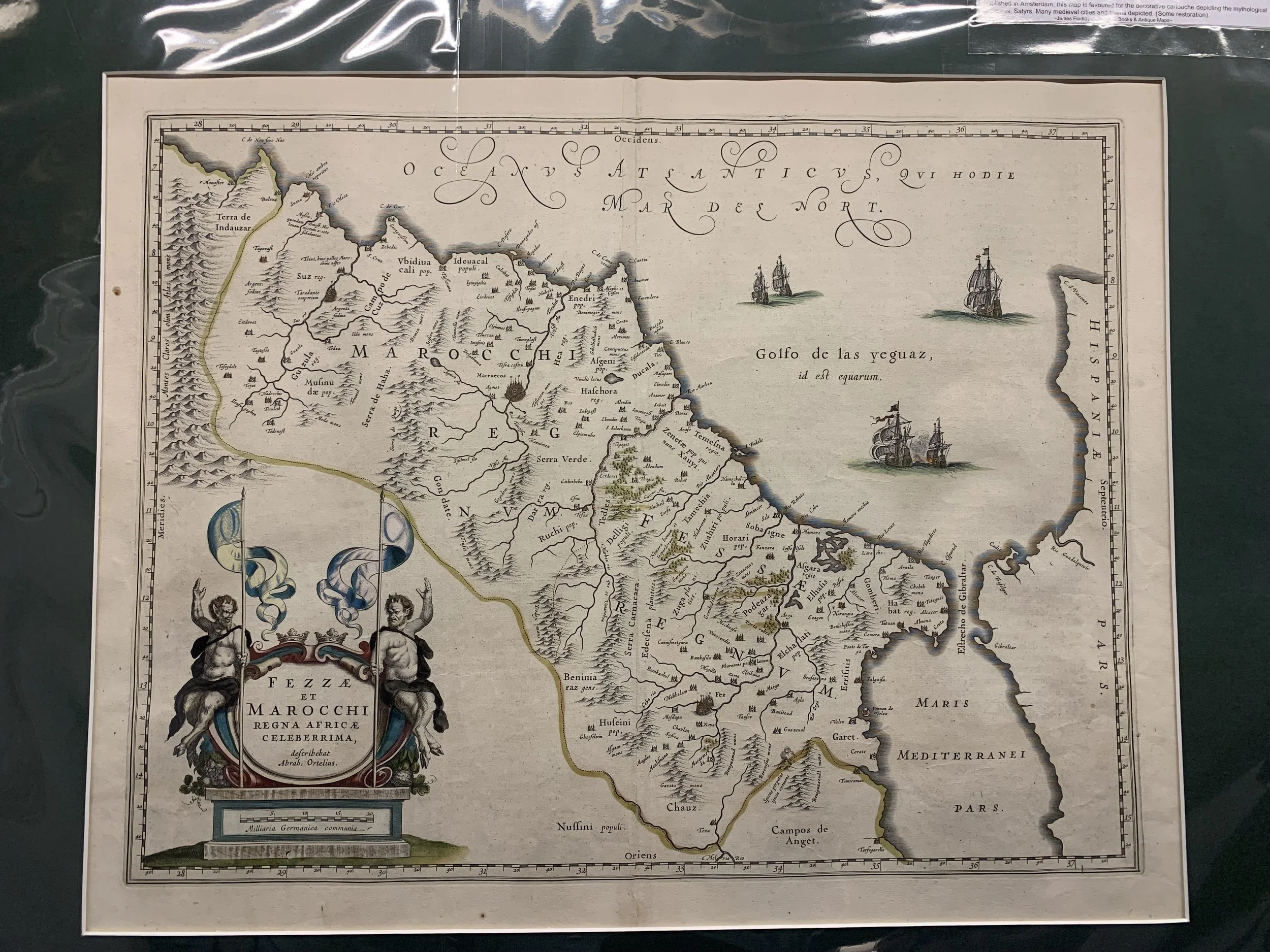
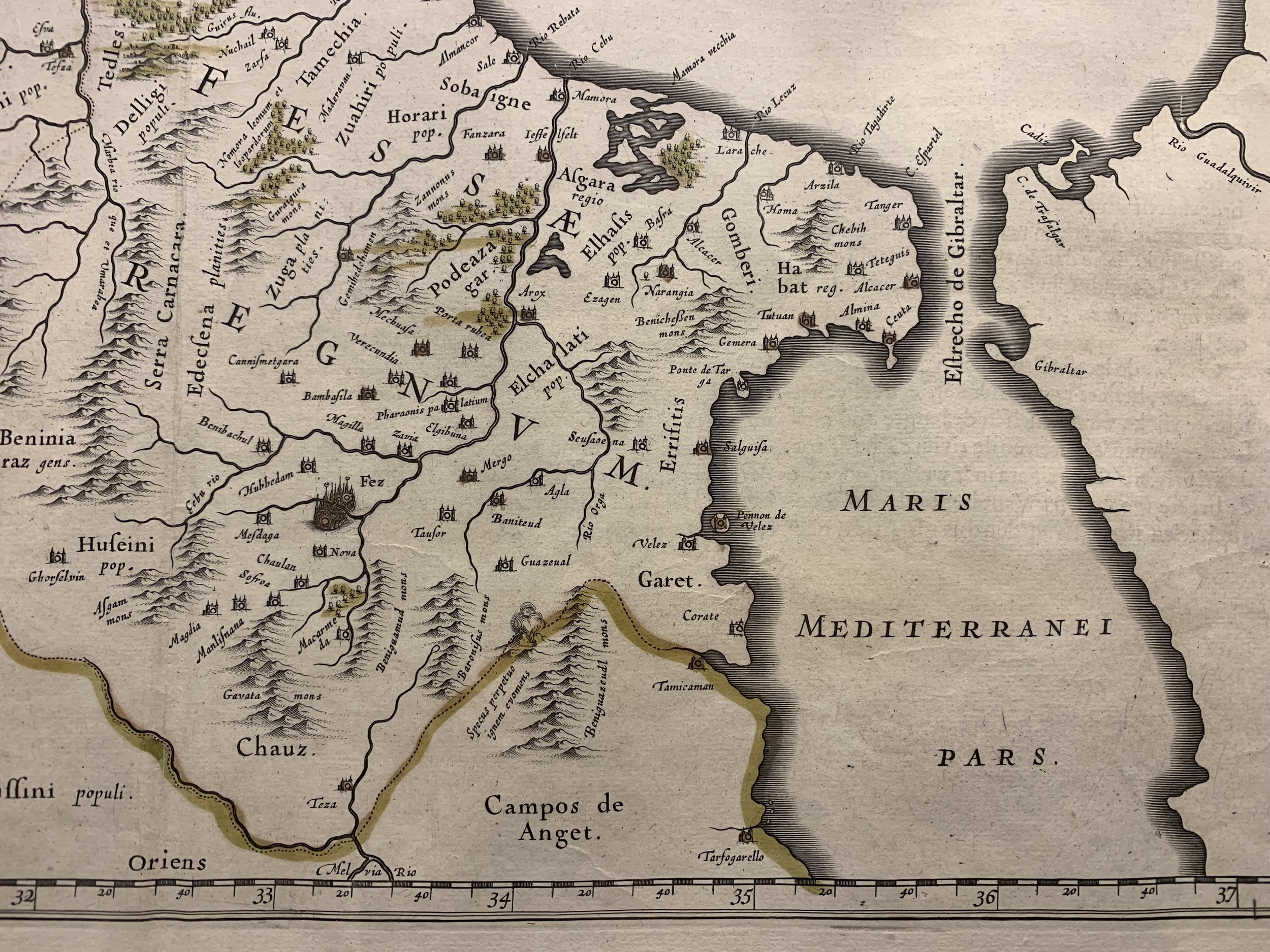
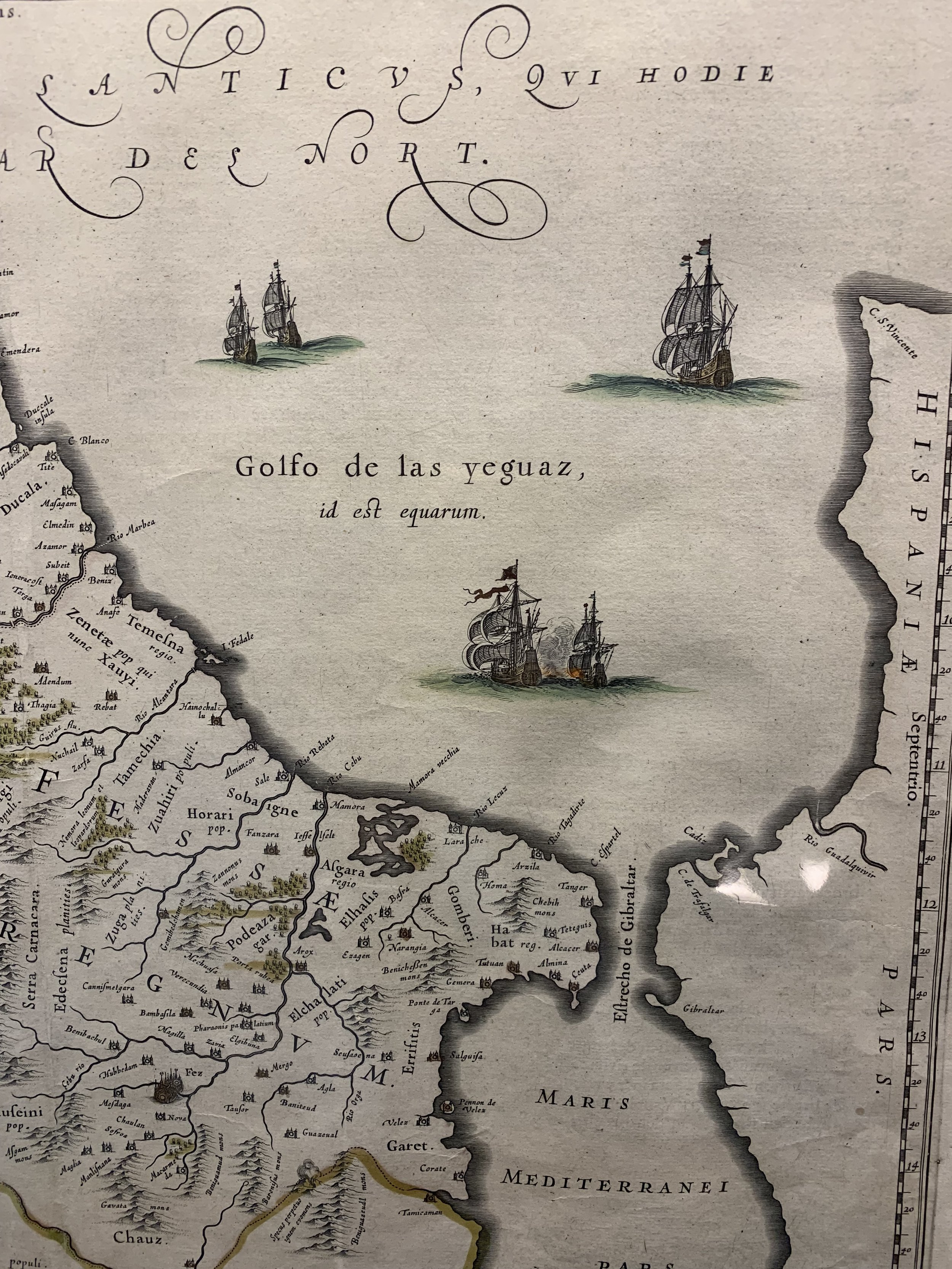
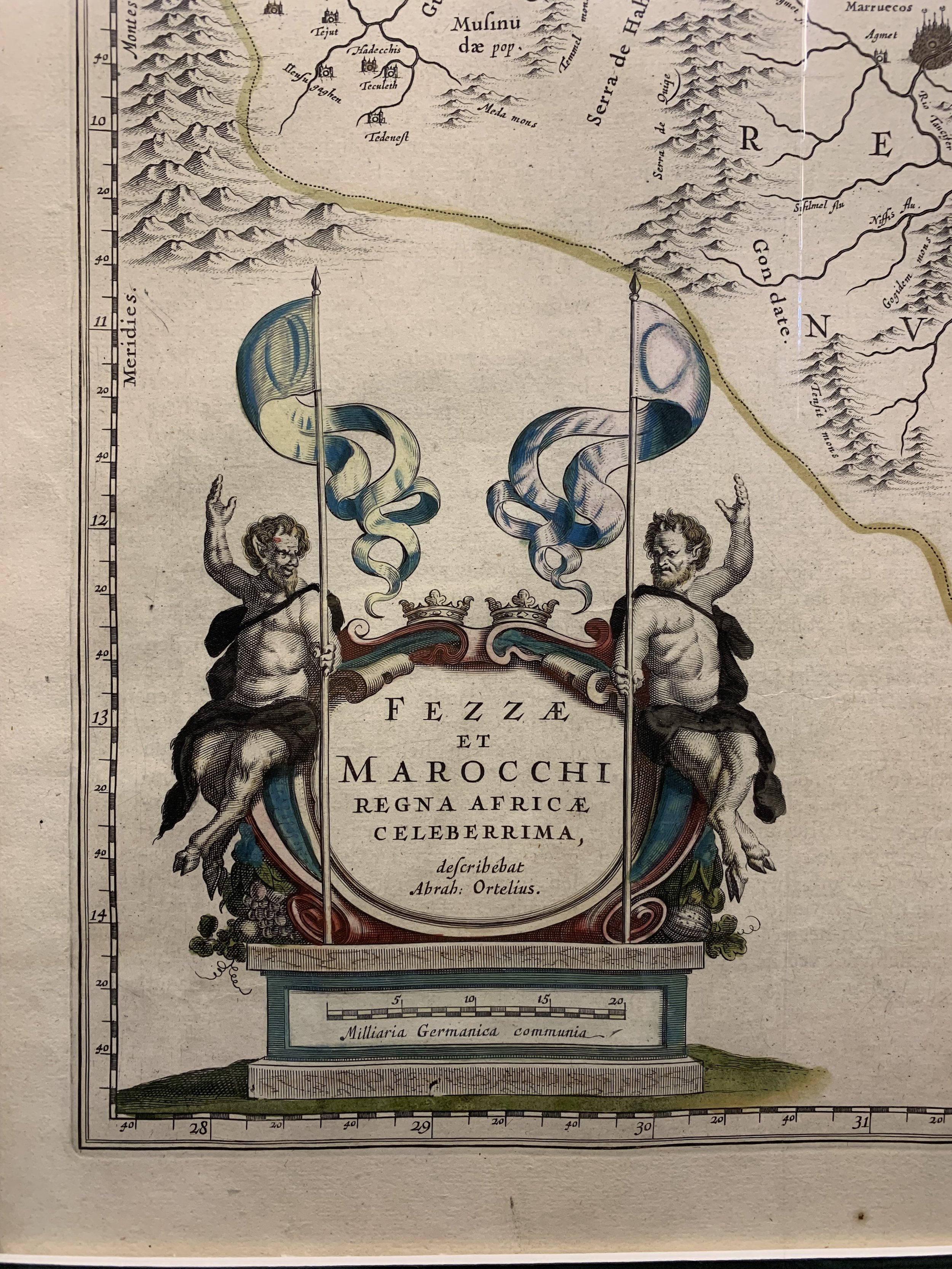
The Kingdom of Morocco 1636
Hand-coloured copperplate engraving.
c.1636.
By Willem Janszoon Blaeu (1571–1638) also known as Willem Jansz, a Dutch cartographer, globe maker, and publisher.
He was one of the leading figures of the Dutch school of cartography in the seventeenth century.
Trained in astronomy under Tycho Brahe between 1594 and 1596, Blaeu established a workshop in Amsterdam where he produced globes, nautical charts, and maps. These works formed the basis of a series of atlases, including the Atlas Novus (1635), and were widely used in navigation and geographic study.
In 1633 he was appointed mapmaker to the Dutch East India Company. After his death in 1638, his business was continued by his sons, including Joan Blaeu, who later published the multi-volume Atlas Maior, one of the most extensive atlases of the seventeenth century.
Blaeu based this version of the map on a map by Abraham Ortelius.
Abraham Ortelius, also Ortels, Orthellius or Wortels (1527 – 1598) was a cartographer, geographer, and cosmographer from Antwerp in the Spanish Netherlands. He is recognized as the creator of the first modern atlas, the Theatrum Orbis Terrarum ('Theatre of the World'). Along with Gemma Frisius and Gerardus Mercator, Ortelius is generally considered one of the founders of the Netherlandish school of cartography and geography. He was a notable figure of this school in its golden age (approximately 1570s–1670s) and an important geographer of Spain during the age of discovery. The publication of his atlas in 1570 is often considered as the official beginning of the Golden Age of Netherlandish cartography. He was the first person proposing that the continents were joined before drifting to their present positions.
Published in Amsterdam.
540mm x 425mm (unframed)
R7,500