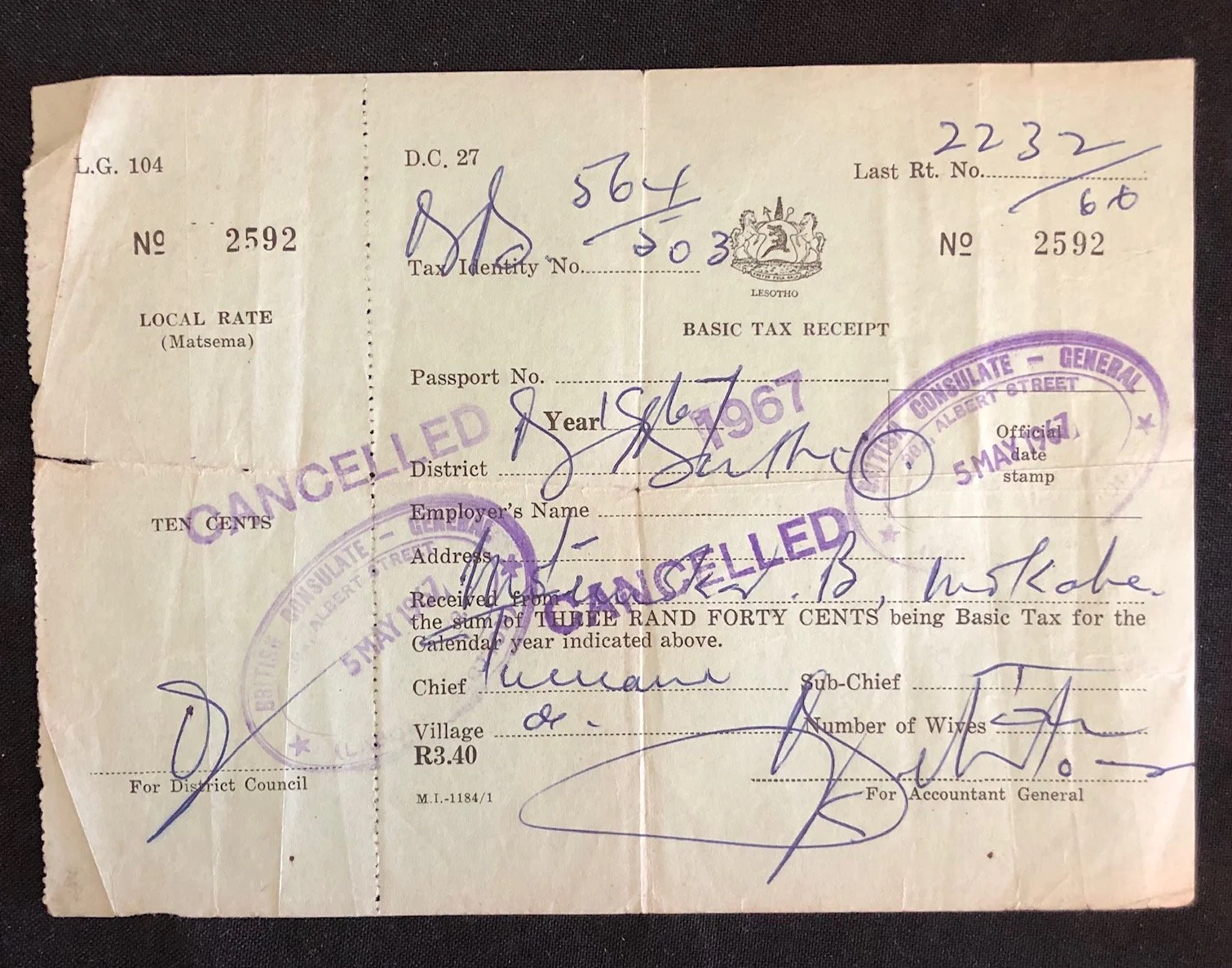
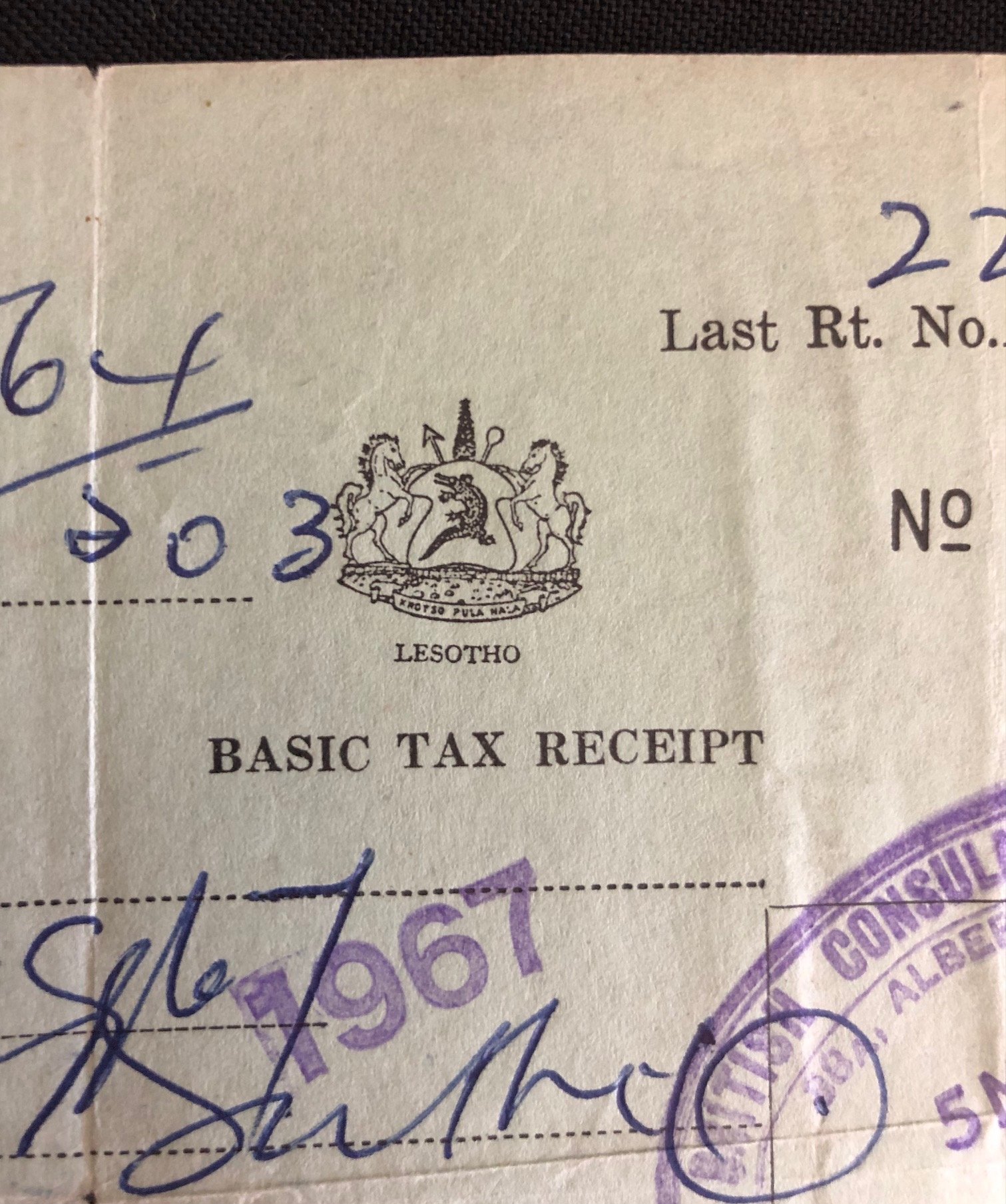
Lesotho Basic Tax Receipt (Segregation and “Hut Tax”) 1967
This document is an interesting artifact of Southern African socio-political history, capturing the intersection of colonial administration, apartheid-era migrant labor, and the birth of an independent nation.
The Post-Independence Transition (The May 1967 Stamp)
Lesotho officially gained independence from Great Britain on October 4, 1966, transitioning from the crown colony of Basutoland into an independent Kingdom.
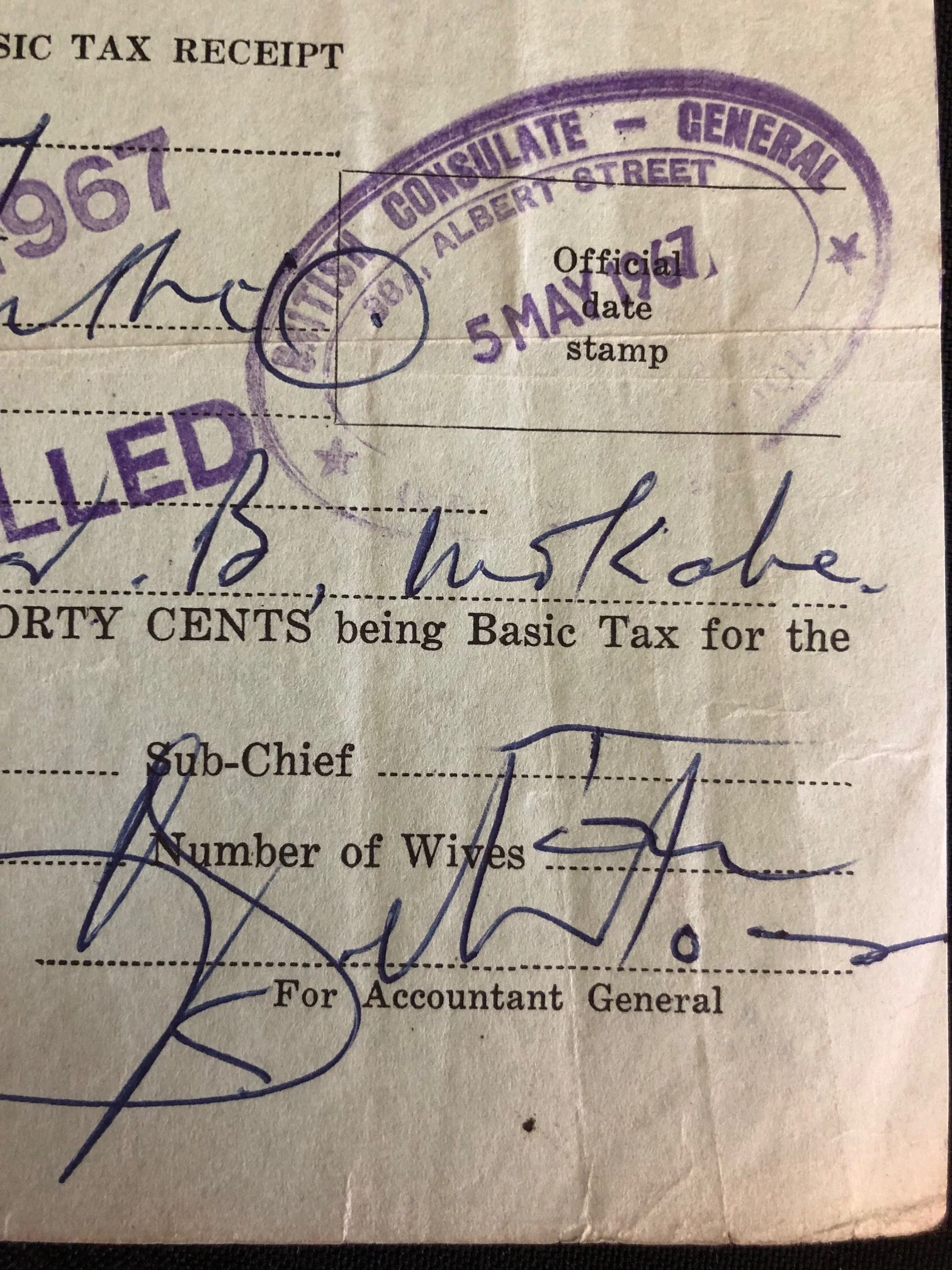
Yet, this basic tax receipt is dated 5 May 1967—seven months after independence—and features a purple date stamp from the British Consulate-General. This reveals the bureaucratic reality of the era: during the immediate post-independence transition, British consular offices in South Africa continued to assist in processing and verifying administrative paperwork for Basotho citizens working across the border.
The Notorious Address: 28A Albert Street, Johannesburg
The purple stamp locates the office at 28A, Albert Street. In the geography of apartheid-era Johannesburg, Albert Street (specifically the Albert Street Pass Office complex in Marshalltown) was the dreaded nerve center of Influx Control.
This was the main complex where black South Africans and foreign migrant laborers had to present their documentation ("dompas") to legally work, reside, or seek employment in the Witwatersrand goldfields. Seeing a Lesotho tax receipt stamped at this specific location highlights how tightly intertwined Lesotho's domestic economy was with South Africa’s migrant labor system.
The "Number of Wives" Field
The form includes a printed ledger line for "Number of Wives."
This field is a direct legal evolution of the colonial Hut Tax, originally introduced by British authorities in the 19th century. Because traditional wealth and household structures in Basutoland were often polygamous—with each wife typically occupying her own dwelling or lapa—colonial authorities structured the tax system around the number of wives a man had to calculate his total household tax liability. Even as late as 1967, the administrative infrastructure preserved this colonial-era ledger line.
191mm x 140mm
Creased and worn.
R750