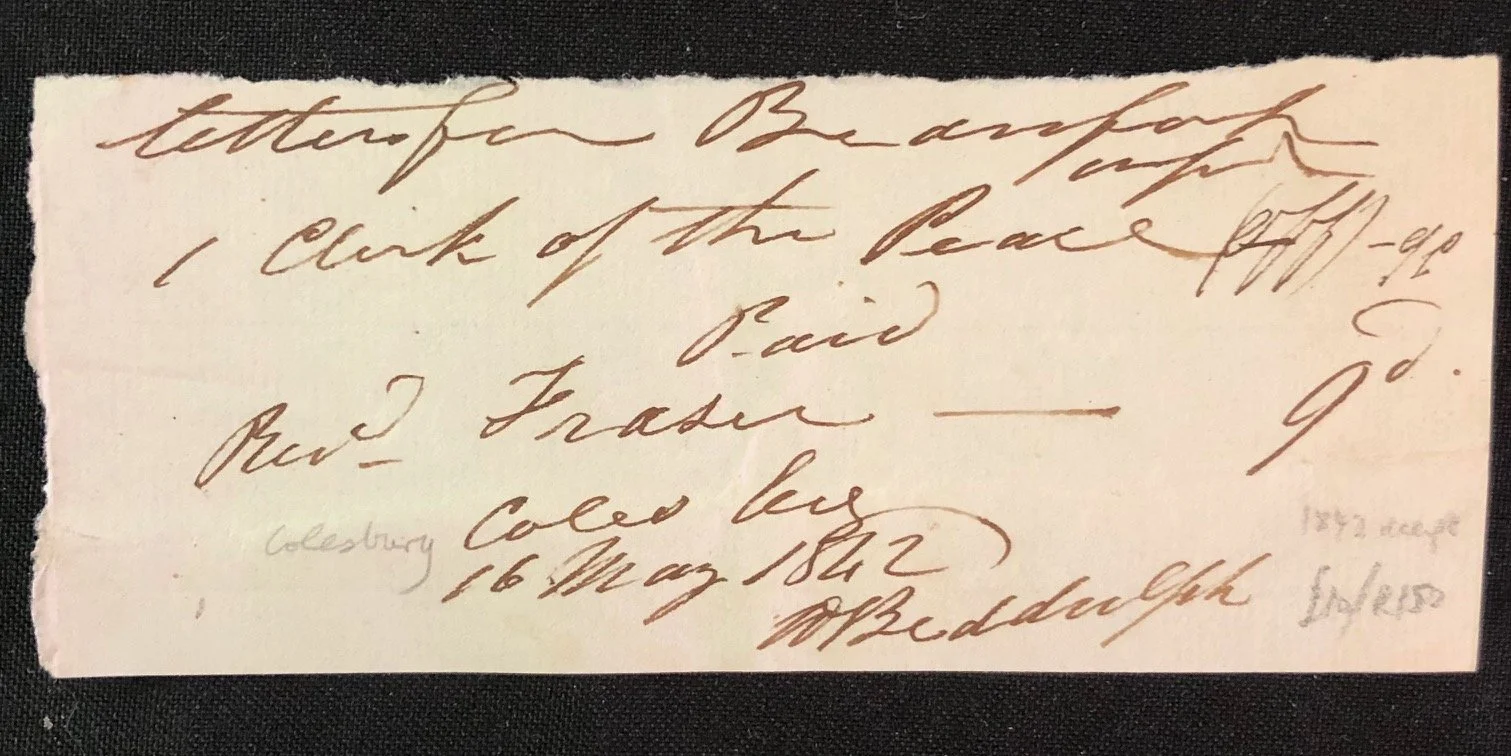
Postal Charge from the frontier of the Cape Colony. Dated 16 May 1842
This brief slip of paper is a local receipt from a highly volatile period on the northern frontier of the Cape Colony. Dated 16 May 1842, it records a small fee or postal charge (9 pence) paid for a letter from Beaufort, handled by the Clerk of the Peace and received in Colesberg.
Behind the faded ink and mundane financial transaction lie some deeply intertwined figures and themes from South African frontier history.
Reverend Colin Fraser of Colesberg
The note records a payment on behalf of "Rev. Fraser". This is almost certainly Reverend Colin Fraser (1796–1870), a Scottish Presbyterian minister recruited by the British authorities to serve in the Dutch Reformed Church (Nederduitse Gereformeerde Kerk).
The Scottish Policy: Lord Charles Somerset brought Scottish ministers like Fraser and Andrew Murray Sr. to the Cape to help "Anglicize" the local population. However, Fraser completely integrated into his community, mastering Dutch and serving the Colesberg congregation faithfully from 1843 until his retirement.
Father to a President: He was also the father of Sir John George Fraser, who later became a prominent politician in the Orange Free State, and grandfather to Colin Fraser Steyn (a prominent South African minister of justice).
The Transcriber: Thomas Jervis Biddulph
The document is signed at the bottom by T. J. Biddulph. Biddulph was an 1820 Settler who held various civil service posts, including serving as a local magistrate and working within the colonial administration system.
A Volatile Frontier Career: Only a few years after this slip was written, Biddulph would find himself directly on the frontline of colonial expansion and conflict. In 1848, Sir Harry Smith appointed him as the first British Resident Magistrate of Winburg in the newly annexed Orange River Sovereignty.
Target of Rebellion: Biddulph’s appointment infuriated the local Emigrant Boers (Voortrekkers). Led by Andries Pretorius, a commando marched into Winburg in July 1848 and expelled Biddulph, an escalation that directly precipitated the Battle of Boomplaats later that August.
Snapshot of 1842: A Frontier on the Brink
The date—May 1842—is remarkably precise in the context of regional tensions.
Colesberg was the absolute edge of the Cape Colony’s northern border, sitting just south of the Orange River.
By mid-1842, the area directly across the river was experiencing heavy friction between Trekboers, Griqua communities (under Adam Kok), and the Basotho.
Just a few months after this note was penned, in December 1842, British troops under Judge William Menzies were rushed to Colesberg to assert British authority over the migrating farmers across the river.
The slip reads:
Letter from Beaufort
to Clerk of the Peace [Ref No]
Paid
Rev. Fraser ————— 9d.
Colesberg 16 May 1842
T. J. Biddulph
(Note: There are also pencil annotations added later by a collector or archivist tracking it: "Colesberg", "1842 receipt", and a system reference "In/R/150").
Torn at the edges.
142mm x 60mm
R2,000