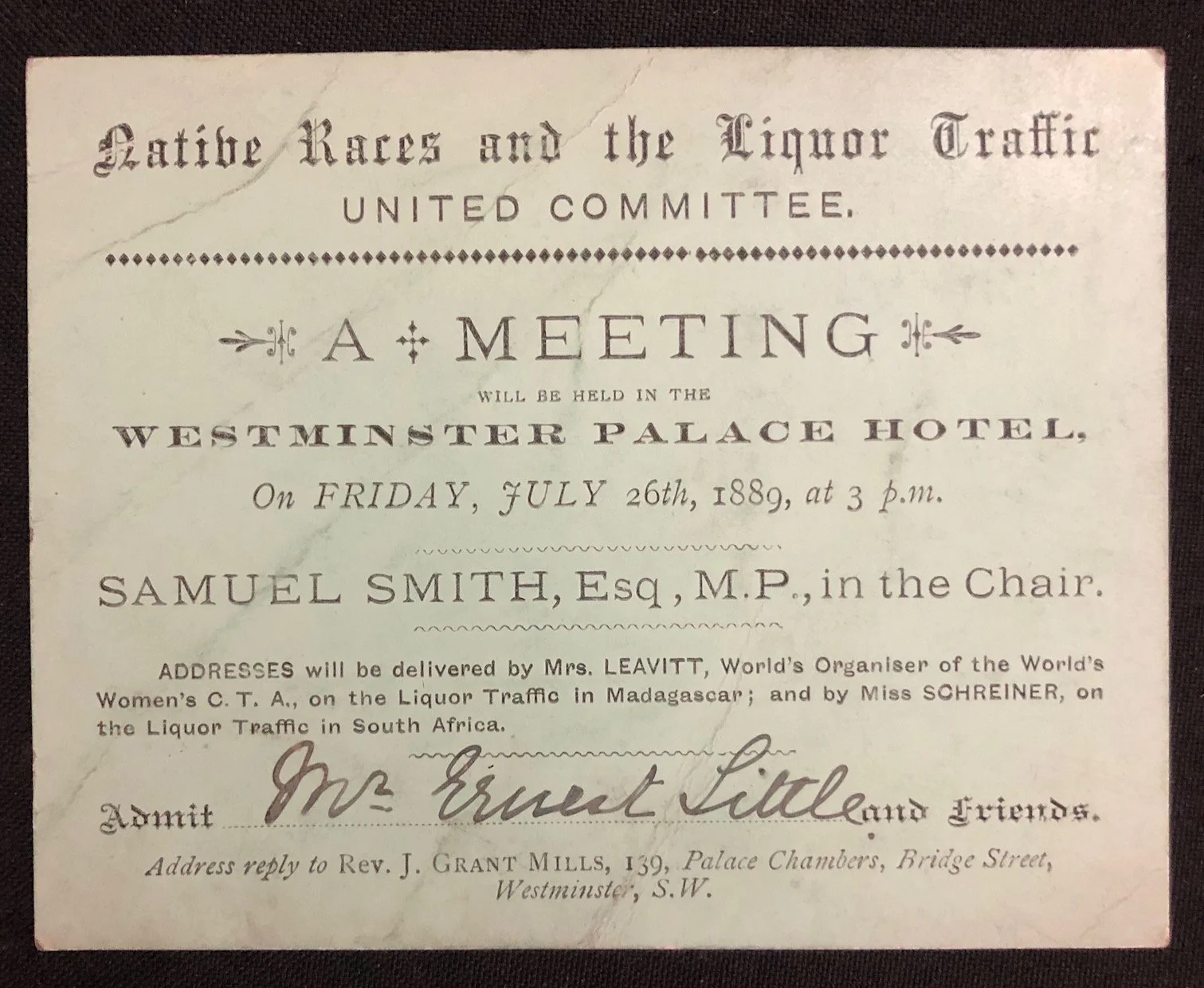
Admission card for a meeting addressed by Olive Shreiner - Native Races and the Liquor Traffic United Committee 1889
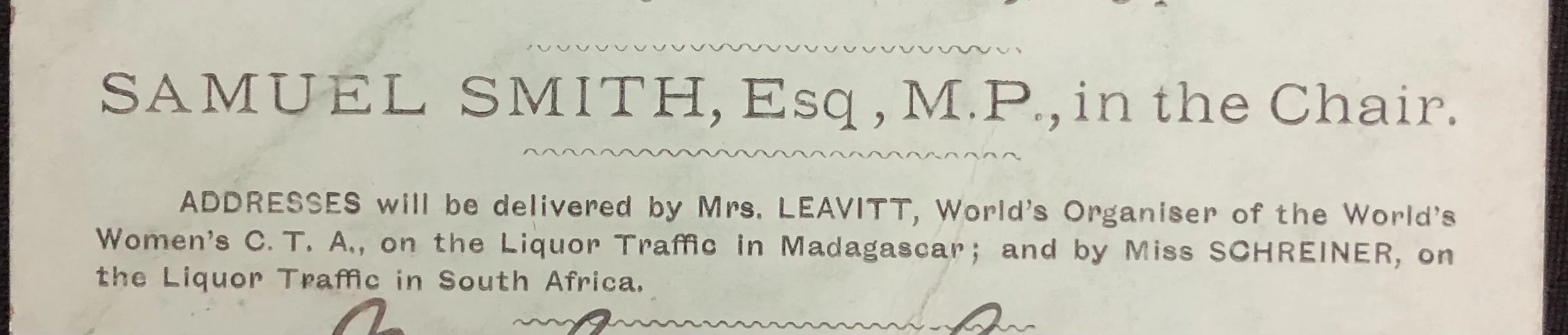
Admission card for a meeting of the Native Races and the Liquor Traffic United Committee on July 26, 1889, announcing an address by "Miss SCHREINER, on the Liquor Traffic in South Africa."
Six years prior, in 1883, Schreiner had published her masterpiece, The Story of an African Farm, under the pseudonym Ralph Iron, which catapulted her to international fame. By 1889, she was living in England, recognized not just as a brilliant novelist but as an ardent social reformer, feminist, and anti-imperialist.
Her presence as a keynote speaker at Westminster highlights how she leveraged her literary celebrity to advocate on complex South African social and political issues directly to the British political establishment.
The International Temperance Network: Mrs. Leavitt
The card also lists an address by "Mrs. LEAVITT... on the Liquor Traffic in Madagascar." Mary Greenleaf Clement Leavitt was the first world missionary for the American-based Woman’s Christian Temperance Union (WCTU). Embarking on a monumental global tour that lasted nearly a decade, Leavitt traveled across Asia, Africa, and Madagascar to establish international branches of the WCTU.
Seeing Leavitt and Schreiner sharing a stage at the Westminster Palace Hotel illustrates how closely interconnected global reform networks were in the late 19th century, linking American evangelists, British MPs, and South African intellectuals.
Imperial Paternalism and the "Liquor Traffic"
The host organization, the Native Races and the Liquor Traffic United Committee, was a powerful British lobby group formed in the 1880s by a coalition of temperance advocates, politicians (like the chairman listed here, Samuel Smith, MP), and missionary societies.
The committee argued that Western merchants and colonial trading companies were destroying indigenous societies across Africa and the Pacific by flooding them with cheap, industrial spirits (often trade rum or gin) to create dependency and extraction advantages. While genuinely motivated by a desire to prevent social devastation, the movement was also deeply intertwined with Victorian imperial paternalism—the belief that Great Britain had a moral duty to act as a protective "guardian" over the indigenous populations of its expanding empire.
The Setting: Westminster Palace Hotel
The venue, the Westminster Palace Hotel, was not just a random meeting hall; it was located directly opposite Westminster Abbey and was the premier luxury hotel for political networking in London. It frequently hosted high-level parliamentary committee meetings, international delegates, and influential pressure groups. Holding a meeting here meant the committee was directly targeting British lawmakers and the London elite to influence colonial policy in Africa.
115mm x 90mm
Minor creasing and wear.
R1,500