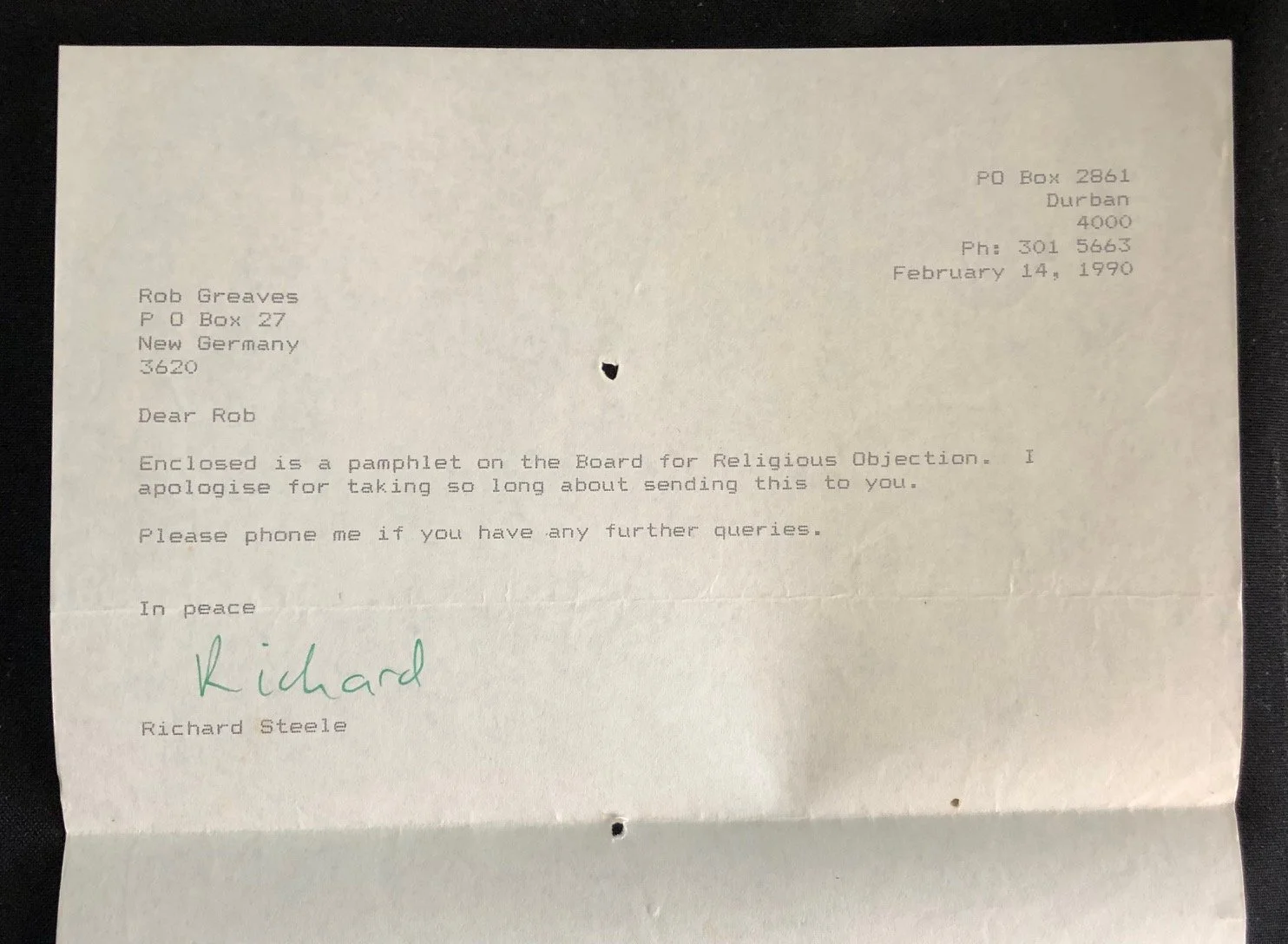
Richard Steele, signed letter: End Conscription Movement in South Africa (1990)
These two documents—the personal letter and the accompanying pamphlet provide a compelling window into the anti-apartheid resistance and the anti-conscription movement in South Africa during the twilight of the apartheid regime.
A Pioneering Anti-Apartheid Pacifist
The letter is signed by Richard Steele, one of South Africa’s most prominent and historically vital conscientious objectors.
In 1980, Steele (a devout Baptist and universal pacifist) became one of the very first South Africans to face a military court and be sentenced to a year in military prison for refusing compulsory conscription into the South African Defence Force (SADF).
He chose prison over exile because he believed the SADF was a direct instrument for upholding white domination and the violence of the apartheid state. He later helped form the highly influential End Conscription Campaign (ECC) in 1983 and served as the caretaker of the Phoenix Settlement—Mahatma Gandhi’s original ashram near Durban.
The "Board for Religious Objection" Strategy
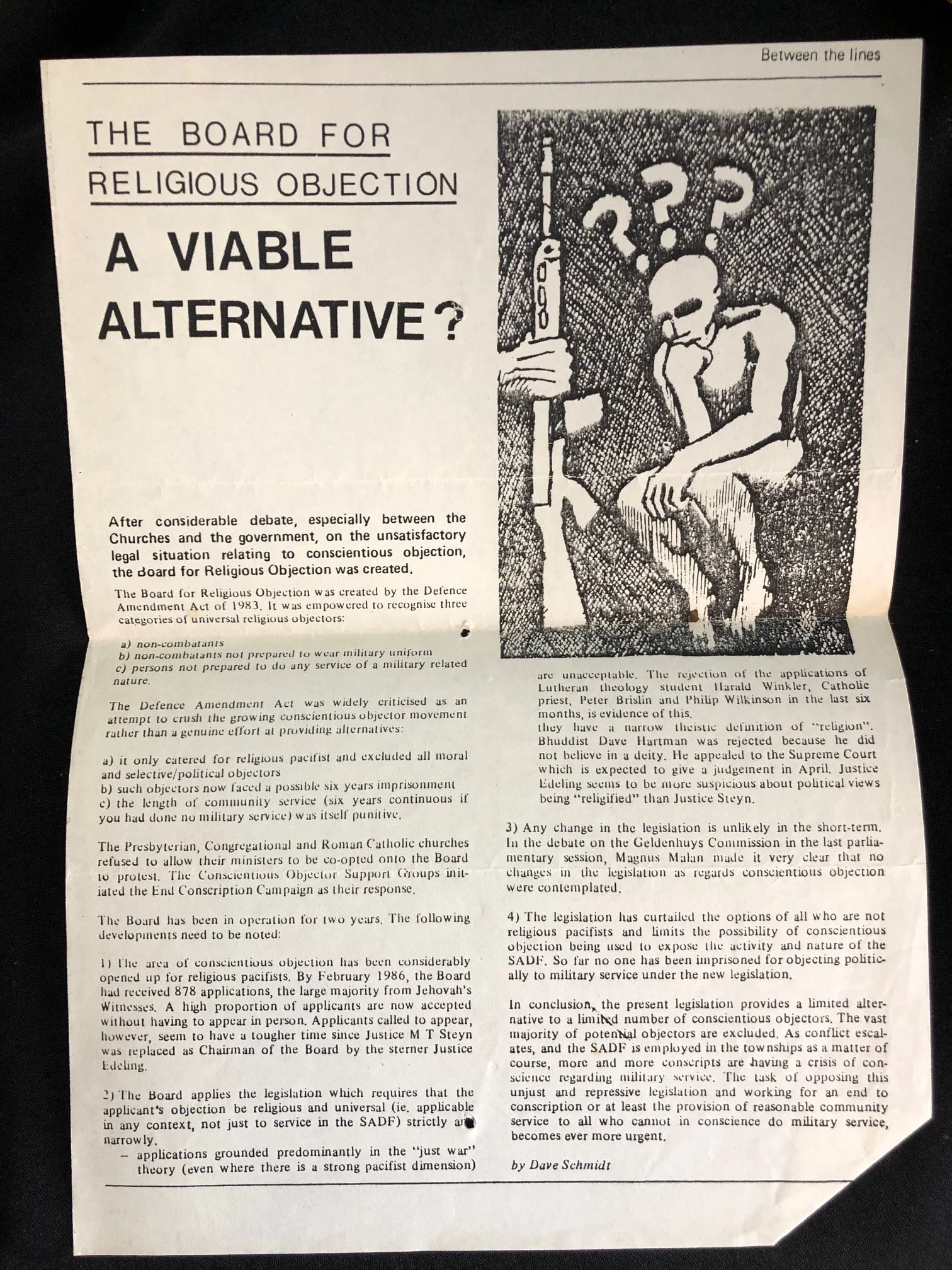
The pamphlet details the Board for Religious Objection, which was established by the state via the Defence Amendment Act of 1983.
As resistance to fighting in township crackdowns and the border wars in Angola/Namibia grew among young white conscripts, the apartheid government created this board as a pressure-release valve.
However, as the author of the pamphlet (Dave Schmidt) highlights, the board was deeply controversial because it strictly limited legal objection to universal religious pacifists (such as Jehovah's Witnesses). It completely excluded anyone whose objections were political, moral, or based on "Just War" theory.
A Highly Punitive "Alternative"
As noted in the text, choosing alternative community service through this board meant facing a continuous period that was one-and-a-half times longer than standard military service—resulting in up to six years of compulsory labor. If a conscript refused on political grounds, they faced an automatic six-year prison sentence.
A Pivotal Moment in Time: February 1990
The date on the letter—February 14, 1990—is incredibly poignant. Just two days earlier, on February 11, 1990, Nelson Mandela was released from prison, and the liberation movements were unbanned. This correspondence captures the ground-level reality of activist networks still actively helping young men navigate the repressive apparatus of the military draft at the exact moment the old regime was beginning to fracture and unravel. Conscription was eventually abolished just a few years later in 1993.
210mm x 300mm
Creased and worn.
R1,250