Health and Safety Day - Kinross Gold Mine disaster (1991)
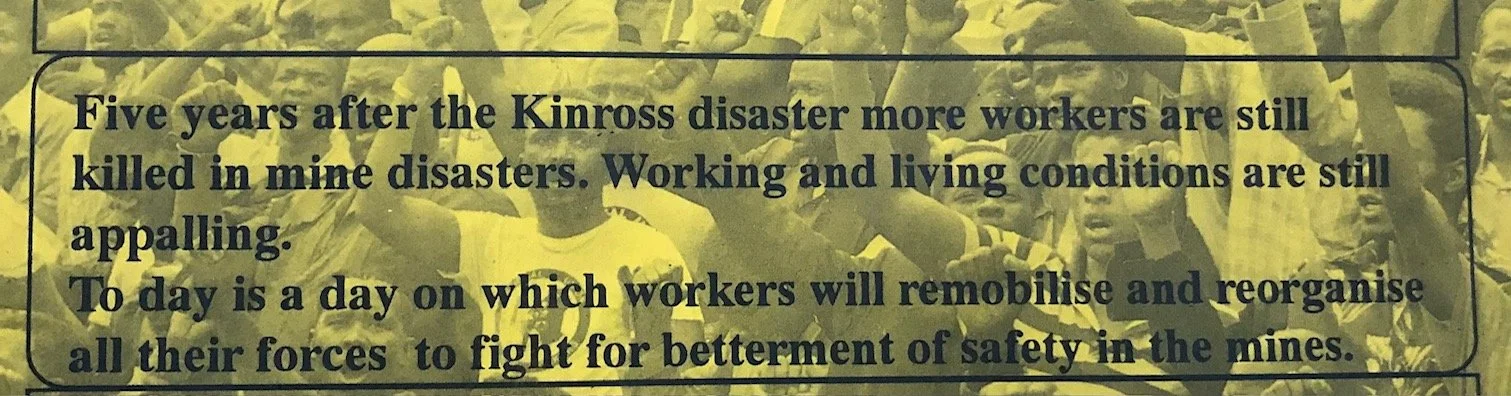
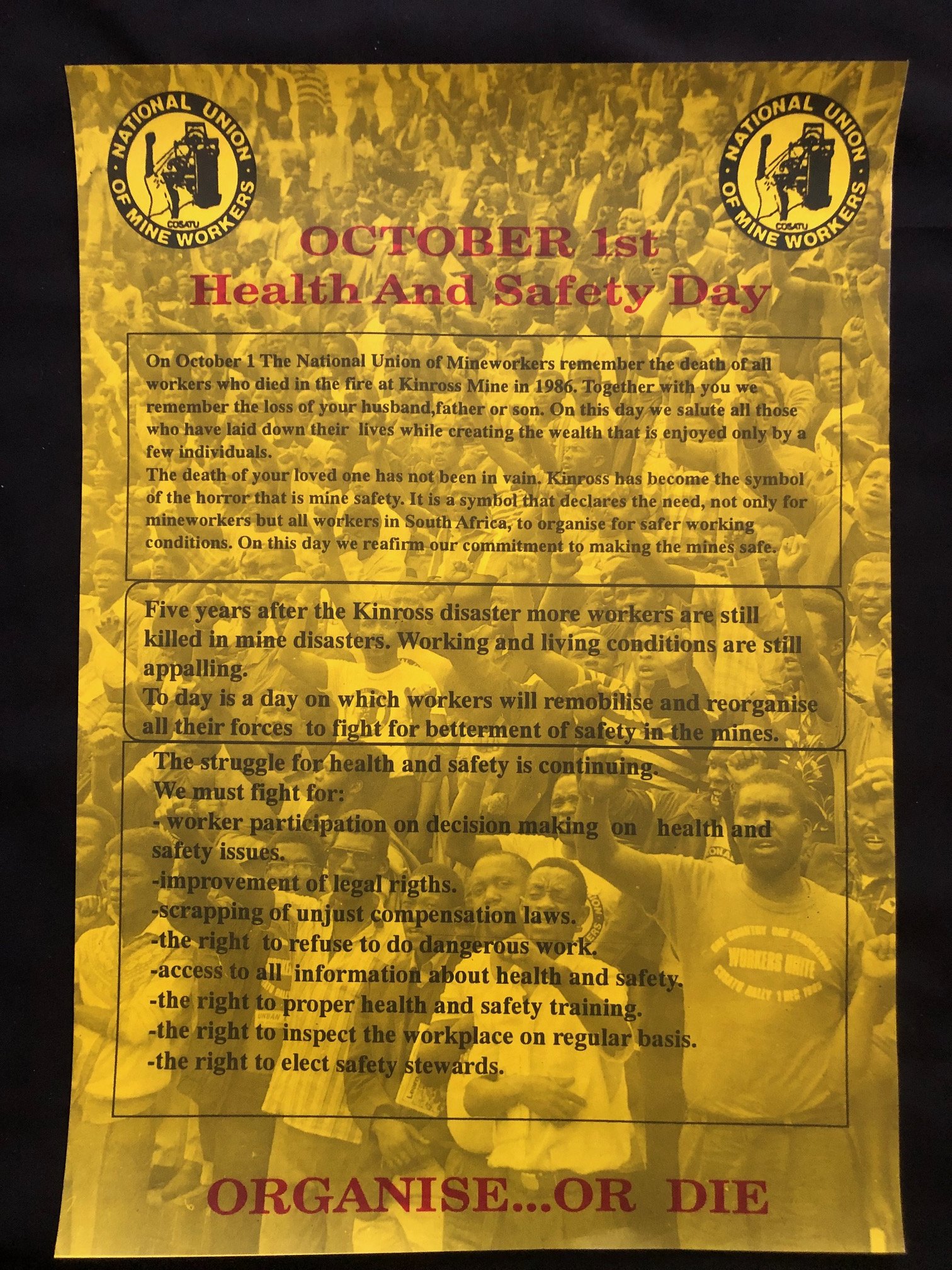
This poster is a remarkably powerful piece of South African labour and anti-apartheid history. Produced by the National Union of Mineworkers (NUM) and printed via offset lithography around 1991 (noted by the text "Five years after the Kinross disaster"), it serves as both a memorial and a political manifesto.
The Catalyst: The Kinross Mine Disaster (1986)
The context of the poster hinges on the Kinross Gold Mine disaster of September 16, 1986, located near Evander.
An underground welding accident sparked a fire that ignited toxic polyurethane foam used to line the tunnel walls.
The fire pumped highly poisonous chemical fumes through the shafts, killing 177 miners and injuring 235 others. It remains one of the worst gold mining disasters in world history.
The Birth of "October 1st: Health and Safety Day"
Following the disaster, the mine's owners (Gencor) tried to host an official memorial service. Black miners and the NUM fiercely boycotted and disrupted it because union leaders were banned from attending, and the company refused to take responsibility for the abysmal safety standards.
In defiance, the NUM declared October 1st, 1986, as a national Day of Mourning. Over 325,000 mineworkers staged a massive strike and stayed away from work to honour their fallen comrades. This poster marks the 5-year anniversary of that tragedy, demonstrating how a single day of mourning evolved into an annual rallying cry for workers' rights.
Links to the Anti-Apartheid Struggle
In 1980s and early 1990s South Africa, labour rights and the fight against apartheid were deeply intertwined.
Cyril Ramaphosa (who later became the President of South Africa) was the General Secretary of the NUM at the time of the disaster and fiercely condemned the mine bosses, stating that the industry was "back in the Dark Ages."
Apartheid segregation even applied to the dead: following the 1986 disaster, the bodies of Black and white miners were transported in separate ambulances to separate, segregated mortuaries. The poster’s underlying message directly challenges this systemic devaluation of Black lives.
Early Demands for Basic Workplace Rights
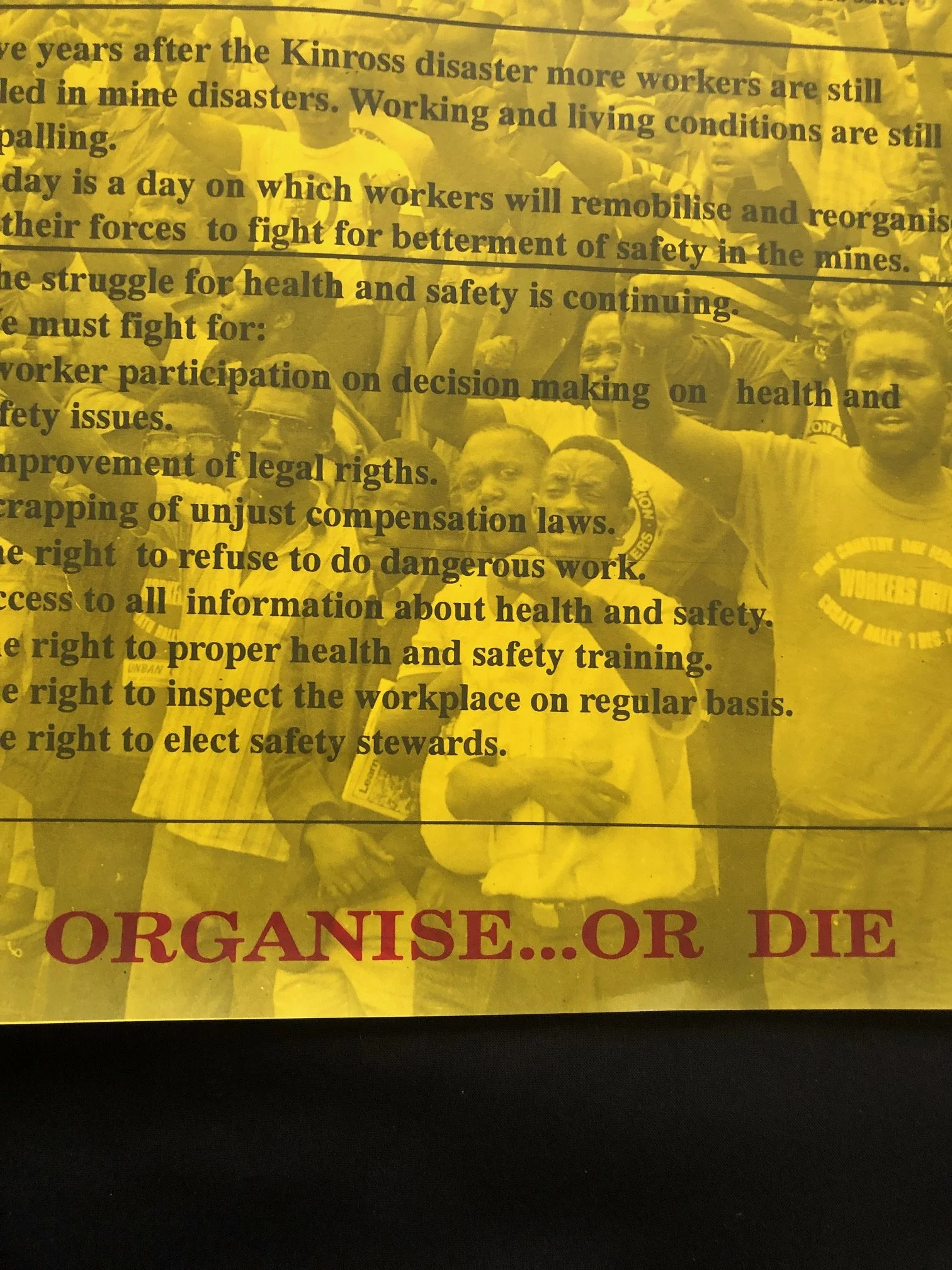
The bottom box lists eight demands (e.g., "the right to refuse to do dangerous work," "the right to elect safety stewards," and "scrapping of unjust compensation laws"). In 1991, South African miners had virtually no legal protection to walk away from a lethal environment without being fired, jailed, or physically forced underground by apartheid police. These exact demands laid the groundwork for the post-apartheid Mine Health and Safety Act of 1996.
Striking Visual Design and Slogans
The Background Imagery: The yellow background features a real photograph of a massive, heavily crowded labour rally, with workers raising their fists in the "Amandla" (power) salute.
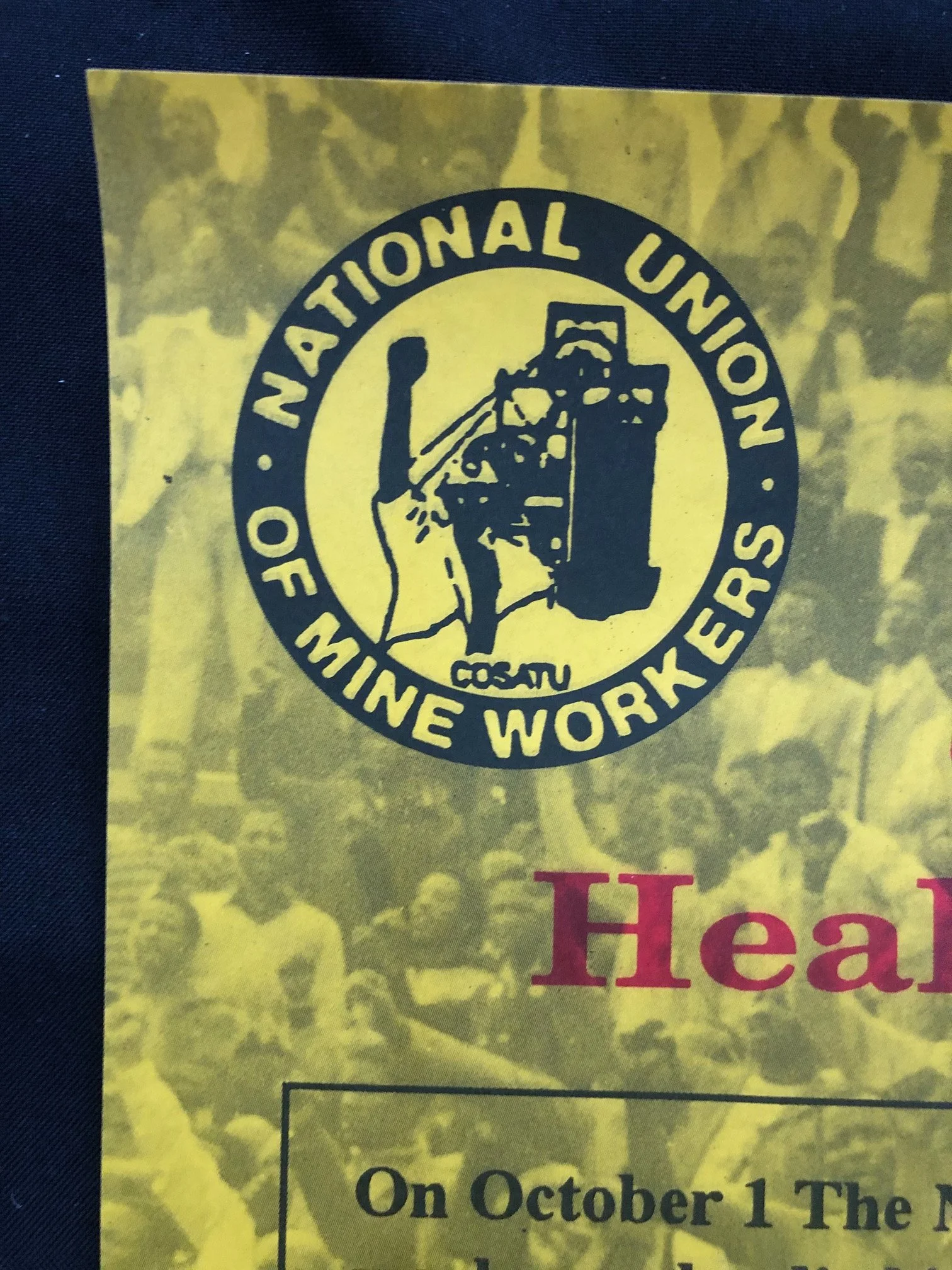
The Logo: In the top corners is the NUM logo, featuring a miner with a hardhat wielding a pickaxe. Underneath the graphic, it notes its affiliation with COSATU (the Congress of South African Trade Unions), which was a massive pillar of the internal resistance against the apartheid government.
"ORGANISE... OR DIE": The stark red slogan at the bottom was not a metaphor. For Black South African miners under apartheid, failing to unionize and demand structural changes literally meant facing fatal working conditions daily.
420mm x 600mm
Good condition
R3,500