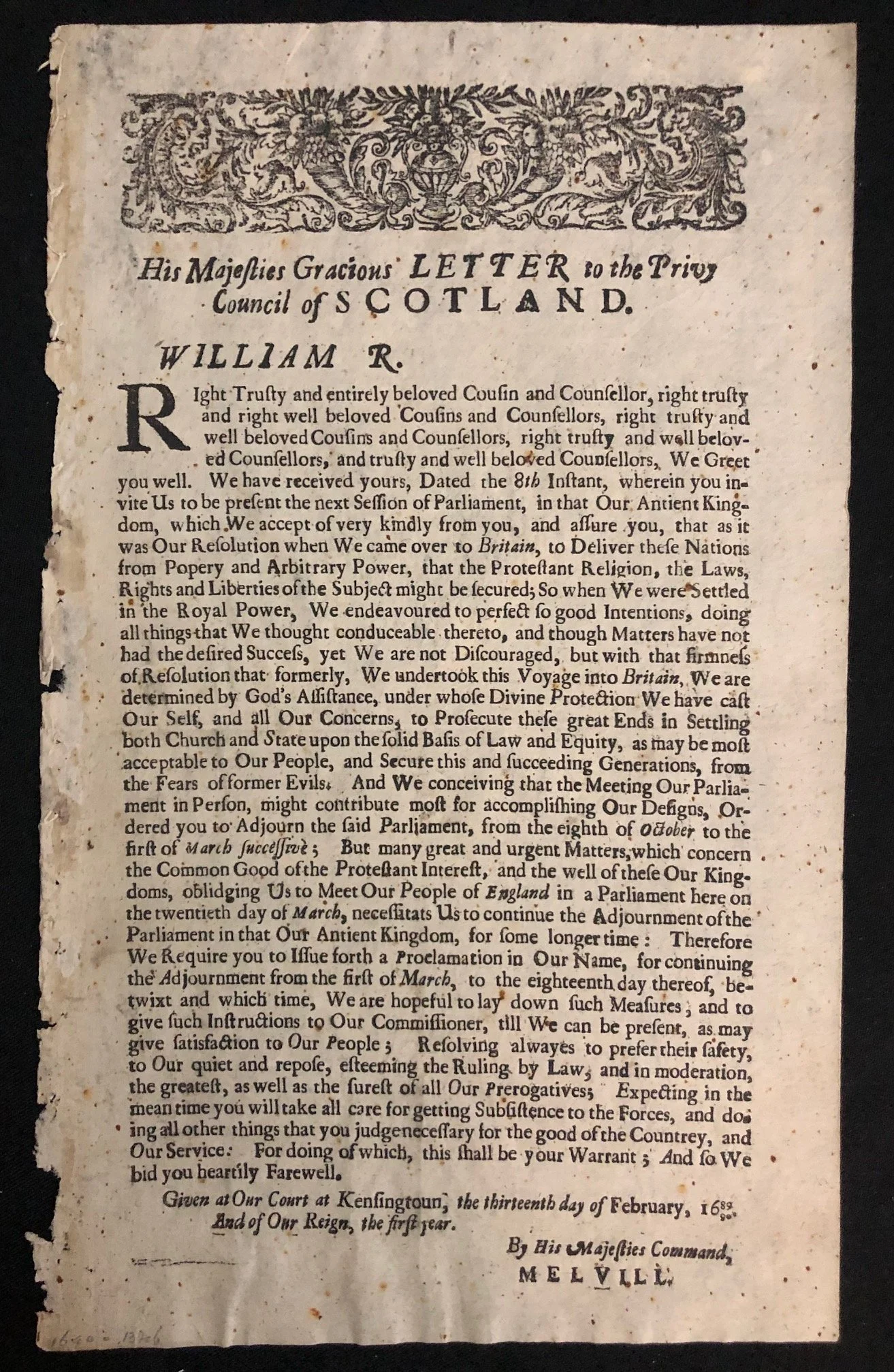
Broadside: King William III (William of Orange) - Scotland (1690)
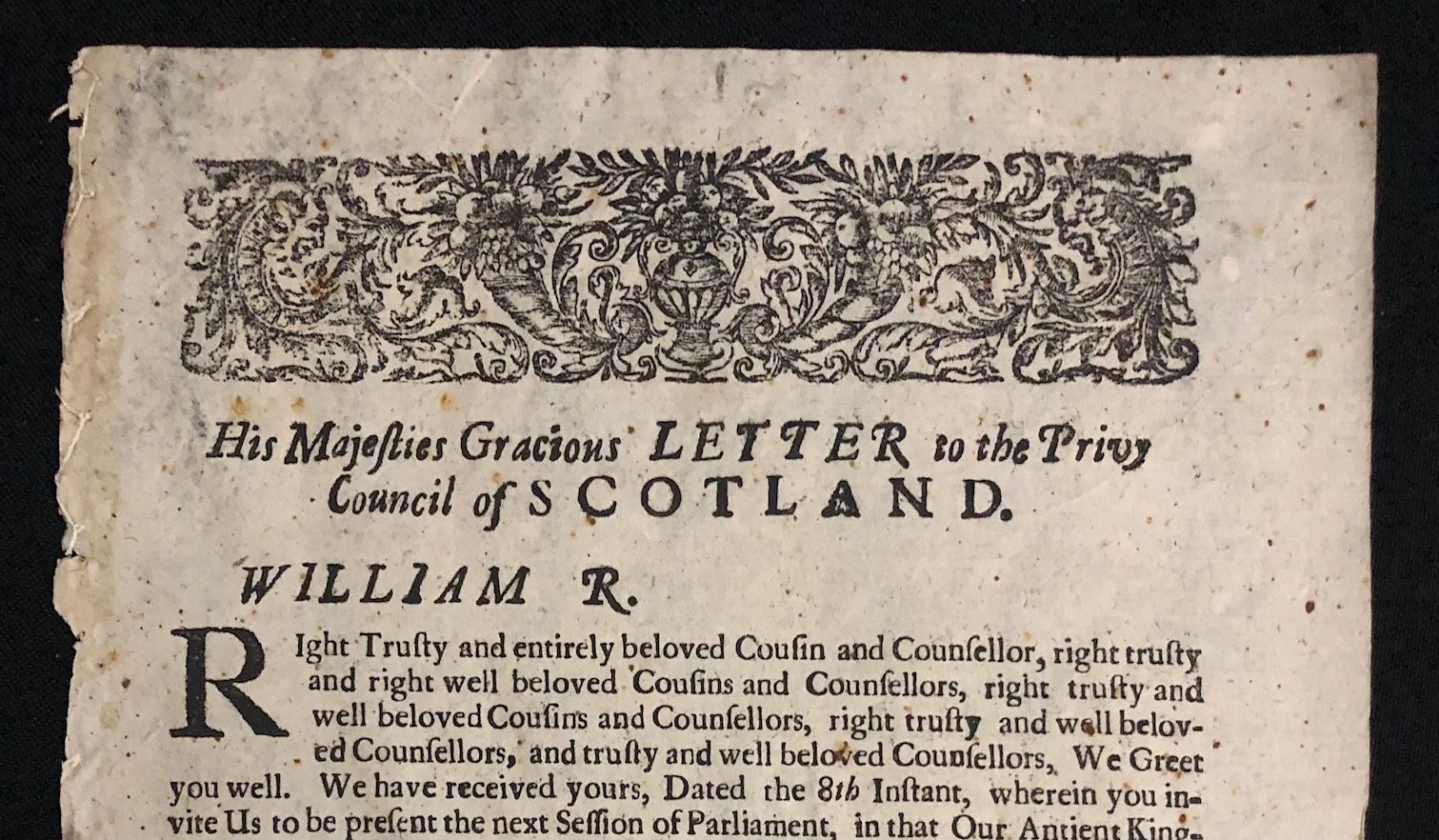
This rare 17th-century broadside is from the Glorious Revolution of 1688–1689. It captures a precarious moment when the newly crowned King William III (William of Orange) was attempting to consolidate power over a highly fractured and volatile Scotland.
Navigating the "Old Style" Calendar and a Crucial Date
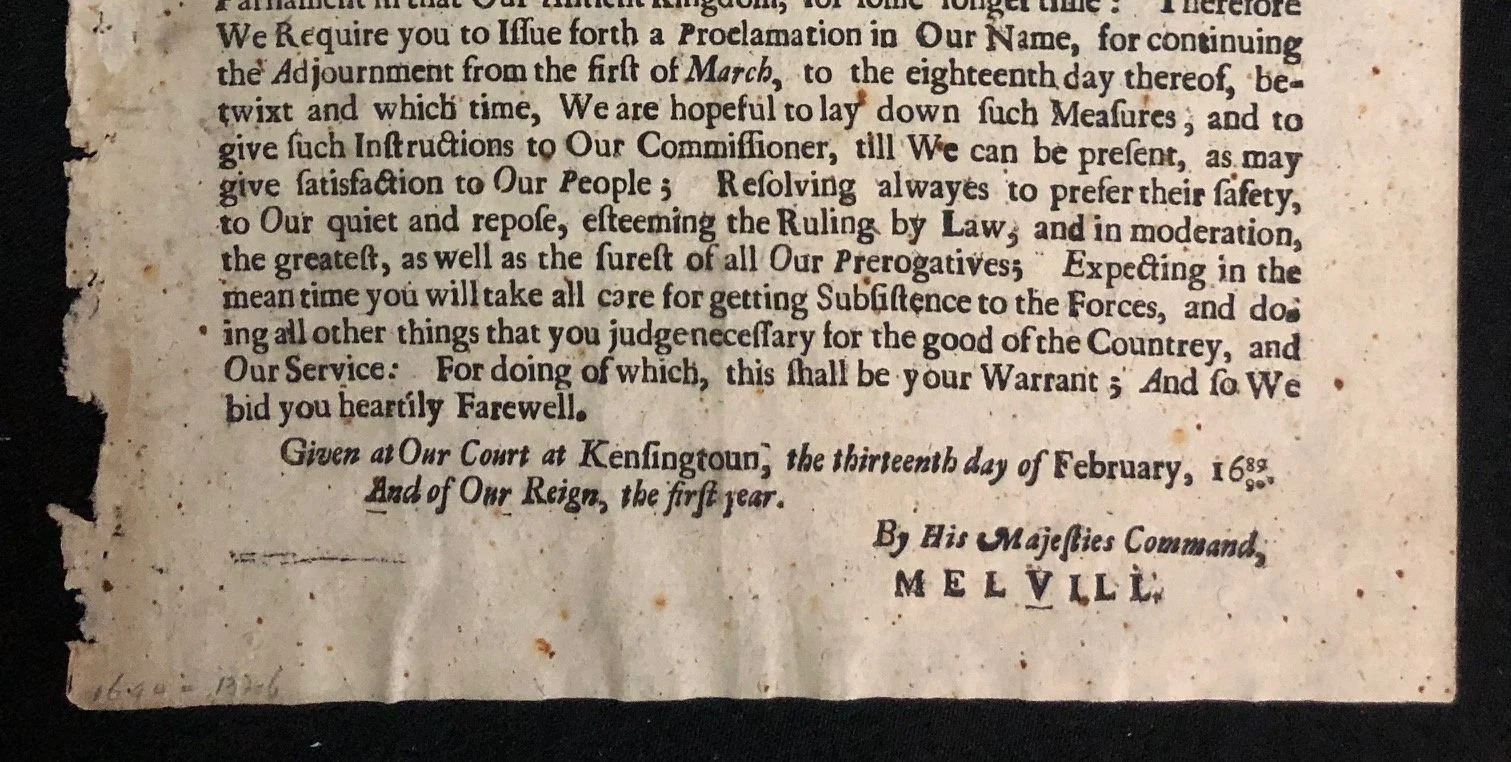
The letter it is dated: “Given at Our Court at Kensingtoun, the thirteenth day of February, 1689/90 and of Our Reign, the first year.”
The split year 1689/90 is a classic example of Julian Calendar (Old Style) dating. At the time, the legal New Year in England and Scotland did not begin until March 25th. Today we would consider this February 1690, but to contemporaries it was still the tail end of 1689.
This specific date—February 13—carries immense symbolic weight. Exactly one year prior, on February 13, 1689, William and Mary had accepted the Declaration of Rights to officially become monarchs of England. By dating this Scottish decree on that anniversary, William was reinforcing his legitimate "Settling in the Royal Power."
The Scottish Tinderbox and the Highland Crisis
In the text, William explains that he must adjourn the Parliament in Scotland because:
“...matters, which concern the Common Good of the Protestant Interest... obliging Us to Meet Our People of England in a Parliament here... necessitats Us to continue the Adjournment...”
Behind this polite bureaucratic language lay a massive military and political crisis. While England had transitioned to William's rule relatively peacefully, Scotland was a bloody battleground. Just months before this broadside was printed, the First Jacobite Rising had erupted. High-ranking Scottish clans loyal to the deposed Catholic King James II (led by Viscount Dundee) had slaughtered Williamite forces at the Battle of Killiecrankie.
William was forced to repeatedly delay and adjourn the Scottish Parliament because he simply could not manage a defiant Scottish assembly while simultaneously funding a war in the Highlands and preparing for another massive campaign against James II in Ireland (which would culminate in the Battle of the Boyne later that year).
The Counter-Signature: Lord Melville
The document is signed (printed) at the bottom by MELVILL (George Melville, 1st Earl of Melville).
Melville was a staunch Presbyterian who had previously been implicated in the Rye House Plot against Charles II and had fled into exile to Holland with William of Orange. When William took the throne, he appointed Melville as his Secretary of State for Scotland. Melville’s presence on this document was a direct signal to the Scottish political elite that the new regime was firmly aligned with Presbyterian interests and determined to dismantle "Popery and Arbitrary Power."
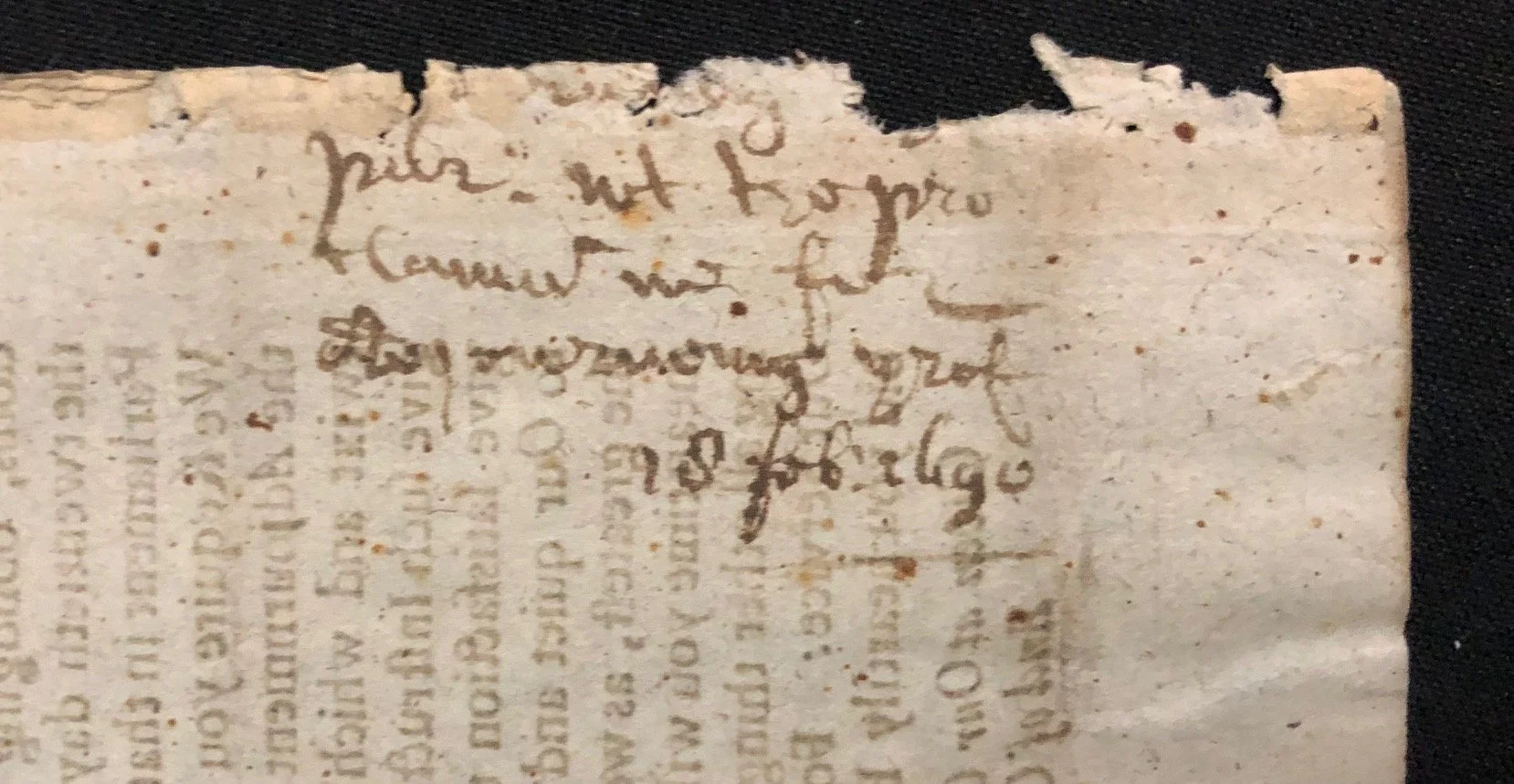
The Contemporary Archival Note
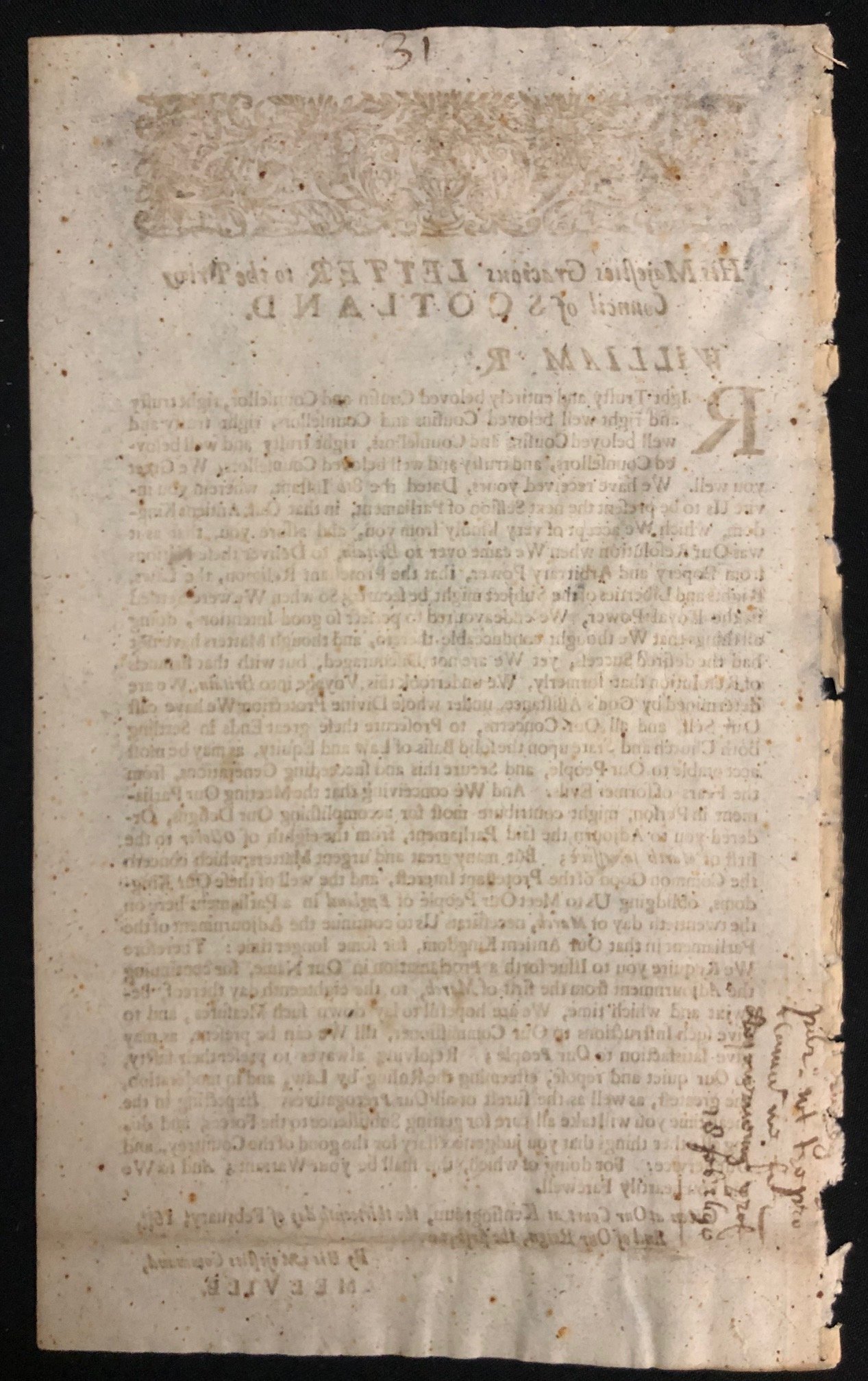
Turned upside down on the reverse side and magnified there is a beautiful piece of contemporary 1690 handwriting.
It reads:
“pnt. [presented] wt [with] the pro[clation] / Anent [concerning] the ... / ... / 28 Feb: 1690”
This note indicates that it took 15 days for this royal decree to be printed in London, carried by horseback along the Great North Road to Edinburgh, and officially presented/filed by a Scottish official or clerk on February 28th.
This document is a remarkable survivor from the months when the modern constitutional makeup of Great Britain was being hammered out through warfare, religious strife, and tense executive decrees.
172mm x 280mm
Offsetting of text on the back; right edge torn; some mellowing of the paper.
R3,500