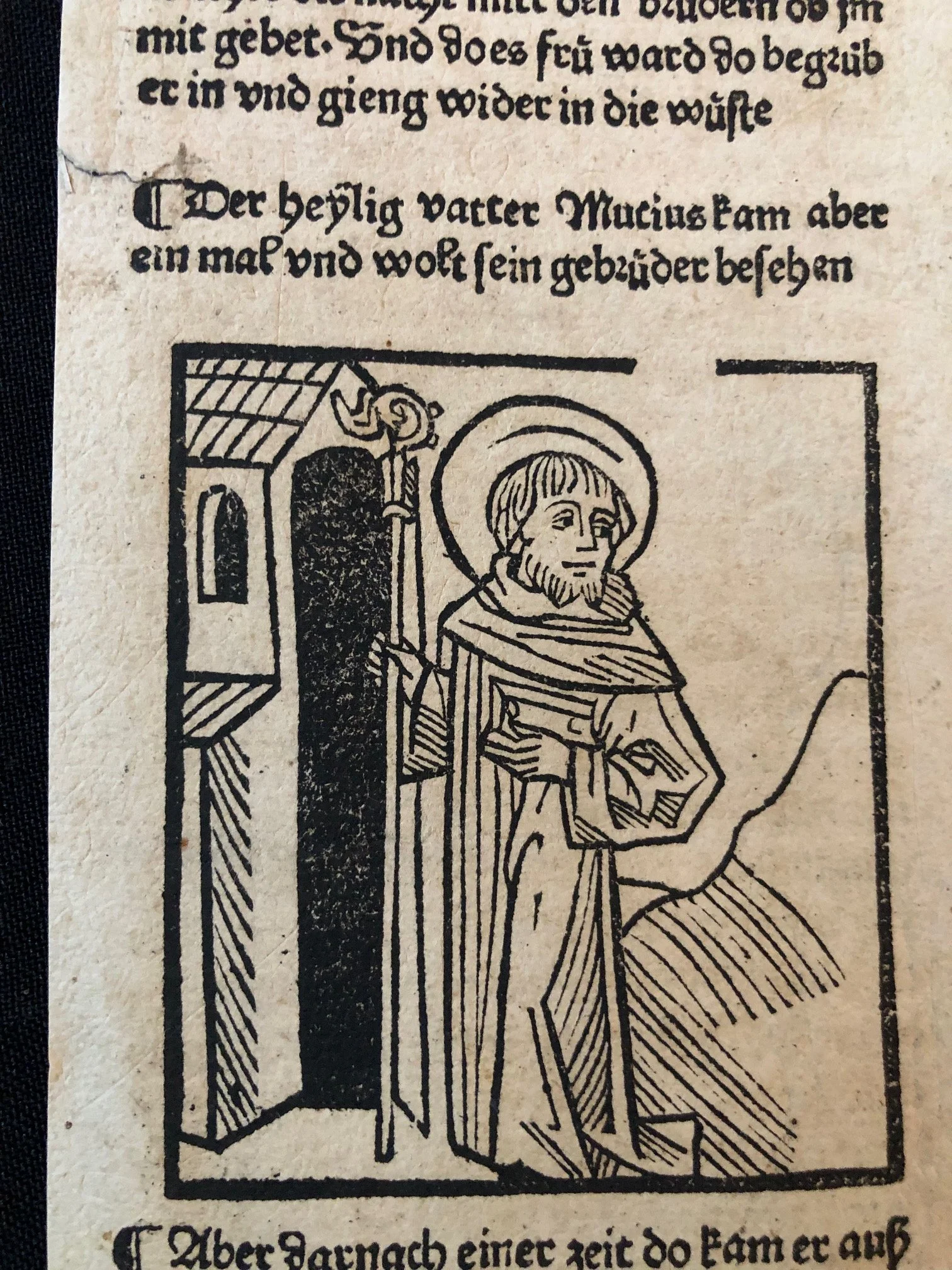
A leaf regarding The Life of the Holy Father Mucius (c.1500)
A leaf from a German edition of the "Lives of the Saints" or "Lives of the Desert Fathers" (Das Buch der Heiligen or Das Leben der Altväter). Specifically, these pages detail the life and miracles of Saint Mucius (often identified as Mutius or Mucius the Hermit).
The Life of the Holy Father Mucius (Mucius/Mutius), Folio Number: lxiiij (64) c. 1480–1510
This leaf is a significant artifact of early printing history, representing the transition from manuscript culture to the mass-produced religious "bestsellers" of the Reformation era.
Page 1
A woodcut depicts Saint Mucius standing before a monastic or hermit's cell. He holds a pastoral staff or crutch, symbolizing his authority and ascetic lifestyle. He is portrayed with a halo, wearing traditional monastic robes.
The text describes Mucius visiting his brothers. He encounters a monk who is "unsteady" and nearing death. The monk, filled with fear of death and regret for a life poorly lived, begs for mercy. Mucius prays for the monk. The text notes that the monk's health is restored ("stund der bruder gesund auf") and he praises God. After three years of living a holy life under Mucius's guidance, the monk dies a "peaceful sleep," having been redeemed.
Page 2
A woodcut depicts Mucius being tempted by a Demon. The demon is shown with horns, animal-like ears, and clawed feet, offering something to the Saint (likely food or gold, as mentioned in the text). Mucius is shown in a prayerful or resistant posture.
The heading reads: "Hie versuchten die bösen geyst den heiligen vater Mucium mit essen" (Here the evil spirits tempted the holy father Mucius with food). The text describes how, during a long fast, the devil appeared as a messenger of God, bringing white bread, fish, and meat. Mucius recognizes the deception, and the food vanishes into "unclean" waste. Another temptation is described where the devil offers gold, silver, and the "treasures of Pharaoh." Mucius rejects these, telling the devil to take his "perishing goods" with him to eternal damnation. The page concludes with a brother having a vision of a "wunniɡlecher jungling" (a blissful youth/angel) holding a book with golden letters, reinforcing the truth of the stories told by the elders.
This is a rare and fascinating example of an Incunable (a book printed before 1501) or a very early 16th-century German woodcut book. The text is written in Early New High German (Frühneuhochdeutsch) and utilizes a classic Schwabacher or Fraktur typeface.
Some stains, tears, worm hole.
180mm x 277mm
R3,500