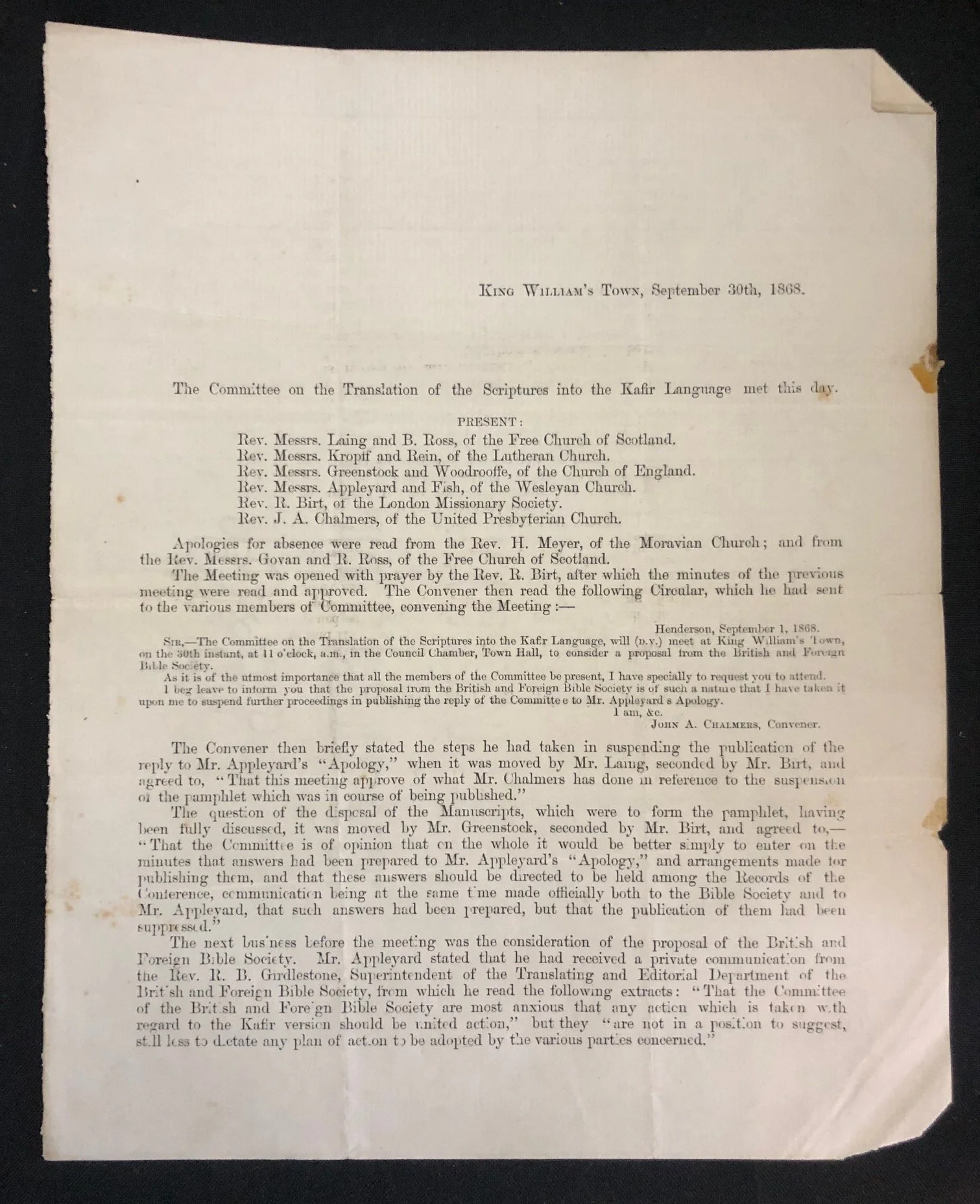
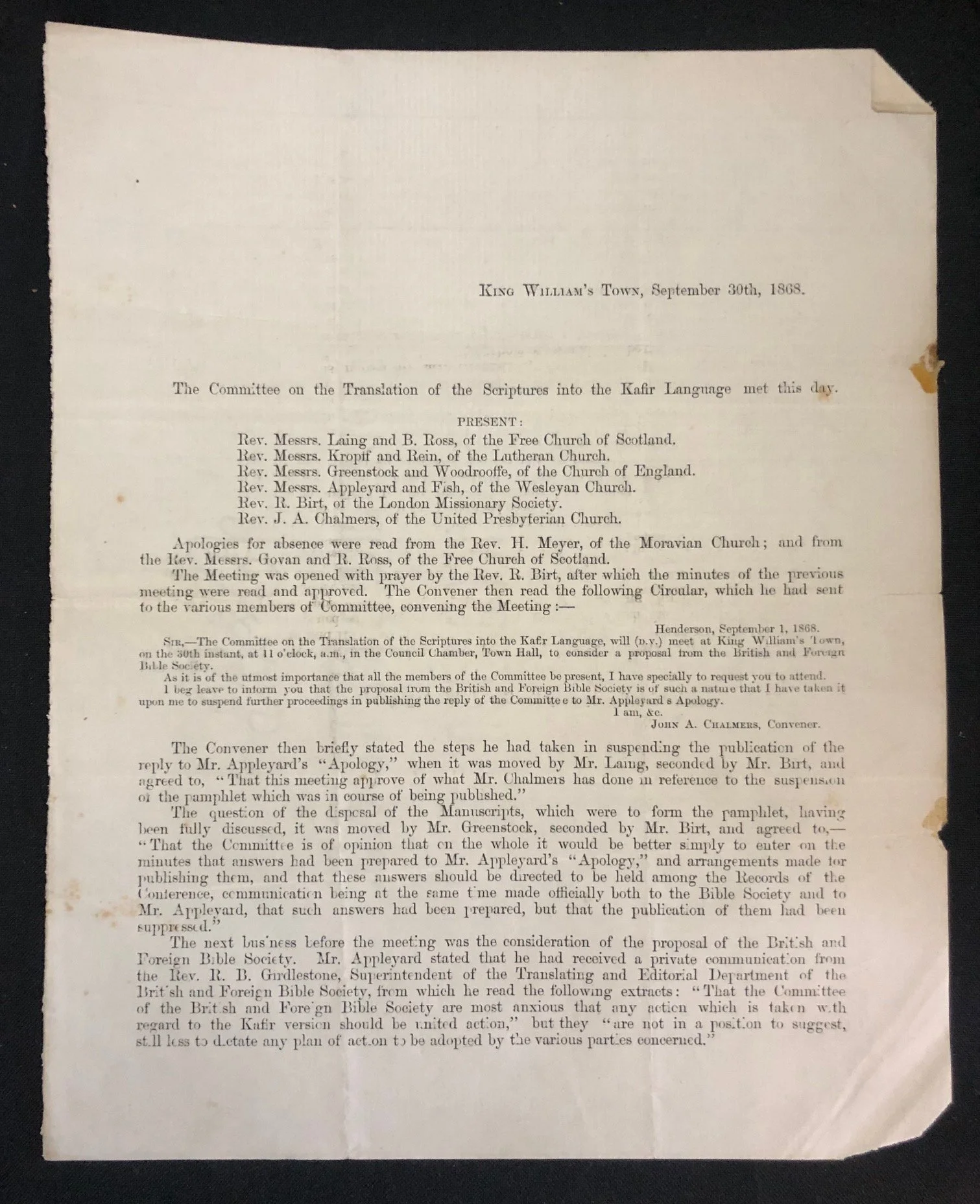
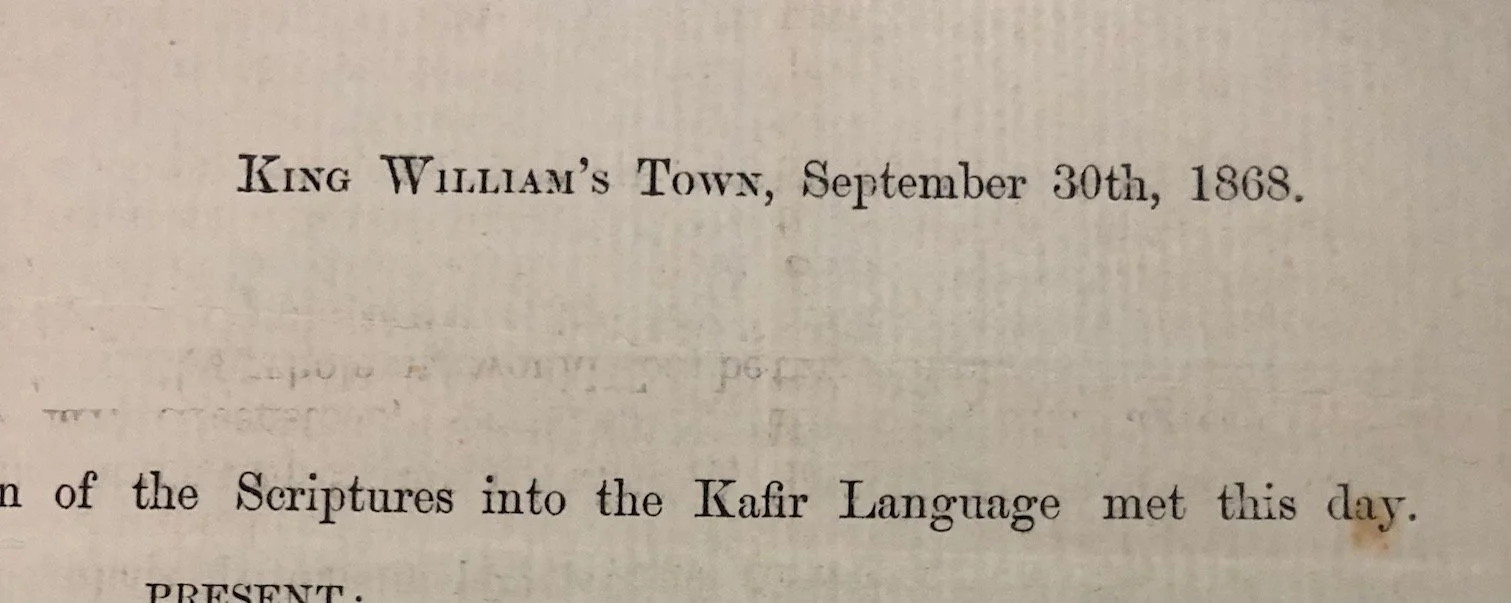
Xhosa Language: printed minutes dated September 30th, 1868.
This document shown is a significant piece of South African linguistic, cultural, and printing history. This printed minutes sheet, dated September 30th, 1868, from King William’s Town, captures a critical turning point in the standardization and translation of the isiXhosa language (referred to in the period's colonial terminology as the "K* language").
Rather than a simple administrative record, these pages document a fierce, decades-long intellectual and theological war that shaped South African orthography.
The "Appleyard Bible" Controversy
To understand what is happening in this meeting, you have to look at the name closing the session, the Rev. J. W. Appleyard.
John Whittle Appleyard was a Wesleyan missionary and a brilliant linguist who, in 1859, completed the monumental task of translating and printing the first complete Bible into isiXhosa at the Mount Coke mission press.
However, his translation triggered an immediate, explosive controversy among rival missionary societies (the Anglicans, Presbyterians, and Glasgow Missionaries represented on this committee). Critics, led by figures like Tiyo Soga (the first ordained Black Presbyterian minister) and the men present in this meeting—such as John A. Chalmers and Charles Brownlee (the noted scholar/official)—argued that Appleyard’s Wesleyan translation was too literal, lacked idiomatic Xhosa flavor, and relied on a flawed grammatical framework.
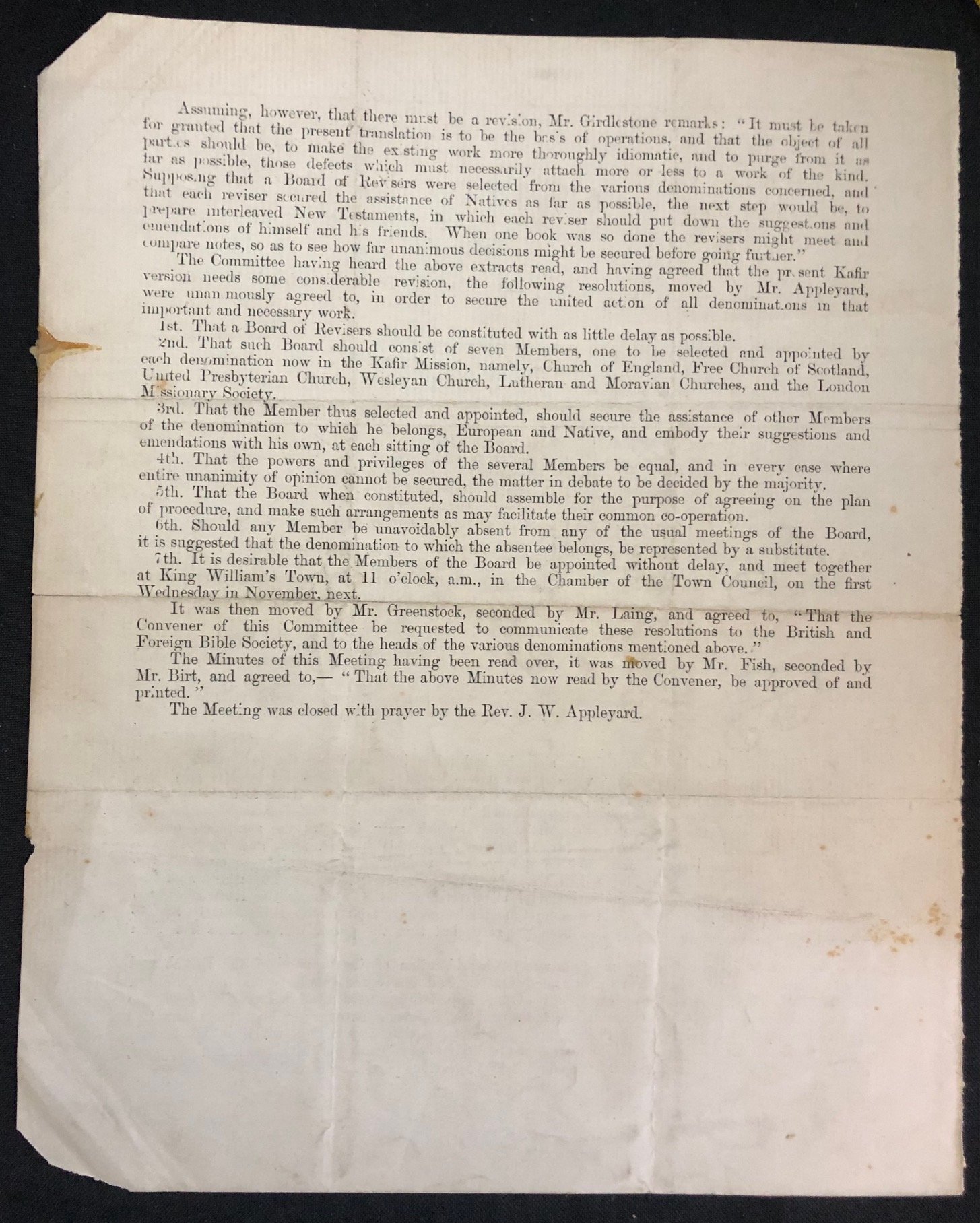
This specific 1868 document records the exact moment the British and Foreign Bible Society stepped in to force a truce, demanding a unified, pan-denominational Board of Revisers to overhaul the text.
The Frontier Mission Presses: King William’s Town and Mount Coke
The location at the top of the page, King William's Town—was the administrative and military hub of the tumultuous Eastern Cape Frontier. During the 19th century, this region became one of the most active hubs of indigenous language printing in the Southern Hemisphere.
Missionaries realized that military force alone would not colonize the frontier; they needed to master the vernacular. These minutes are a physical product of that highly specialized local printing ecosystem, likely typeset and run off on a small mission press or early local newspaper press (like that of the King William's Town Gazette) under intense resource constraints, as evidenced by the uneven type alignment and layout.
The Structural Erasure and Invisible Agency of Indigenous Scholars
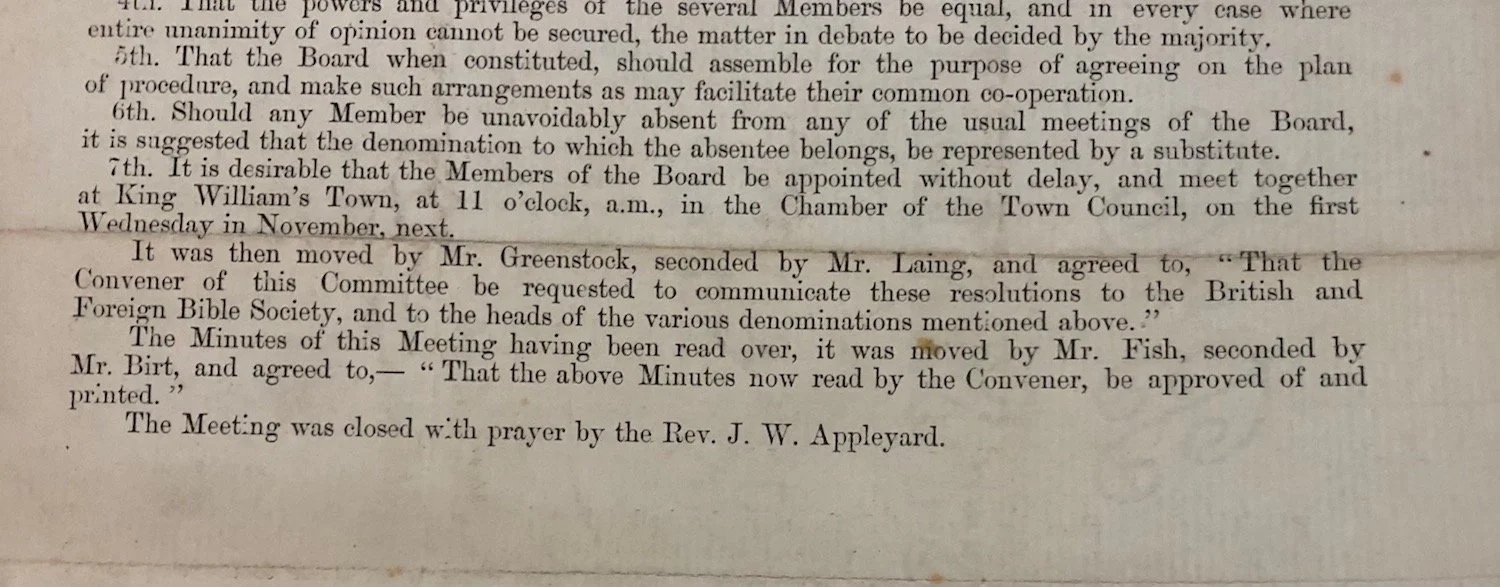
A deeply telling historical element appears in the resolutions. The 2nd and 3rd resolutions state that the Board will consist of seven white European ministers representing different churches, but adds:
"That the Member thus selected and appointed, should secure the assistance of other Members of the denomination... European and Native, and embody their suggestions..."
While the official history records the names on this page—Chalmers, Appleyard, Laing, Ross, Birt—the actual linguistic heavy lifting of refining the isiXhosa Bible was done by unnamed native speakers, teachers, and evangelists. Figures like Tiyo Soga and later Elijah Makiwane worked alongside these committees to ensure the language was authentic. This document beautifully illustrates the colonial paradox: relying entirely on indigenous intellectual labor while structuring the formal committees to keep decision-making power in European hands.
Rarity as Ephemera
Minutes of committees from this era were printed in incredibly small quantities—often just enough copies for the active participants and a few to be mailed back to the home societies in London or Edinburgh. Because they were unbound, utilitarian working documents, the vast majority were thrown away once the final revised Bible was published in the 1880s. A survival like this, is a foundational document for any collection tracking the history of the book, printing, and linguistics in Southern Africa.
205mm x 260mm
Creased; stained; incorrectly folded; glue marks in the margin.
R3,500