A Page from Aristotle’s De Caelo et Mundo (On the Heavens) c.1500
Incunabula.
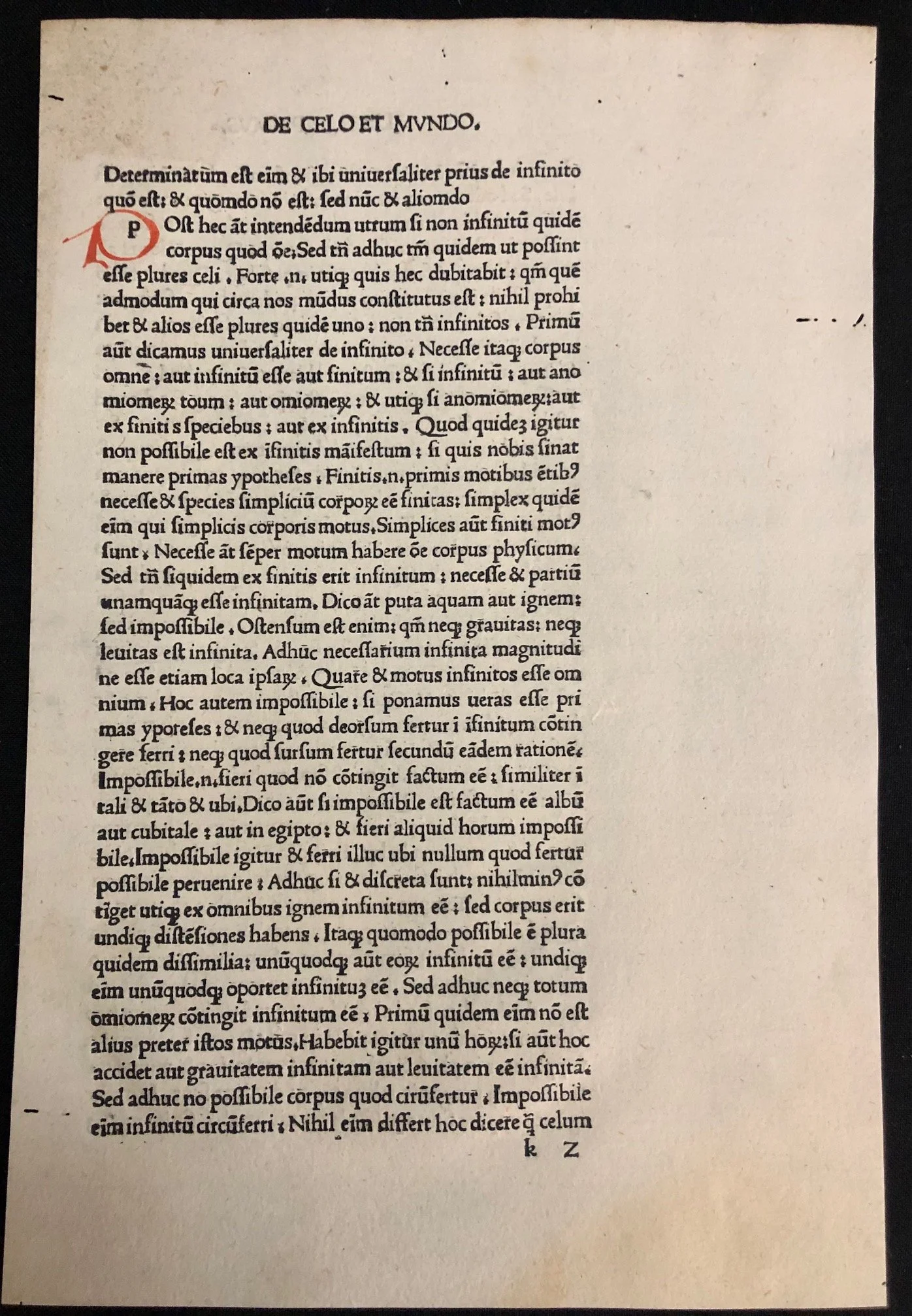
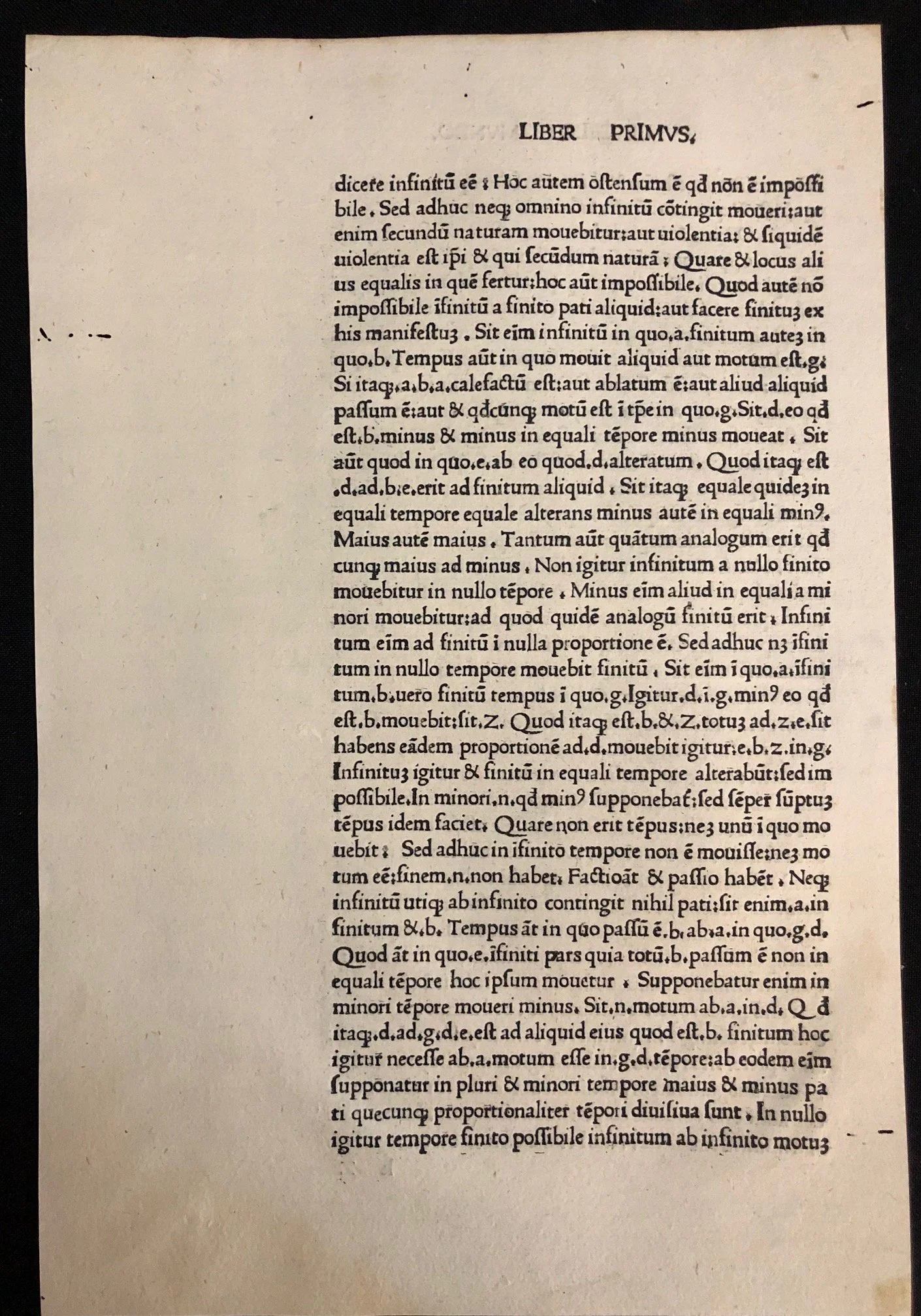
"LIBER PRIMVS" (Book One) of "DE CELO ET MVNDO" is Aristotle's fundamental cosmological treatise where he discusses the nature of the universe, the celestial bodies, and the concept of infinity.
It is set in a Gothic type (blackletter), which was standard for academic and theological texts in the late 15th century, particularly in printing centers like Venice, Lyon, or Basel.
The signature mark "k 2". These guides the bookbinder to ensure the folded sheets (quires) are assembled in the correct order.
There is a hand-painted Lombardic initial "P" in red ink. In early printing, spaces were often left blank for a "rubricator" to add these initials by hand, mimicking the style of medieval manuscripts.
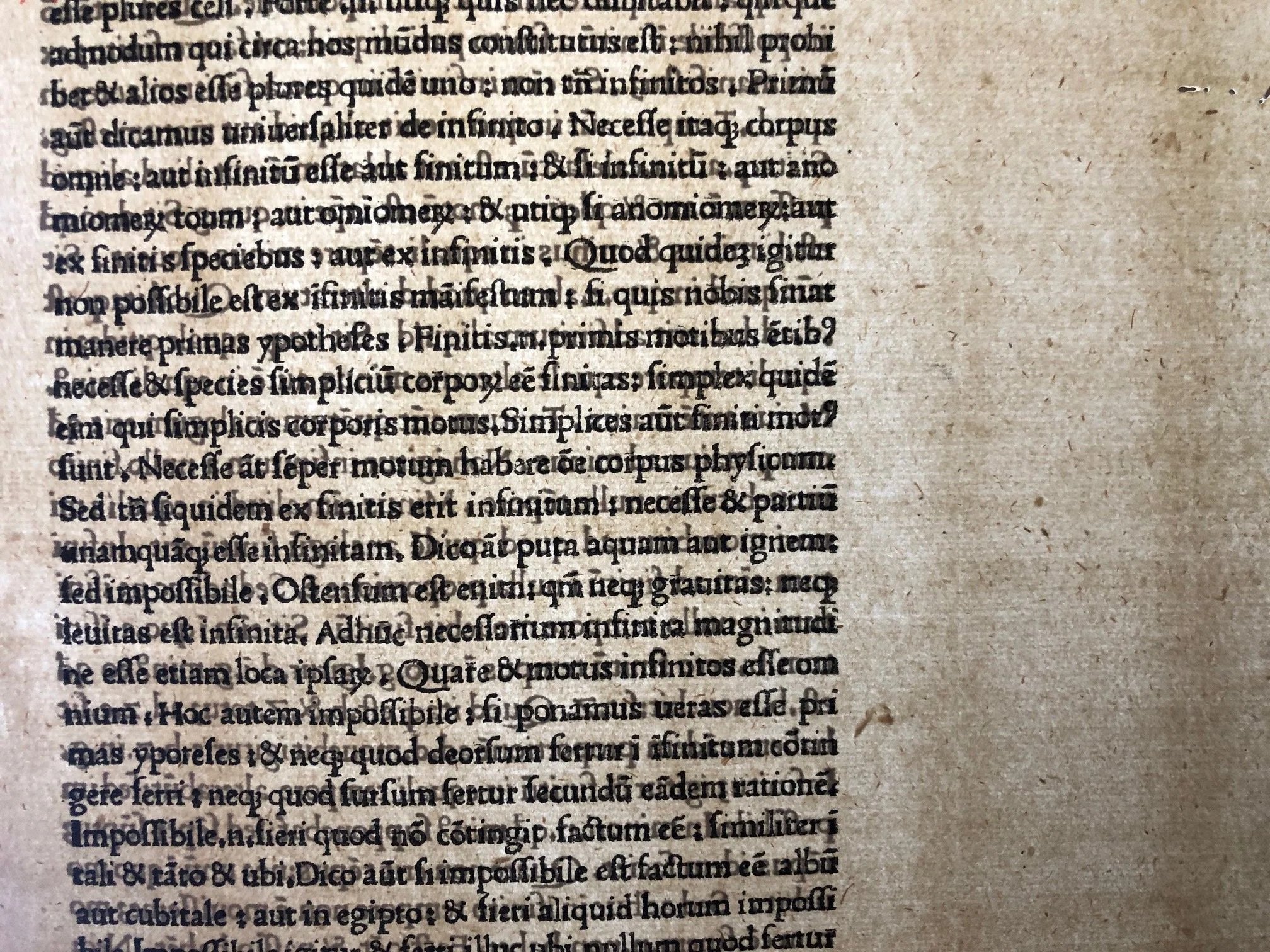
The Latin text deals with one of Aristotle's most famous arguments: the impossibility of an infinite body or infinite motion, exploring the relationship between time, distance, and force, using variables (like a, b, g, d) to demonstrate that if a body were infinite, it could not move in a finite time.
The second page begins with a summary of what has been determined regarding the "infinite" and moves into the specific properties of the "world" (mundus) and the elements (fire, water, etc.).
Minor foxing and slight edge wear.
190mm x 380mm
R10,000