Manuscript Letter: Sir Francis Galton (1909)
This letter is an artifact from the final months of Sir Francis Galton (1822–1911), one of the most brilliant, eclectic, and controversial polymaths of the Victorian and Edwardian eras.
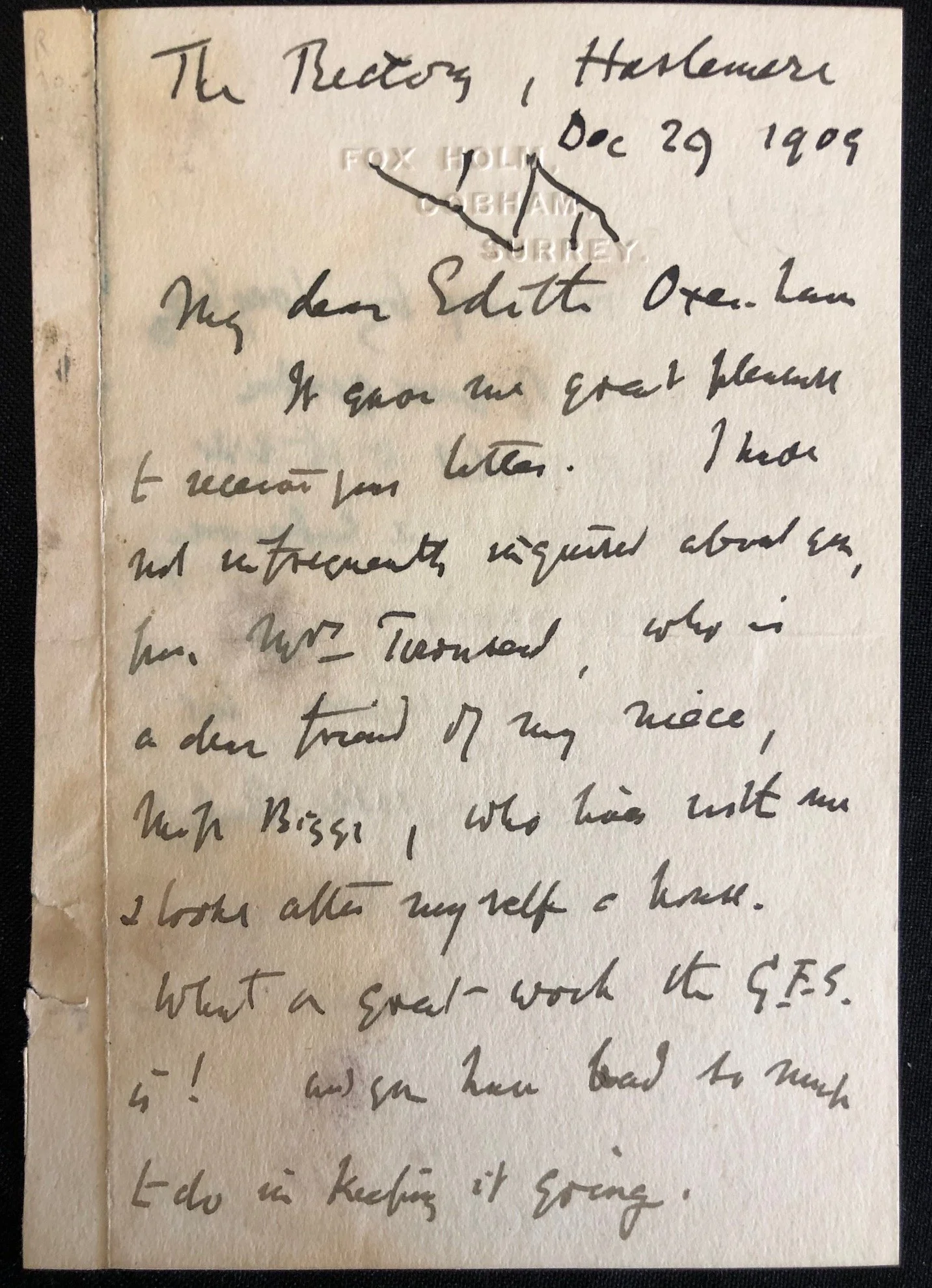
Dated December 29, 1909, this letter captures a giant of 19th-century science at the absolute twilight of his life—written just the same year he received his knighthood, and barely a year before his death in January 1911.
The Mind of a Mapmaker, Even in Decay
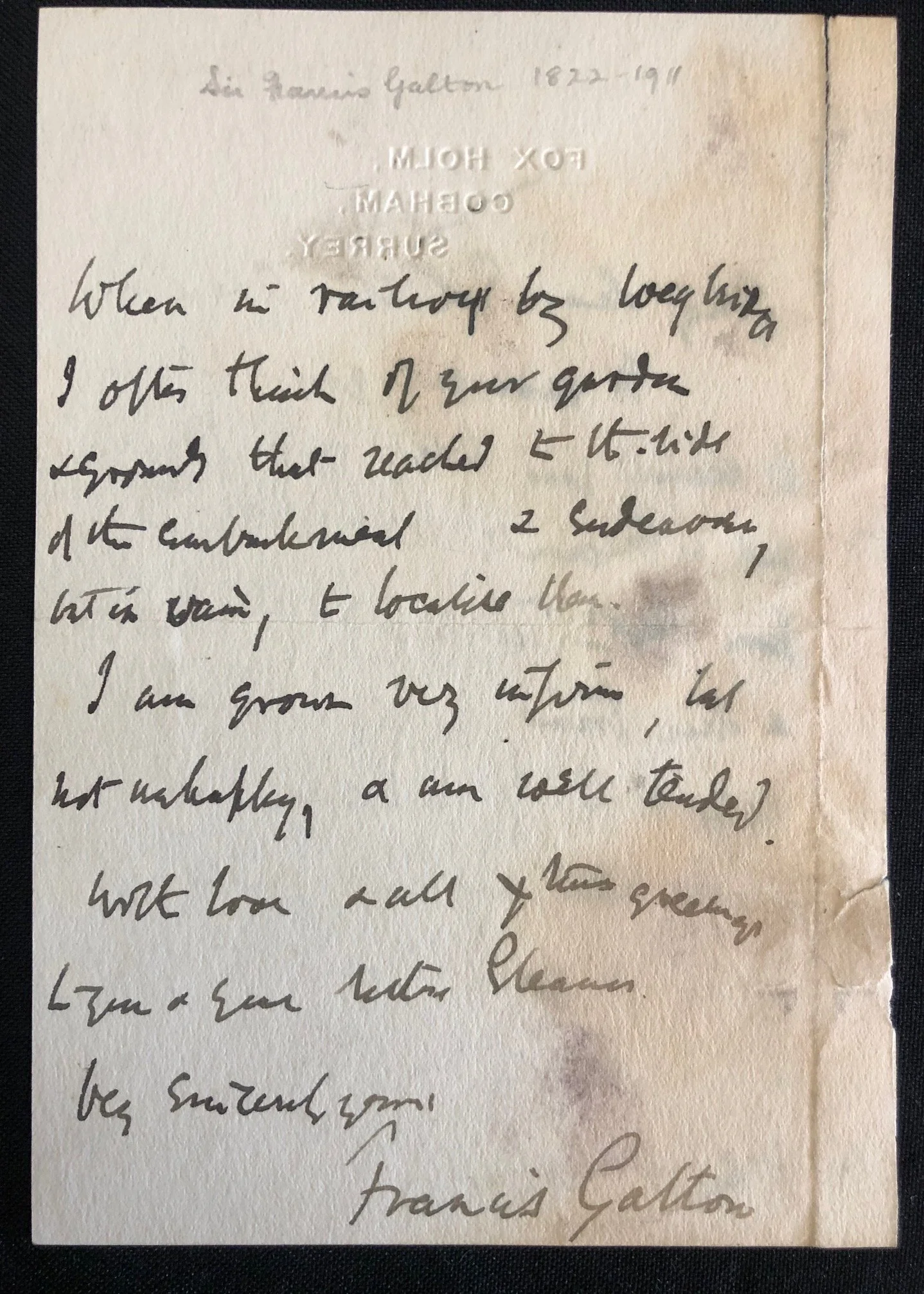
Galton writes a poignant reflection of his physical decline:
"I am grown very infirm, but not unhappily, & am well tended."
Despite his failing body, what makes this letter historically fascinating is how his trademark scientific mind refuses to turn off. Galton remarks that when traveling by train into London, he still tries to visually locate the recipient's old garden near the Thames Embankment: "...and endeavour, but in vain, to localise them."
This instinct to "localise" and map spatial data was the defining trait of Galton's life. He was a pioneering geographer who explored and mapped southwestern Africa in the 1850s, invented the modern weather map (discovering the anticyclone), and spent his life trying to quantify and map every facet of human existence. Even as an infirm octogenarian looking out a train window, he was still mentally processing geography and landscape coordinates.
The Darwin Connection and a Complex Legacy
Galton was a member of the elite intellectual aristocracy of Great Britain—he was the half-cousin of Charles Darwin. Inspired by Darwin’s On the Origin of Species, Galton dedicated his later life to studying human heredity.
While his work yielded foundational breakthroughs that we rely on today, his legacy is deeply double-edged:
The Good: He revolutionized forensic science by creating the first workable system for classifying fingerprints (proving they are unique and permanent). He also pioneered modern statistics, inventing the concepts of correlation and regression toward the mean.
The Dark: His obsession with measuring human traits led him to coin the term "Eugenics" in 1883. He advocated for selective human breeding to improve the genetic stock of society, a philosophy that would later be twisted into devastating 20th-century social engineering programs.
The Girls' Friendly Society (G.F.S.) Connection
Galton praises his correspondent, Edith Oxenham, for her dedication to an organization:
"What a great work the G.F.S. is! and you have had so much to do in keeping it going."
The G.F.S. (Girls' Friendly Society) was a massive, highly influential Anglican philanthropic organization established in 1875. Its primary mission was to protect and support young, unmarried working-class girls who were migrating from rural areas into industrial cities to work in domestic service or factories.
There is an intriguing historical intersection here: while mainstream Victorian philanthropists in the G.F.S. sought to protect working-class girls through Christian morality, housing, and social networks, Galton approached the working classes through the cold lens of statistics, data collection, and demographic tracking.
A Traveling Polymath’s Stationery
The letterhead on the paper reveals a small glimpse into his domestic life. The printed address "Fox Holm, Cobham, Surrey" (the home of his niece, Eva Biggs, who cared for him) is boldly crossed out and replaced by hand with "The Rectory, Haslemere." To escape the brutal London winters that aggravated his bronchitis, Galton spent his final years moving between rented country homes in the south of England, carrying his correspondence paper with him wherever his failing health required him to retreat.
Tide mark stain; edge tear.
110mm x 160mm
R3,000