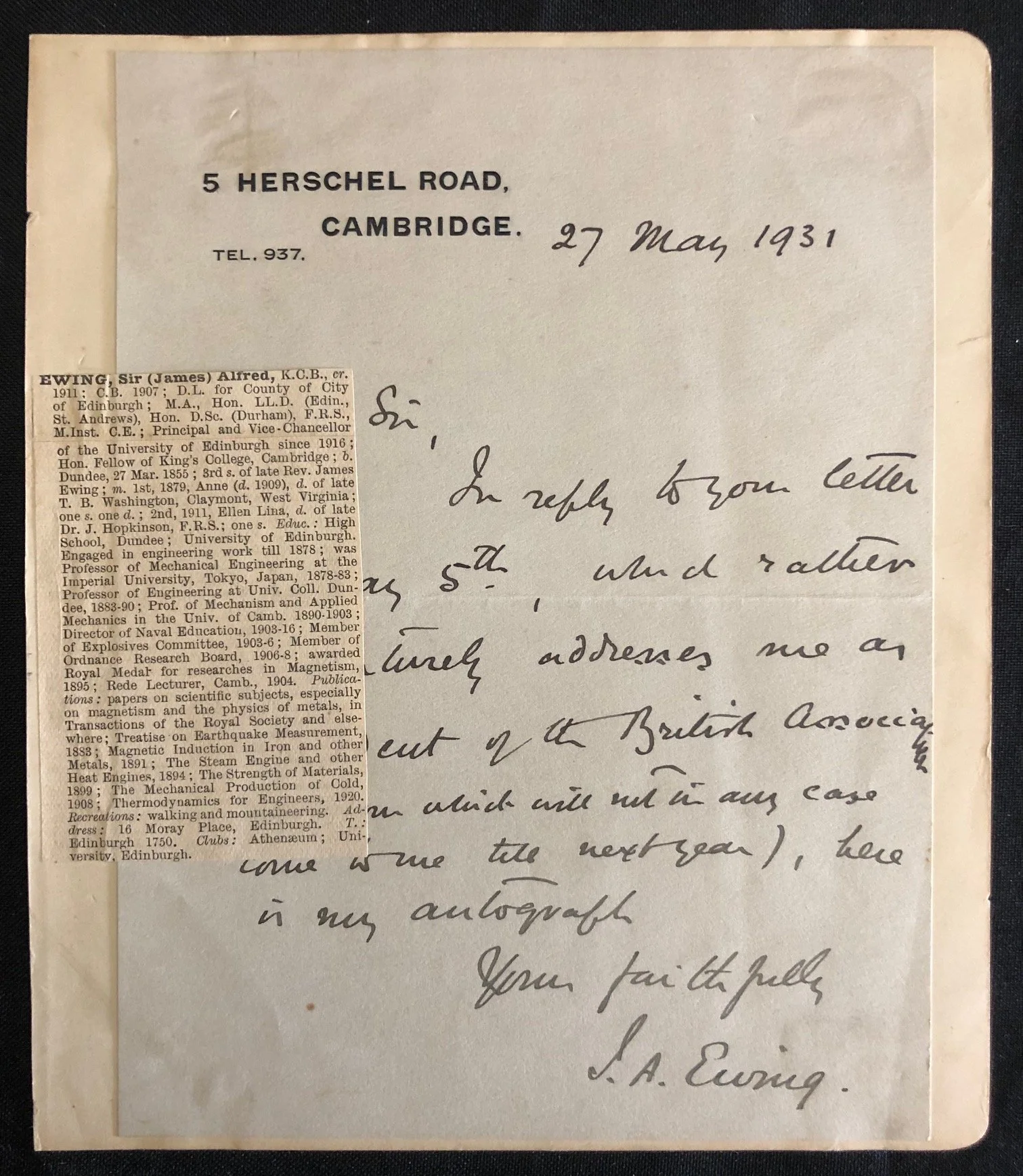
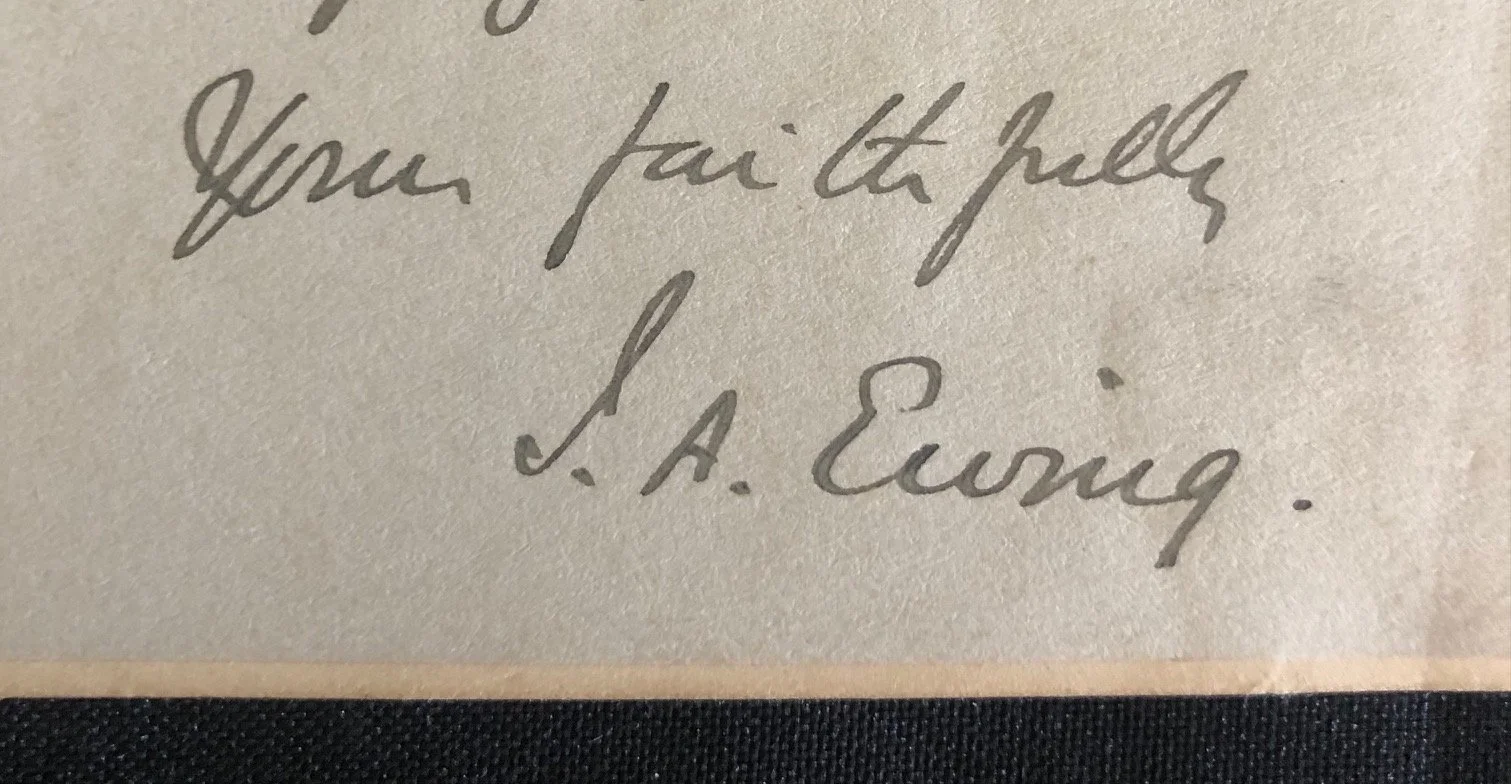
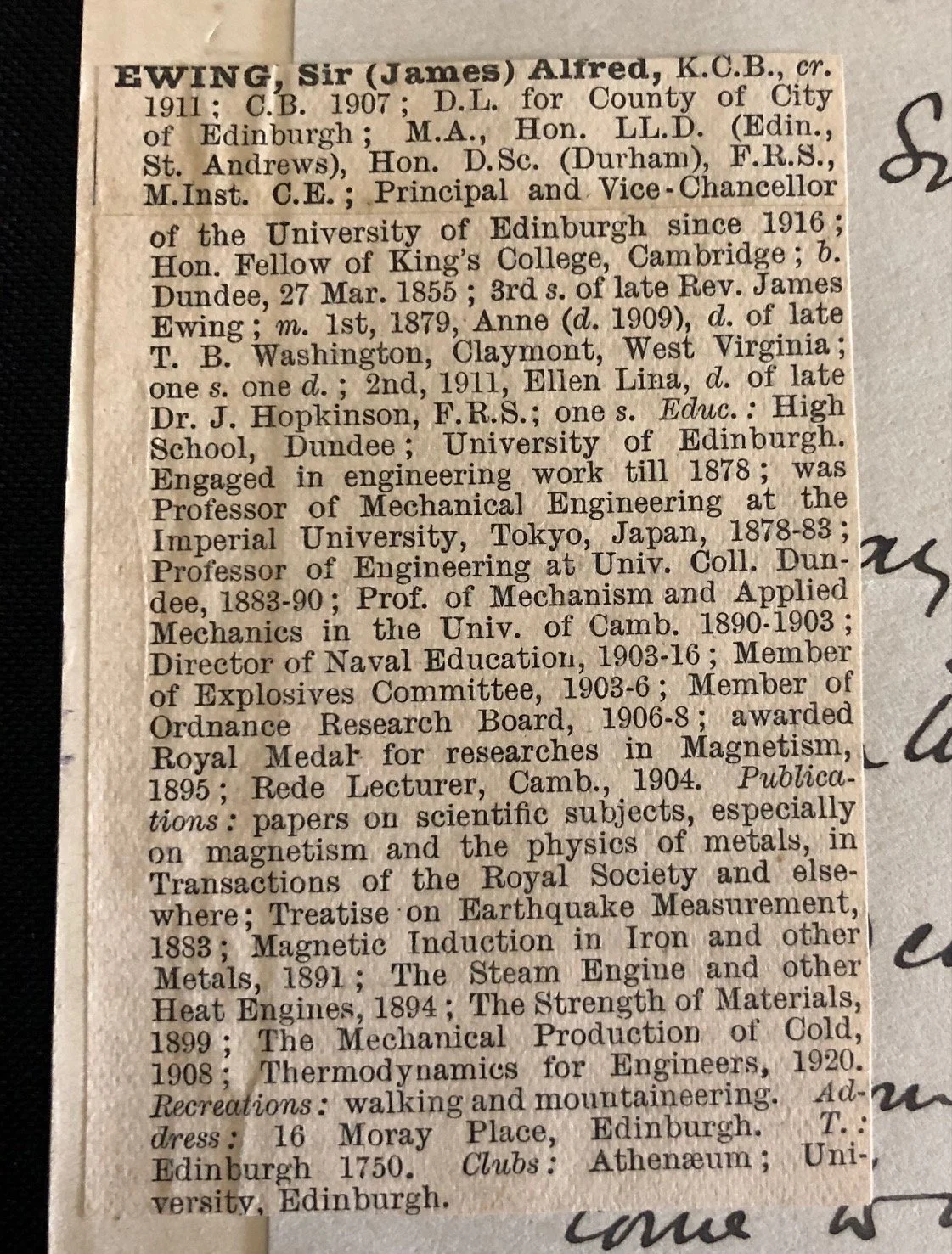
Manuscript Letter: ‘The Cipher King’, Sir James Alfred Ewing (1931)
This letter captures an amusing, modest moment from a man who was quietly one of the most influential figures in British scientific and wartime intelligence history.
In the letter, dated May 27, 1931, Sir James Alfred Ewing gently chides a collector for "prematurely" addressing him as the President of the British Association, noting that the office won't pass to him until the following year. He did indeed go on to serve as the President of the British Association for the Advancement of Science in 1932.
Beyond his presidency of that prestigious association, Ewing is a fascinating historical figure:
WWI's "Cipher King" and Room 40
Though his public profile was that of an elite academic and physicist, during World War I, Ewing was the mastermind behind Room 40—the Admiralty's ultra-secret codebreaking operation.
As its director, he recruited a team of academics, linguists, and chess masters to intercept and decrypt German naval communications.
Under his watch, Room 40 famously intercepted and decoded the Zimmermann Telegram in 1917, a crucial catalyst that helped draw the United States into World War I. His secret work earned him wartime nicknames like "The Cipher King" and "Eavesdropper Ewing."
Coining "Hysteresis"
In the realm of physics and metallurgy, Ewing is celebrated for his classical research into the magnetic properties of metals. He discovered that the magnetization of material lags behind the magnetic force applied to it, and in 1881, he coined the term hysteresis (from the Greek for "lagging behind")—a foundational concept still used in electrical engineering and computing memory today.
Founding Seismology in Japan
As a young man in 1878, Ewing was recruited as an o-yatoi gaikokujin (a foreign expert hired to assist in the modernization of Meiji-era Japan). While serving as a professor of mechanical engineering at Tokyo Imperial University, he became deeply fascinated by earthquakes. Along with colleagues John Milne and Thomas Gray, he co-invented the first modern horizontal-pendulum seismograph, effectively helping to establish the modern scientific study of earthquakes in Japan.
When he signed this brief note in 1931 from his home in Cambridge, his correspondent likely only knew him as a distinguished elder statesman of science—unaware that the polite Scotsman writing to them had also spent years orchestrating Britain's top-secret wartime espionage.
Laid down.
Card size: 160mm x 182mm
R2,000