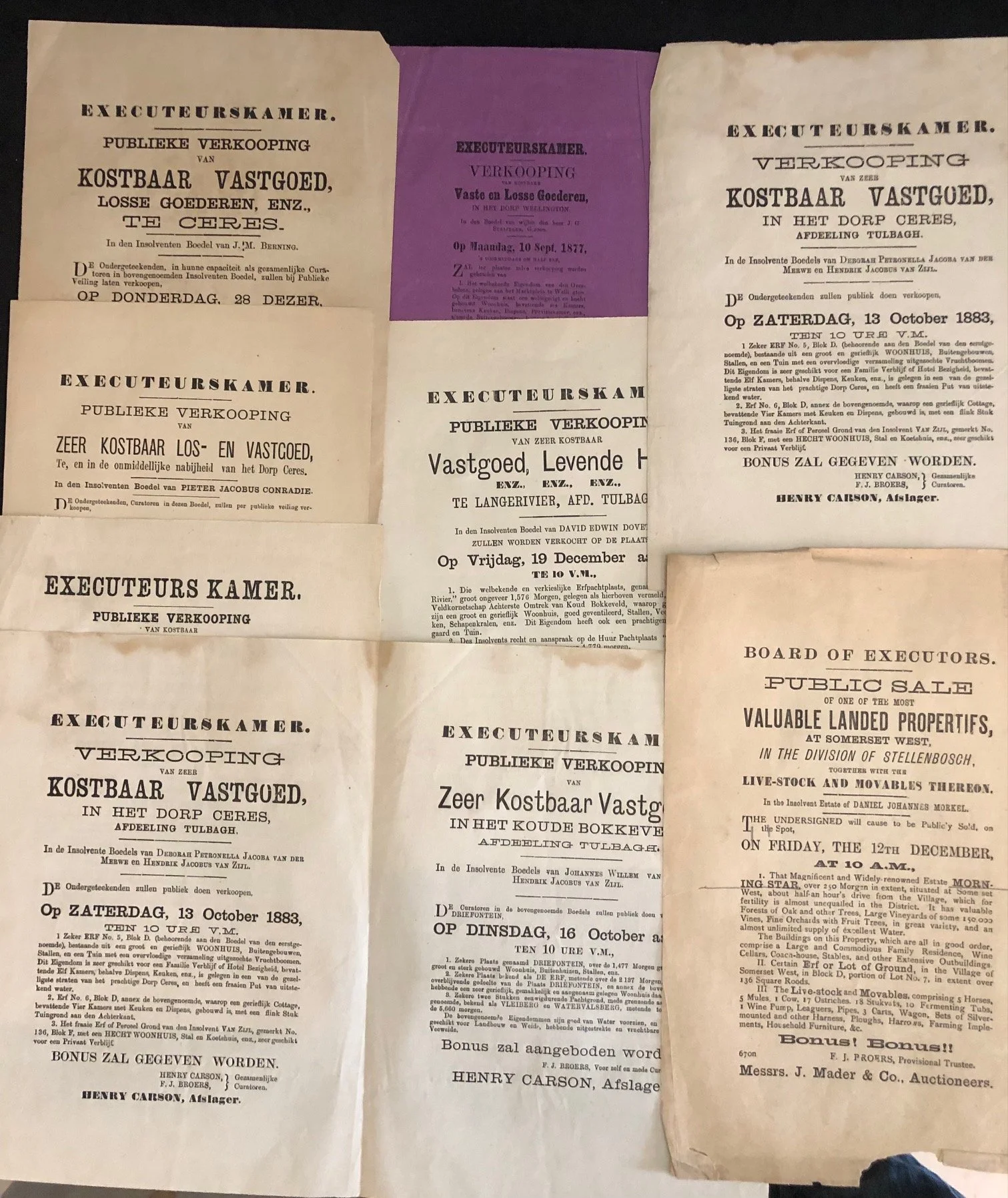
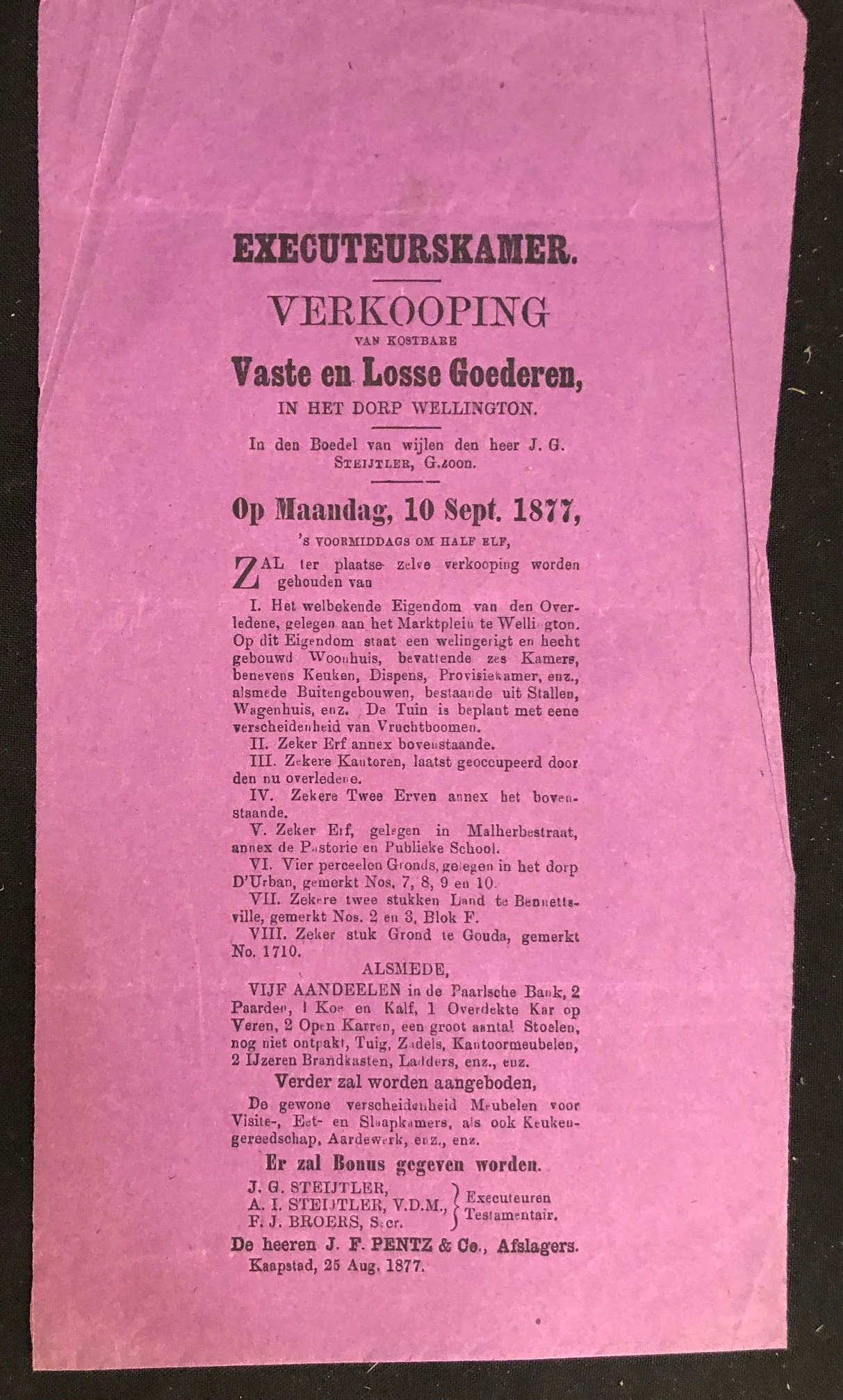
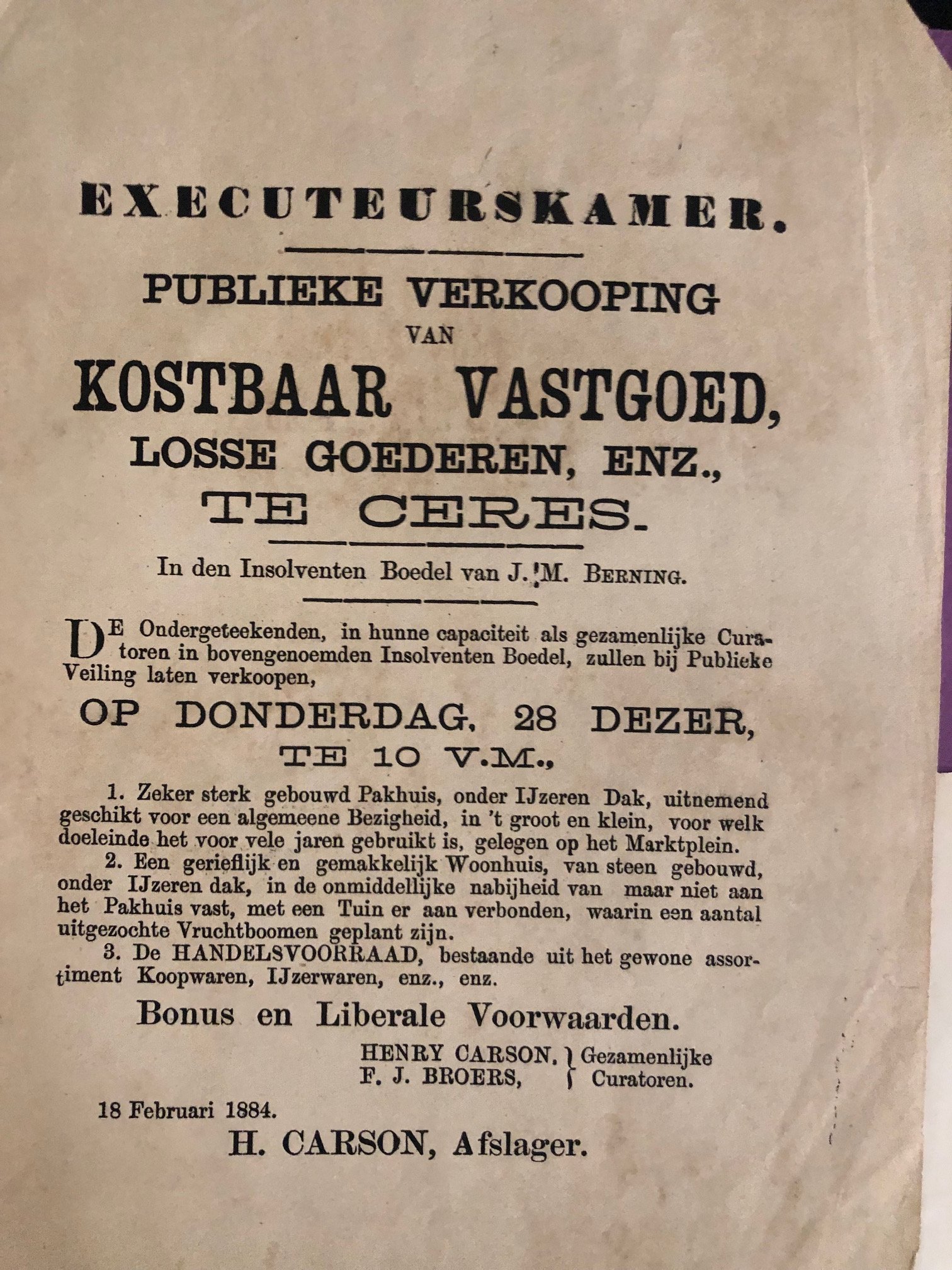
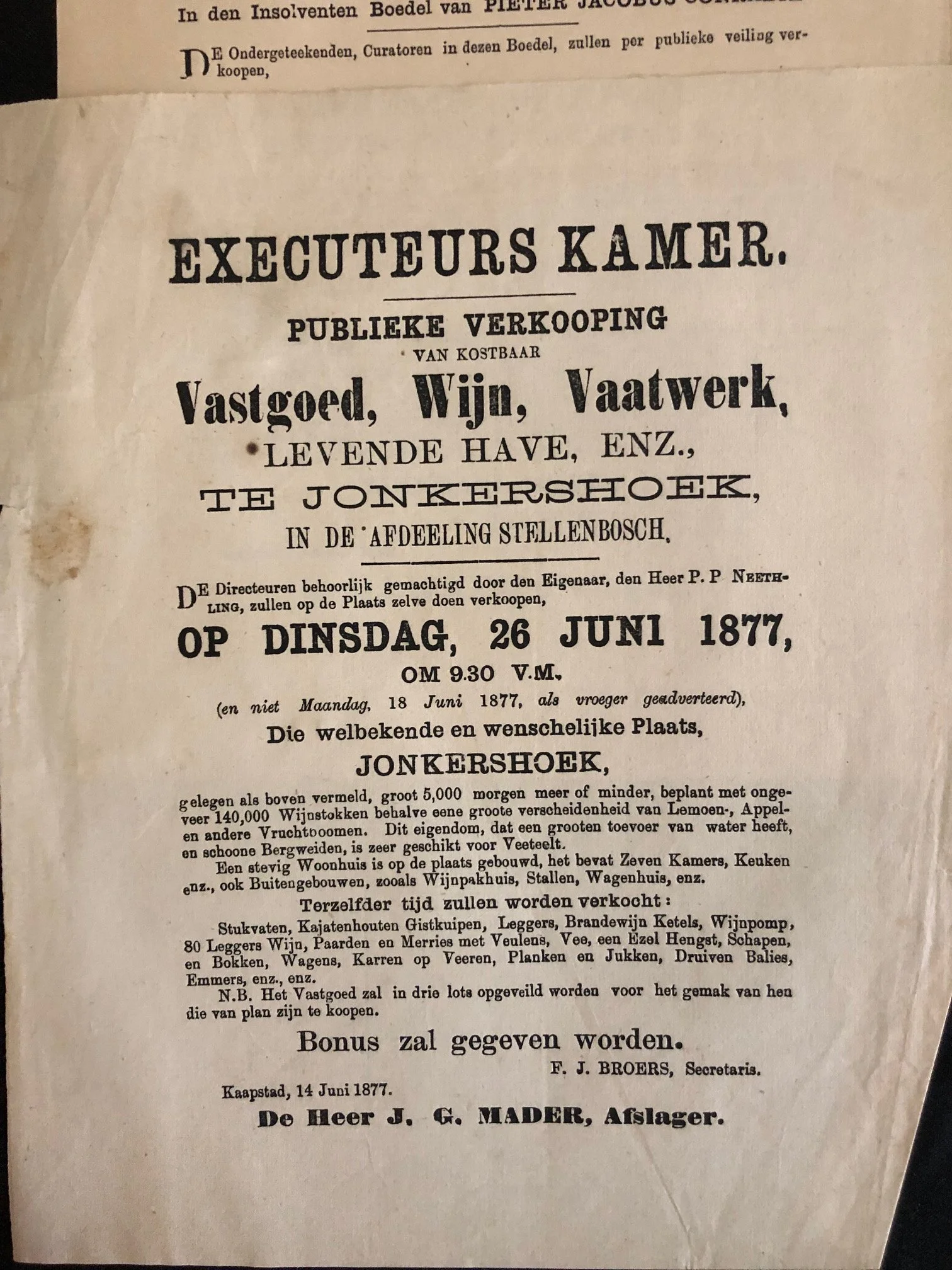
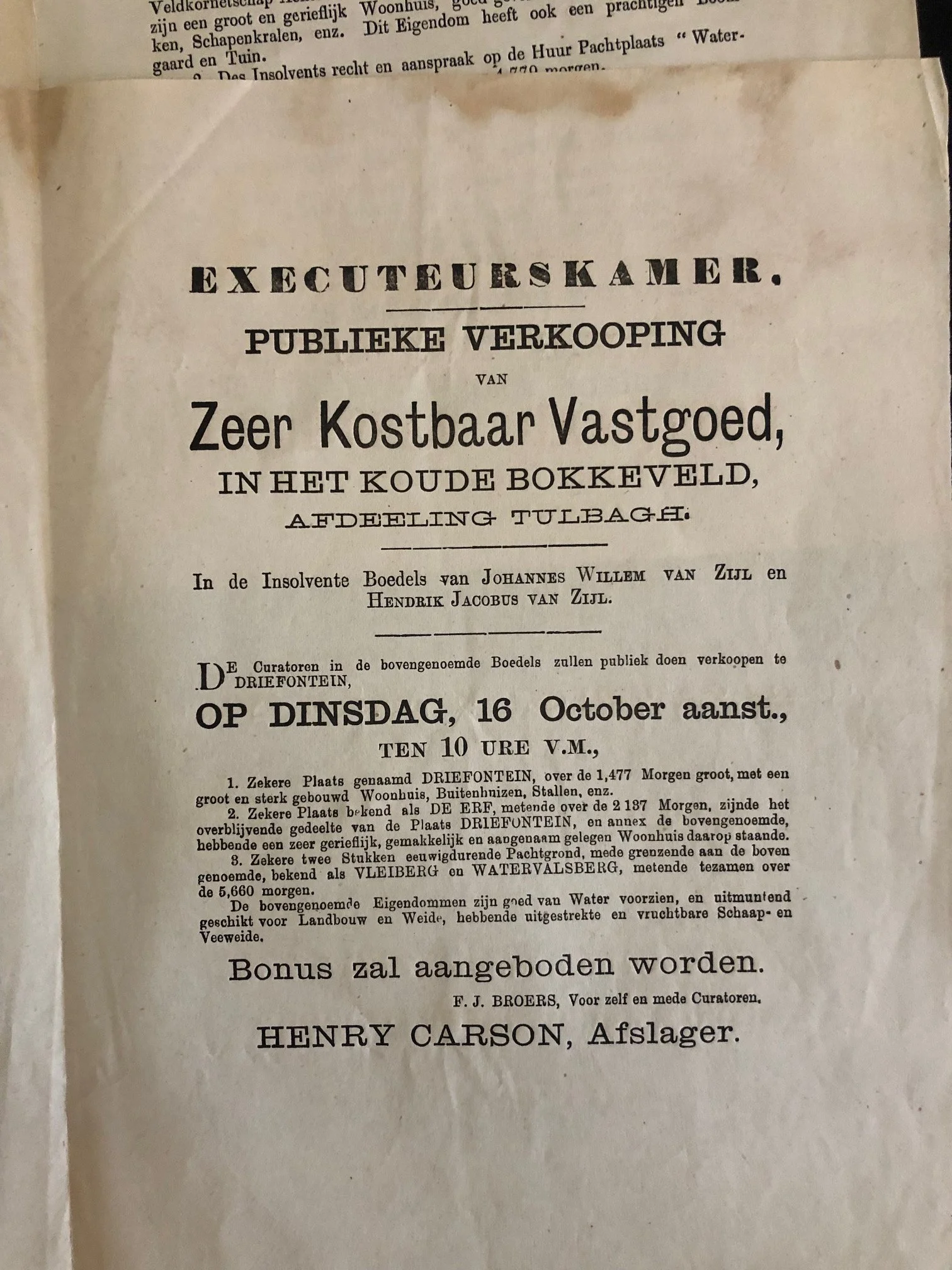
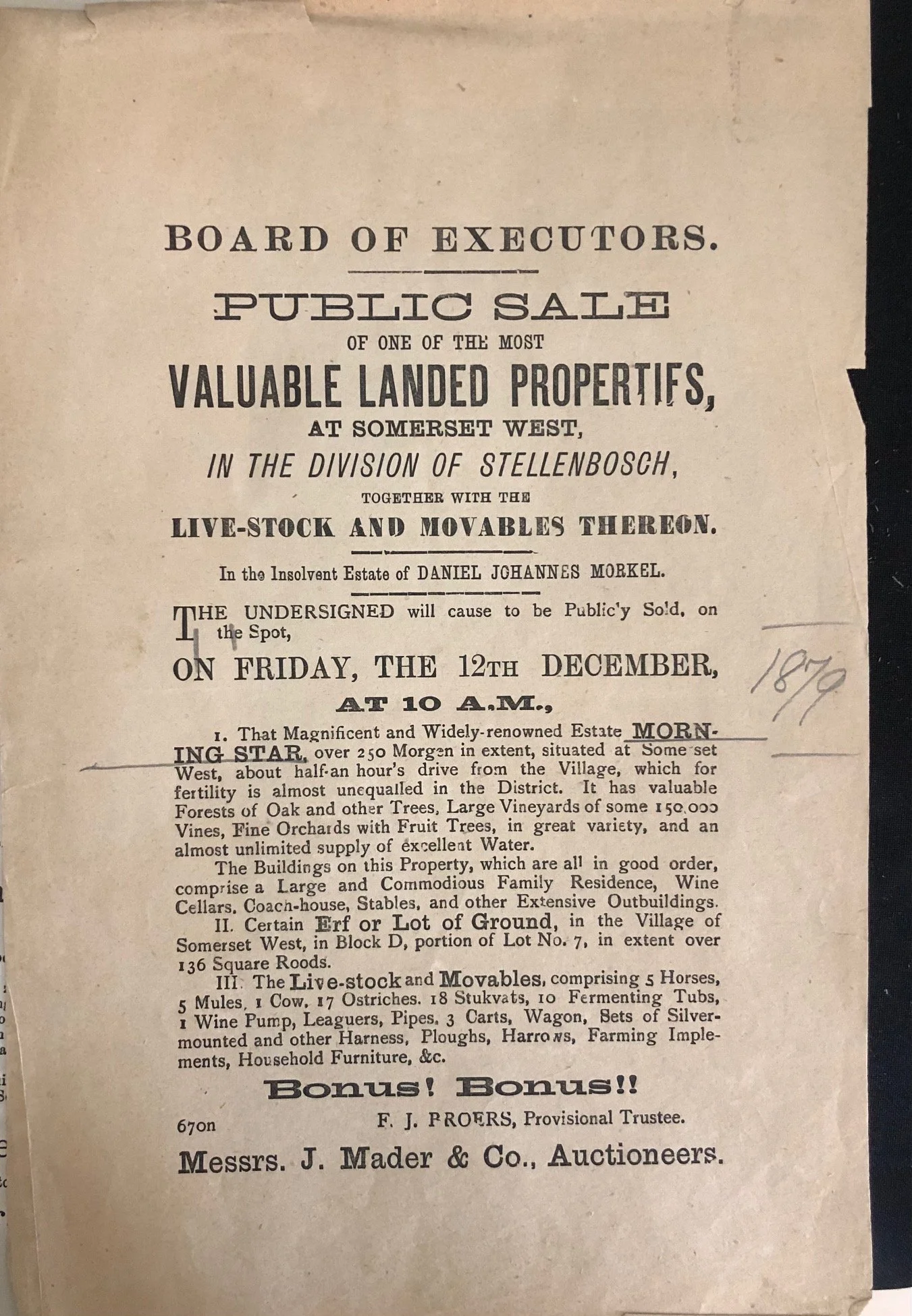
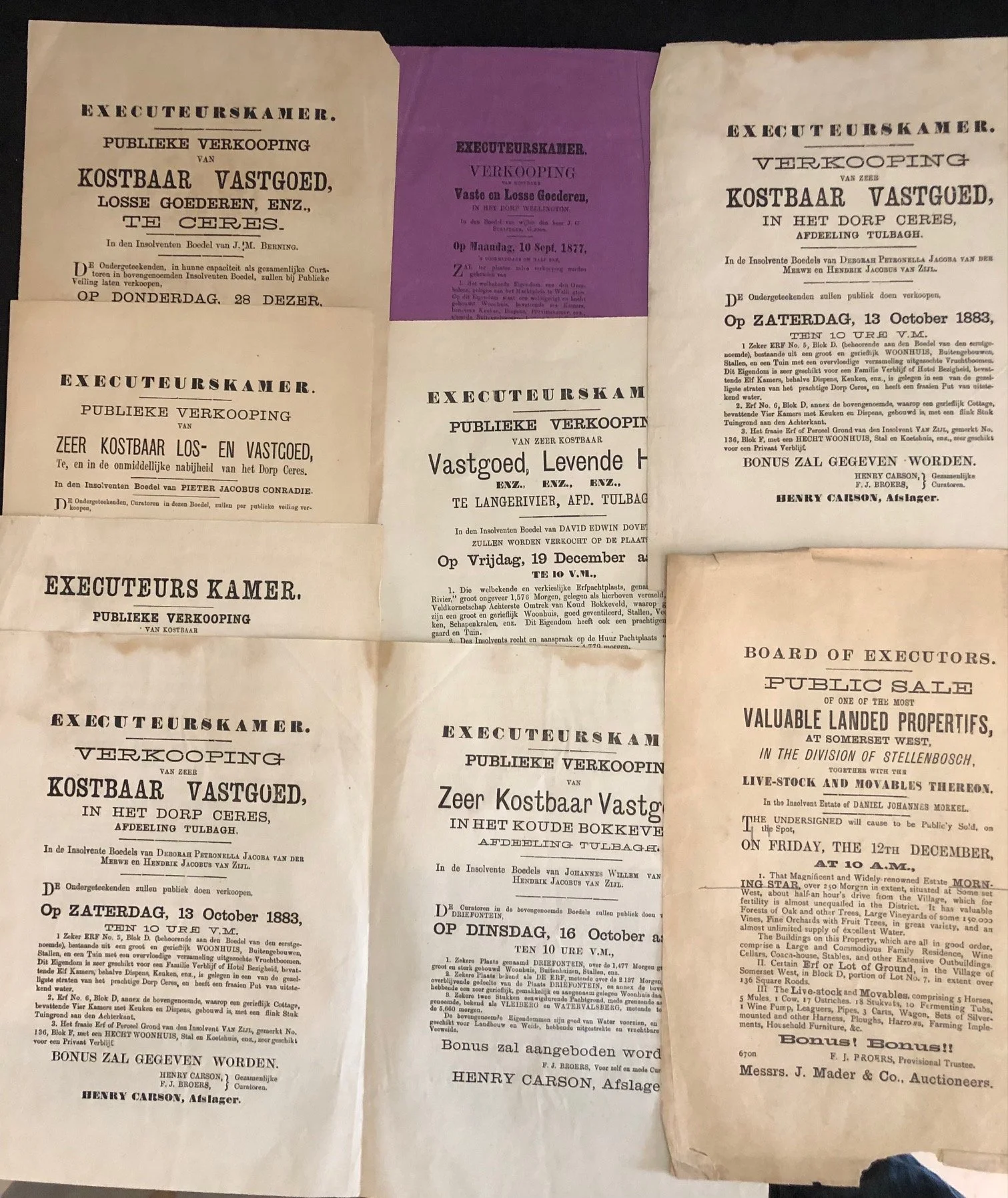
Western Cape Auctioneers Broadsides c.1880’s
The collection of 19th-century public auction broadsides offers a fascinating window into the legal, economic, and linguistic landscape of the Cape Colony during the late 1800s.
The Financial Crisis of the Cape Wine Industry
The English-language broadside on the bottom right captures a major historical turning point for a prominent Cape dynasty. It advertises the public sale of the "Morning Star" estate in Somerset West, belonging to the insolvent estate of Daniel Johannes Morkel.
The Morkels were one of the most prominent landed families in the Hottentots-Holland region, owning historic estates like Morgenster, Rome, and Onverwacht. Following the death of his father in 1876, Daniel Johannes Morkel inherited substantial property but hit severe financial hardship. During this era, Cape wine farmers were devastated by two consecutive blows:
The devastating outbreak of the Oidium vine mildew fungus (powdery mildew).
The 1860 Anglo-French treaty, which slashed British import tariffs on French wines, causing the export market for Cape wines to collapse.
This broadside stands as direct material evidence of the economic realities that eventually forced many established Cape families into insolvency, leading to the fragmentation and sale of historic estates.
The Linguistic Split: Town vs. Country
The broadsides beautifully illustrate the linguistic transition and coexistence of Dutch and English in the 19th-century Cape Colony under British administration:
The Rural Districts: Notice that the broadsides for properties in Ceres, Tulbagh, and the Koue Bokkeveld are printed entirely in Dutch. In these agricultural hinterlands, the farming community (the Boers) remained deeply rooted in their traditional language and Roman-Dutch legal customs.
The Proximity to Cape Town: In contrast, the Somerset West sale is printed entirely in English. As a district closer to the capital and more heavily influenced by British commercial interests, English was the preferred medium to attract wealthier urban buyers and English-speaking settlers.
The Role of the "Executeurskamer"
Almost every Dutch poster prominently features the word Executeurskamer (Board of Executors). This was a uniquely South African fiduciary institution. The first Board of Executors was established in Cape Town in 1838 to administer estates, trusts, and insolvencies.
Because the colony was transitioning from the old Dutch East India Company (VOC) administrative framework to British rule, these boards filled a critical gap. They combined British commercial practices with Roman-Dutch law, ensuring that local estates were managed reliably without relying entirely on a distant imperial government.
A Record of Local Topography
For a researcher or cartographer, these ephemera are invaluable for tracking how specific subdivisions, water rights, and boundaries evolved. They meticulously record land measures in Morgen (an old Dutch unit of land area equal to roughly 2 acres) and name long-standing regional landmarks like the Koue Bokkeveld and Langerivier, serving as a paper trail for the historical geography of the Western Cape.
Roughly A4 in size.
All slightly worn; creased etc
R2,000 for the collection of 9