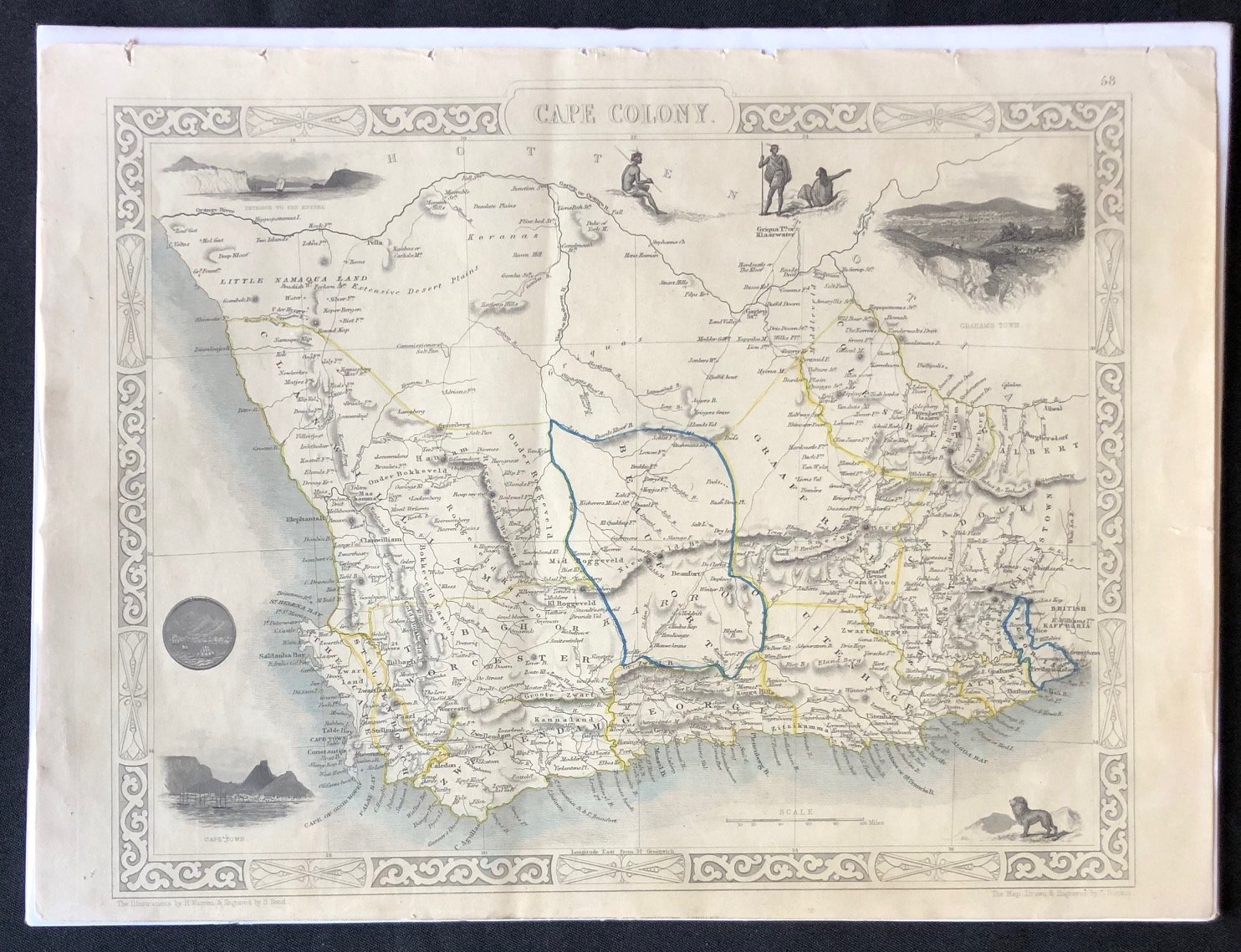
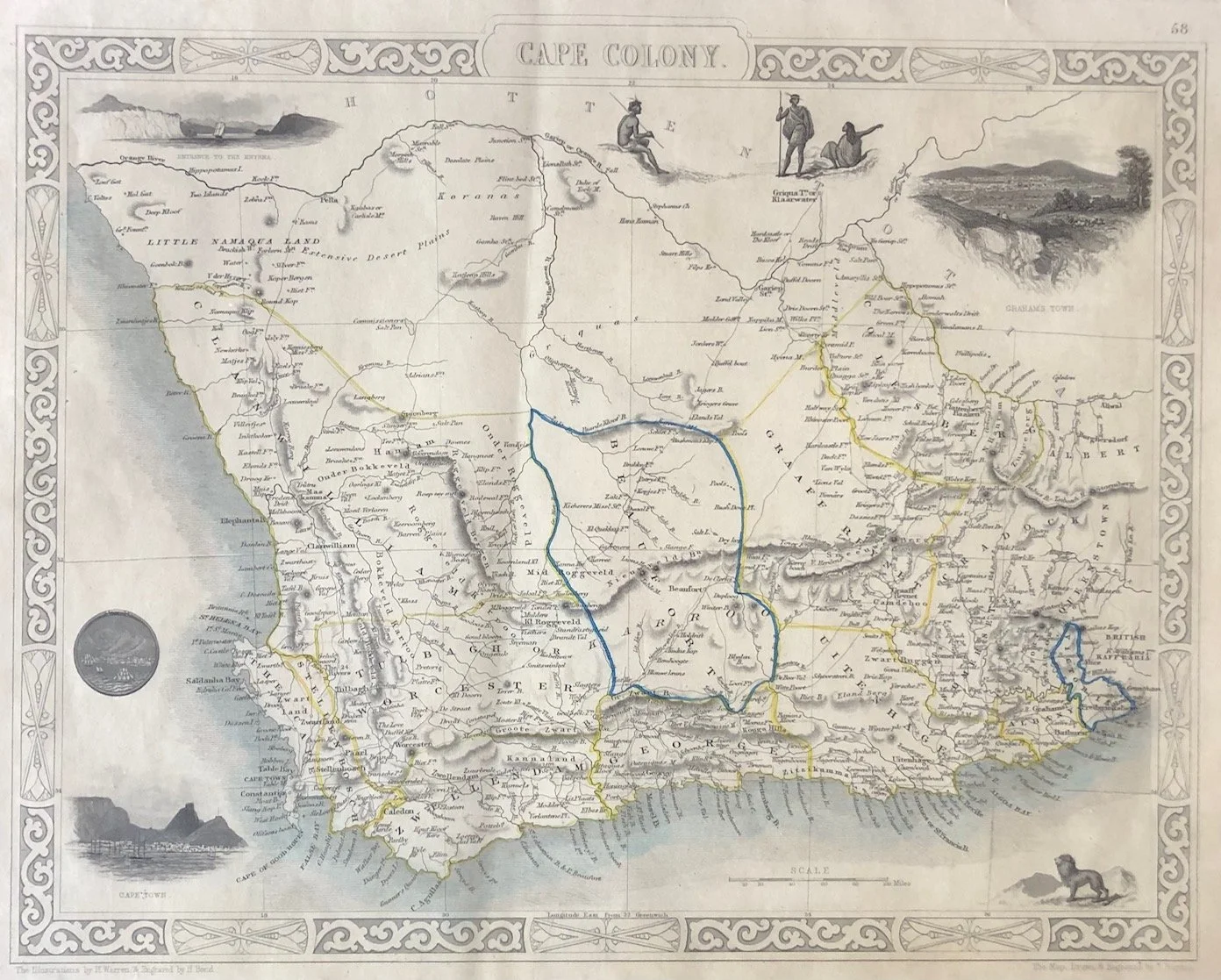
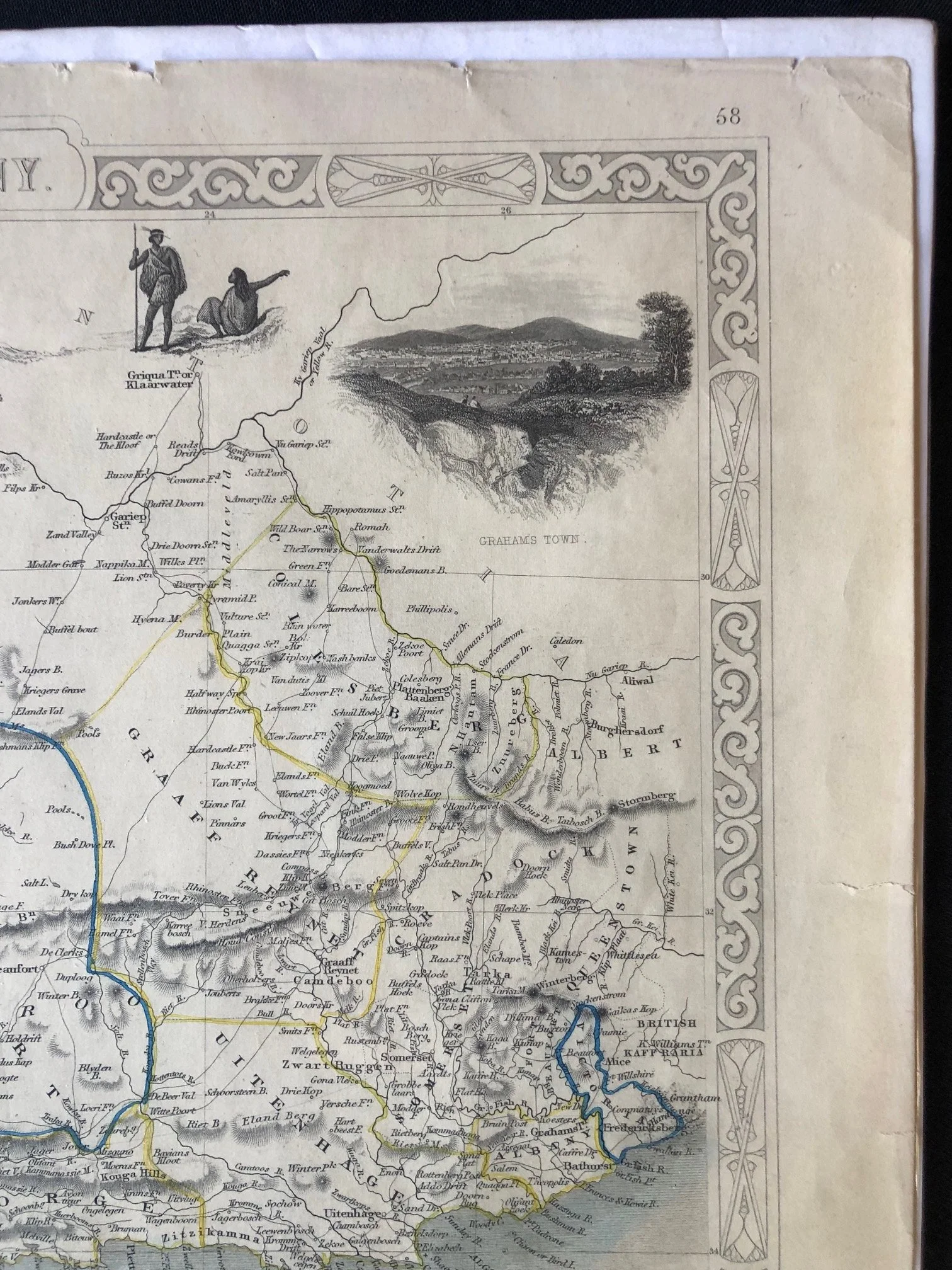
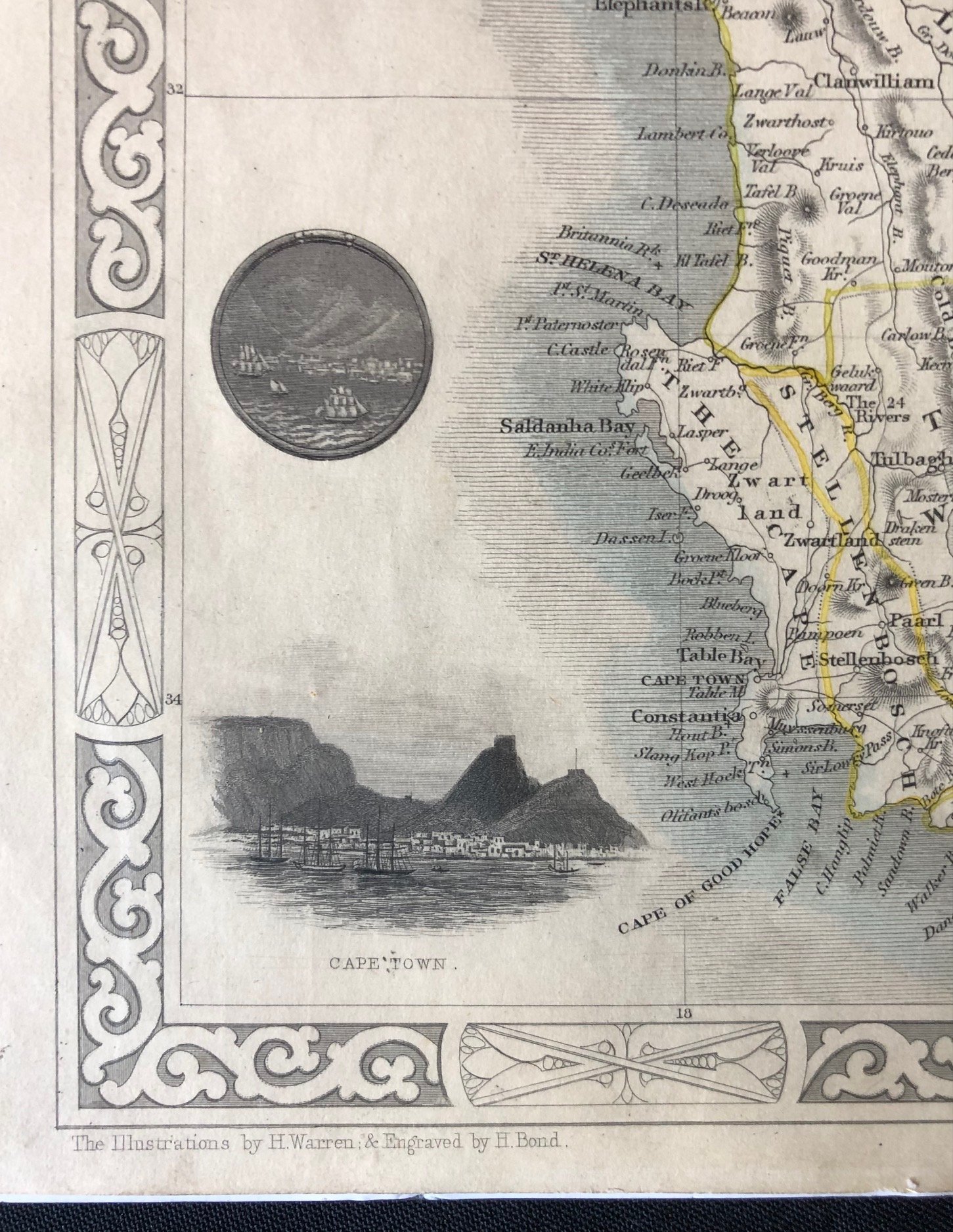
Original hand coloured engraving: Map of The Cape Colony (1851)
Steel engraving of the Cape Colony from 1851, published by John Tallis & Co. for The Illustrated Atlas and Modern History of the World. Designed and engraved by John Rapkin with illustrations by Henry Warren and Henry Bond, it stands as a brilliant historical snapshot of mid-19th-century South Africa.
The Era of the "Decorative" Map's Final Stand
John Tallis was one of the last great commercial publishers to produce highly decorative maps featuring elaborate borders and illustrative vignettes. By the mid-19th century, cartography was shifting heavily toward sterile, purely scientific, and utilitarian designs. This map represents the twilight of cartography as a fine art form.
A Linguistic and Political Tug-of-War
The place names across the map reveal a deeply complex colonial transition. You can see a distinct mixture of older Dutch names left behind from the Dutch East India Company era alongside newer English names—such as Clanwilliam, George, and Worcester—reflecting Britain's aggressive consolidation of power after seizing the Cape permanently in the early 1800s.
Historical Details in the Vignettes
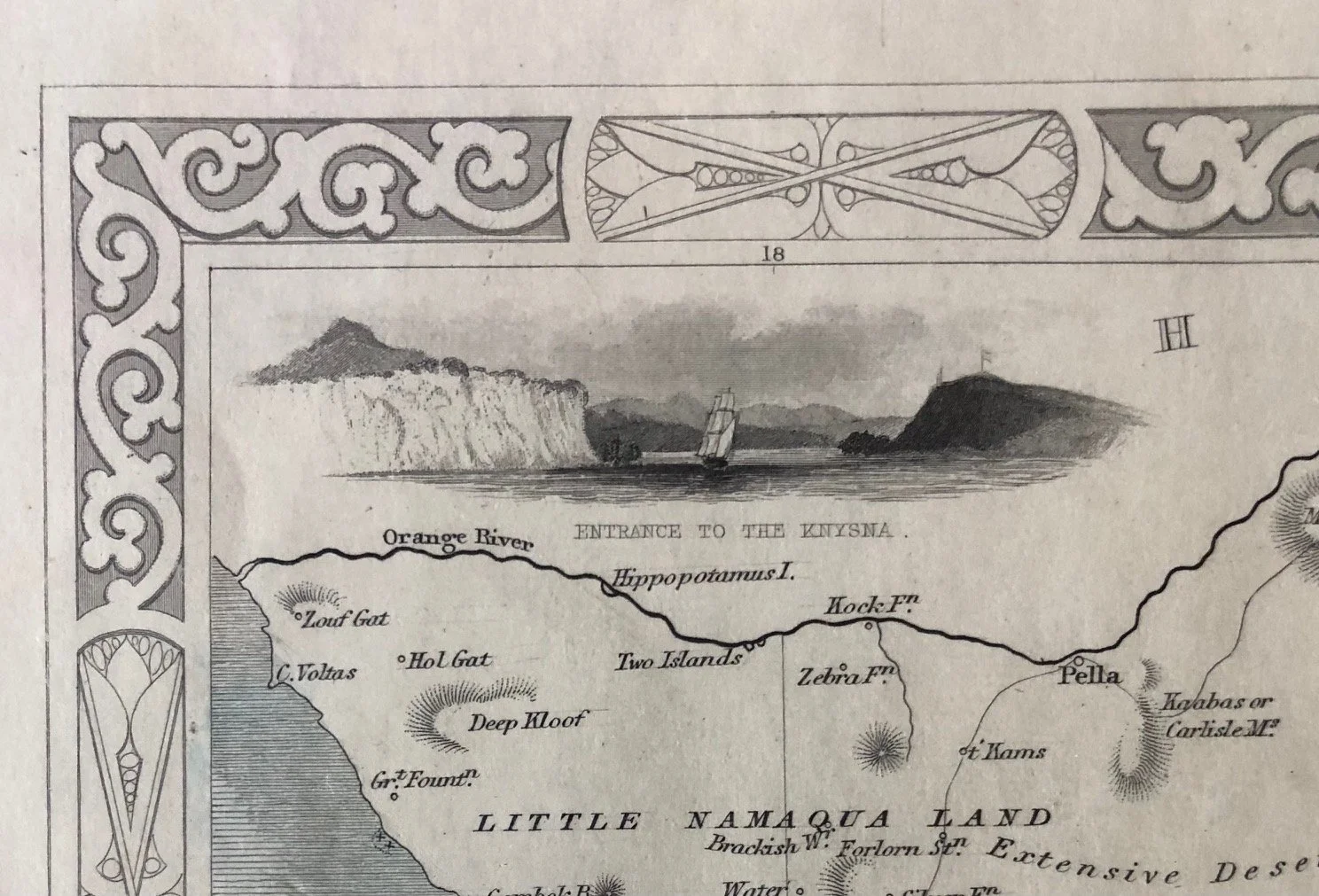
The beautifully detailed illustrations scattered across the map aren't just for decoration; they document specific historical realities of 1851:
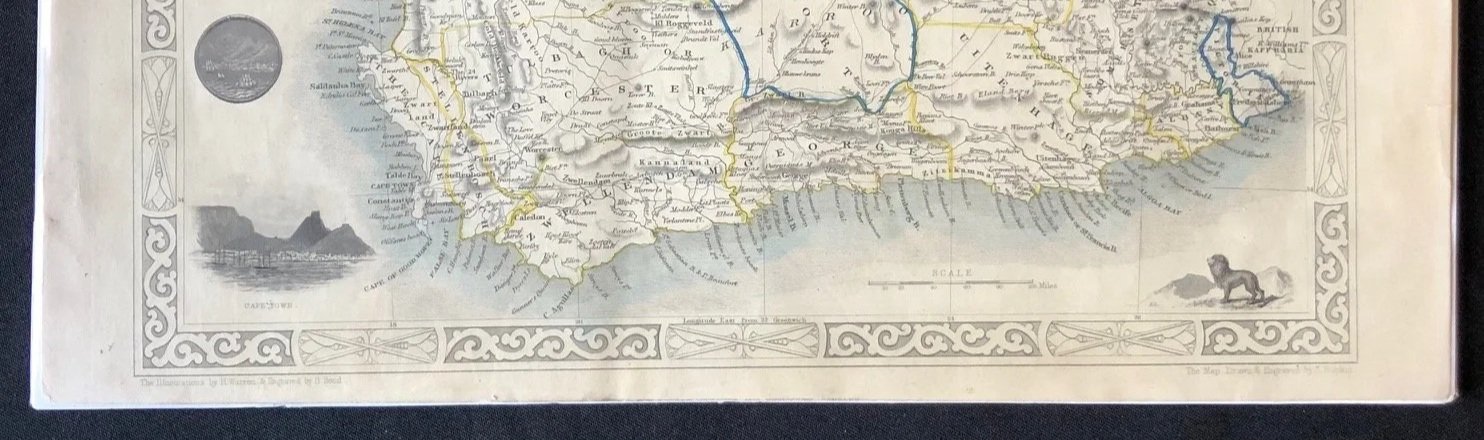
The Cape Town Vignette: In the lower-left corner, look closely at the flag pole atop Signal Hill. Just two years after this map was printed, this pole was replaced by a synchronized "time-ball" triggered by telegraph from the Royal Observatory. This allowed ships' captains in the harbor to precisely calibrate their marine chronometers—the cutting-edge navigation tech of the era.
Graham's Town (Grahamstown): Featured in the top right, this is illustrated because, at the time, it served as a crucial, heavily fortified military frontier outpost for the British during the ongoing Xhosa Wars (Frontier Wars).
Klaarwater (Griquatown): Shown at the top center, this vignette highlights an important inland London Missionary Society station, representing the European religious and cultural expansion into the interior.
Hidden Highroads of the Interior
While the map accurately tracks major coastal boundaries like False Bay and Algoa Bay, its interior details subtly map out the primary ox-wagon routes and "outspans" (resting camps). These routes were forged by early colonial explorers and travelers like William Burchell, marking the exact paths that would soon facilitate the massive expansion of trade, migration, and conflict deeper into Southern Africa.
Hand coloured engraving.
Stitching perforations; creased.
Whole page: 365mm x 275mm
R2,000