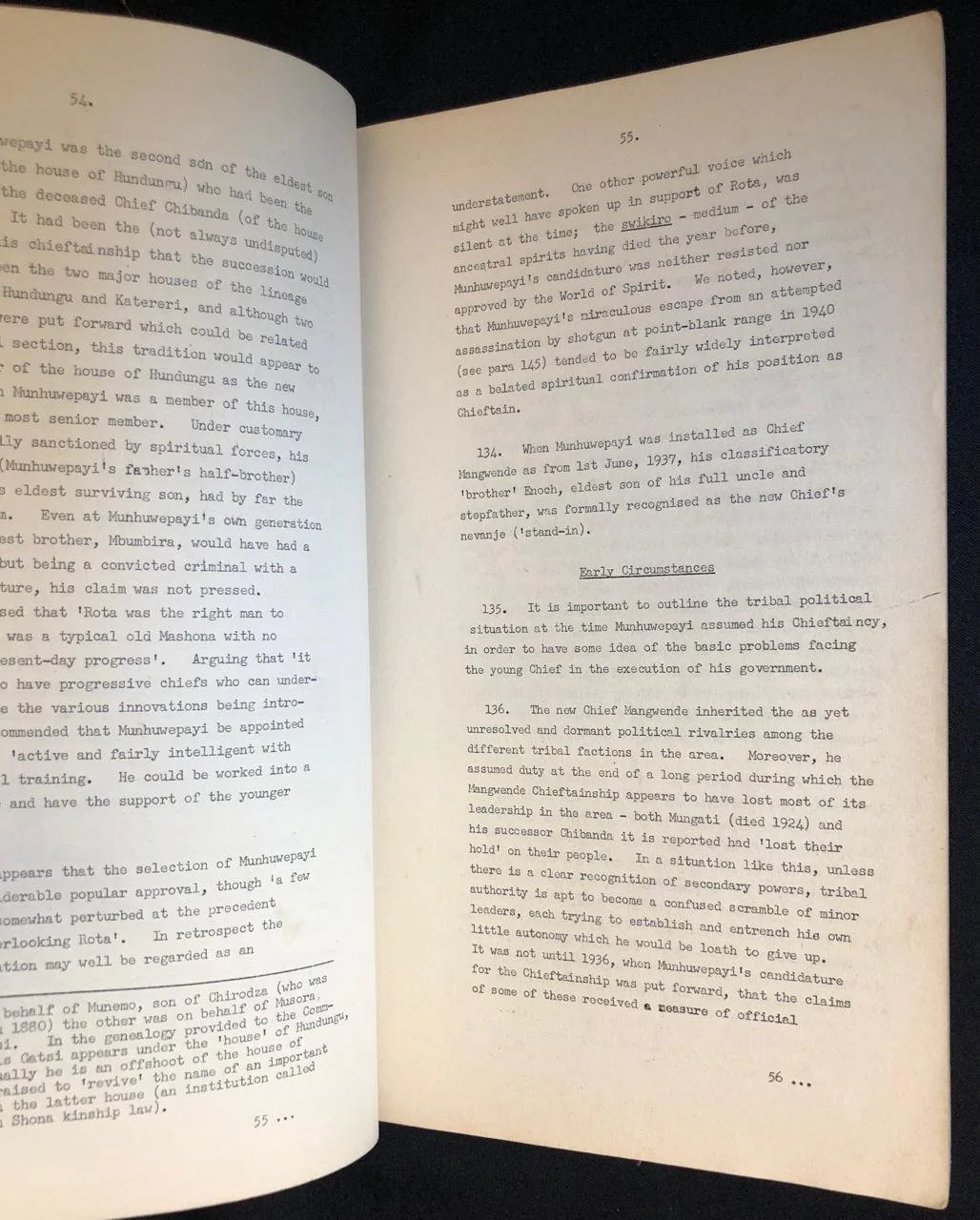
The Report of the Mangwende Reserve Commission of Enquiry (1961)
A pivotal document in the history of Zimbabwe (then Southern Rhodesia). It investigated the causes of unrest and the subsequent deposition of Chief Munhuwepayi Mangwende, a powerful and popular leader of the Nhowe people.
In Antjie Krog’s Begging to Be Black, she uses this report—and the work of its primary author, J.F. Holleman—to explore the tragic "misunderstanding" between Western bureaucracy and African traditional leadership. Krog is fascinated by the idea that two people (the Chief and the Commissioner) can live in the same space but see two entirely different realities.
Krog viewed the 1961 Report as evidence of how Western "technical efficiency" and legal logic can be used to commit profound injustices by ignoring the human and cultural context of the people they are meant to "help."
The enquiry centered on a personal and political clash between Chief Mangwende and the local Native Commissioner. Chief Mangwende was progressive and highly capable, but he frequently challenged the colonial administration's authority. He wanted to maintain autonomy over his people's development, which the colonial government viewed as "gross insubordination. In 1960, the government deposed and banished him to a restriction camp. This led to widespread disturbances in the Mangwende Reserve, prompting the commission of enquiry.
The commission, led by the legal anthropologist J.F. Holleman, was unusually critical of the colonial government for its time. The report highlighted a "schizoid division" in the government. One side wanted to promote "community development" (self-governance), while the other enforced rigid, authoritarian control through the Native Affairs Department. It found that the Native Land Husbandry Act of 1951—which forced people to change their traditional farming and land tenure systems—had caused deep resentment and disrupted the social fabric of the community.
Holleman argued that both the Chief and the Commissioner were men of integrity, but they operated in completely different "frames of reference" (patriarchal tribal rule vs. modern bureaucracy) that made conflict inevitable.
H.E. Sumner was a Native Commissioner who was deeply involved in documenting the oral histories of the Mangwende people during this era. While the 1961 Report dealt with the political explosion, Sumner’s ethnographic work (often cited in scholarly discussions of the report) represents the "other side" of the colonial official: the one who tried to understand the culture he was simultaneously helping to dismantle.
200mm x 322mm x 20mm
R1,000