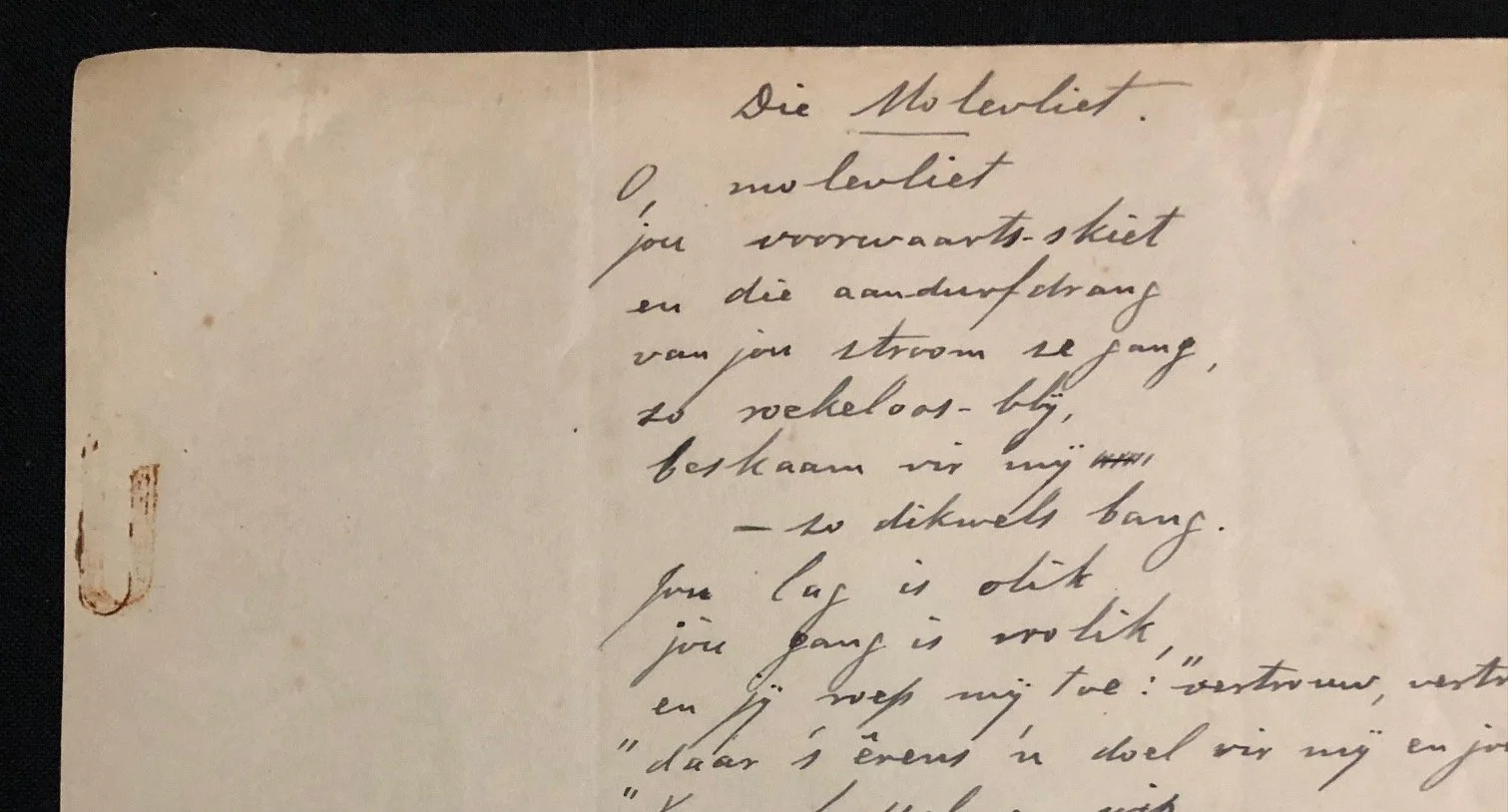
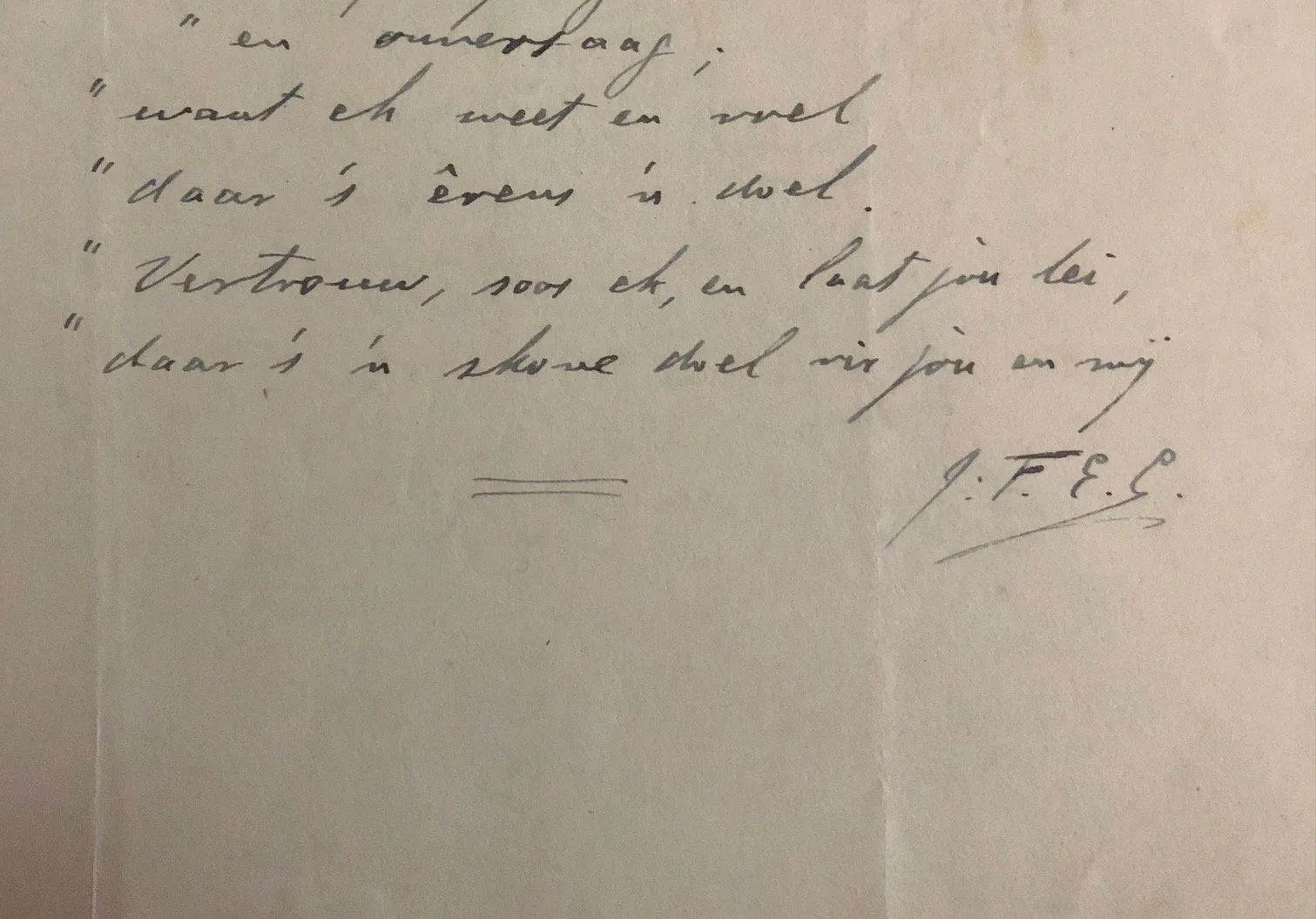
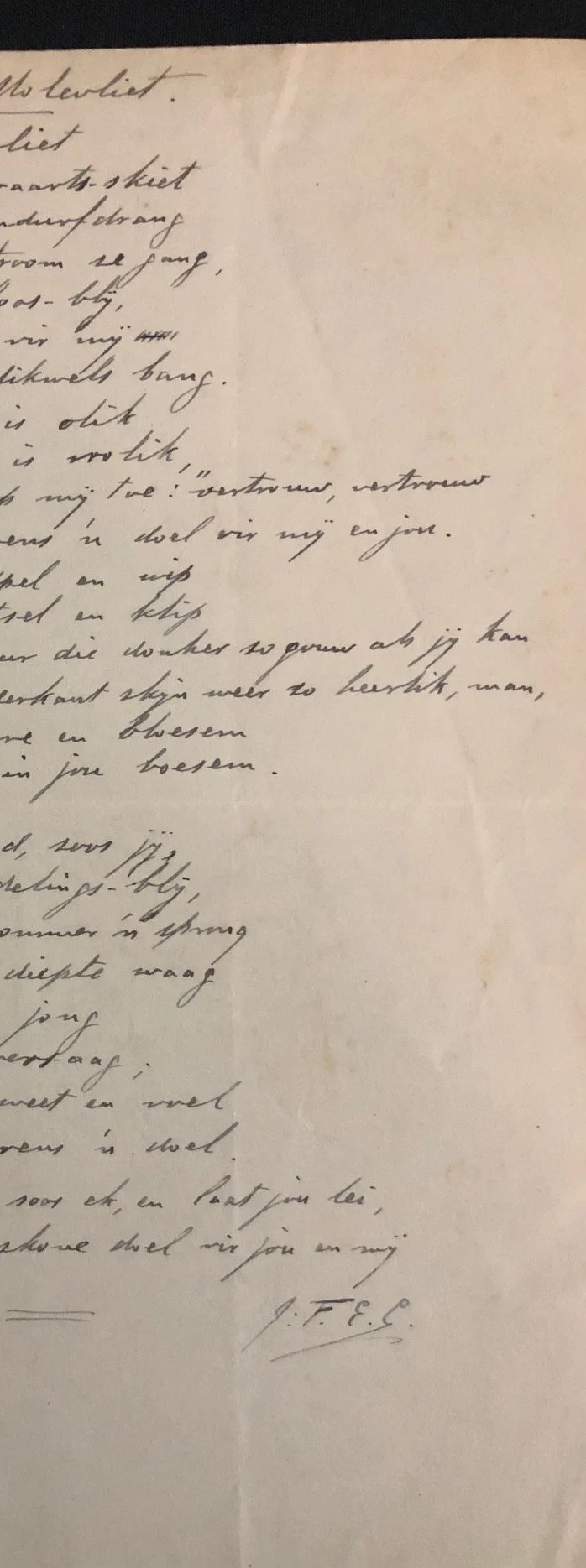
Manuscript poem titled "Die Molevliet" (The Mill Stream)
By Jan F.E. Celliers (c.1920)
This handwritten document is an exceptionally significant piece of South African literary history.
It is an original manuscript poem titled "Die Molevliet" (The Mill Stream) signed with the initials J.F.E.C.—belonging to Jan F.E. Celliers (1865–1940), one of the foundational literary giants of the Afrikaans language.
A Blueprint of the Second Afrikaans Language Movement
Celliers was a central figure of the Tweede Afrikaanse Taalbeweging (Second Afrikaans Language Movement) following the Anglo-Boer War. Before this era, Afrikaans was primarily a spoken dialect ("Boer-hoogduits"), while Dutch or English were strictly used for formal writing, literature, and high culture.
Poets like Celliers set out to prove that Afrikaans was a fully realized, deeply expressive literary language capable of nuanced poetry. Note the transitional state of the language:
The use of early phonetic spelling systems.
Words like "sal ik" (later standardized to ek) and the retention of Dutch linguistic structures mixed with early modern Afrikaans vocabulary.
The Significance of the Title: "Die Molevliet"
The title references a mill stream (molevliet or meulstroom). In the context of early 20th-century Afrikaans romanticism and post-war reconstruction, nature poetry was heavily loaded with political and emotional allegory.
Rather than just describing a landscape, streams and rivers in early Afrikaans poetry almost always served as metaphors for the relentless, forward-surging life force of a traumatized people moving past the devastation of the concentration camps and scorched-earth policies of the war. The opening lines capture this forward momentum perfectly:
"O, molevliet / jou voorwaarts-skiet..."
Insights into the Poet's Creative Process
As a physical artifact, this manuscript offers an intimate look at how Celliers constructed his verse.
On the 6th line, you can see a direct ink strike-through where he crossed out a word and entirely changed his phrasing mid-thought.
The Iconic Signature
The crisp, stylized signature at the bottom right—J.F.E.C.—matches the exact monogram Celliers used when submitting early pieces to cultural journals like Die Brandwag (which he helped edit) and Die Huisgenoot. Hand-penned manuscripts from this generation of "Volksdigters" (People's Poets) are incredibly scarce, as much of their ephemera was lost during the displacements of the era.
A definitive published record for "Die Molevliet" under this specific title cannot be found in his major anthologies—such as Die Vlakte en ander gedigte (1908), Die Brandwag, or Die Huisgenoot.
There are two highly likely historical explanations for why this specific poem hasn't appeared under this title in print:
1. It Was Reworked and Published Under a Different Title
In the early development of modern Afrikaans literary orthography, titles and spelling structures were incredibly fluid. Celliers frequently returned to his drafts to rewrite them. It is very likely that this draft was heavily edited and later integrated into one of his published volumes or cultural journals under a standardized title, such as "Die Meulstroom" or "Die Stroompie", aligning with the classic nature metaphors he used to describe the forward-moving spirit of the post-war Afrikaans community.
2. It Is an Unprinted, Privately Dedicated Draft
Early 20th-century Volksdigters frequently wrote personalized verses, copies of existing drafts, or short poems directly into family albums (poesiealbums), notebooks, or onto loose sheets of paper for friends, patrons, or local cultural societies. Given that the text retains archaic spellings (like "sal ik" and "teer") and visible corrections, this page may simply be a private, working manuscript that never made the transition from his desk to a formal printing press.
Provenance: Out of the collection of Professor Johannes Jacobus "Jan" Smith (5 October 1883 − 18 June 1949). J.J. Smith was a leading figure in the Afrikaans language movement and the compiler of the first standard Afrikaans dictionary. He was an important member of the committee which first attempted to standardize Afrikaans spelling, and was made the founding editor of Die Huisgenoot, the family magazine of the Nasionale Pers, in which early Afrikaans literature was discussed. He was a professor of languages at Stellenbosch University from 1919 until his retirement in 1945.
202mm x 260mm
Manuscript in pen. Paperclip rust mark; creased; minor foxing.
R20,000