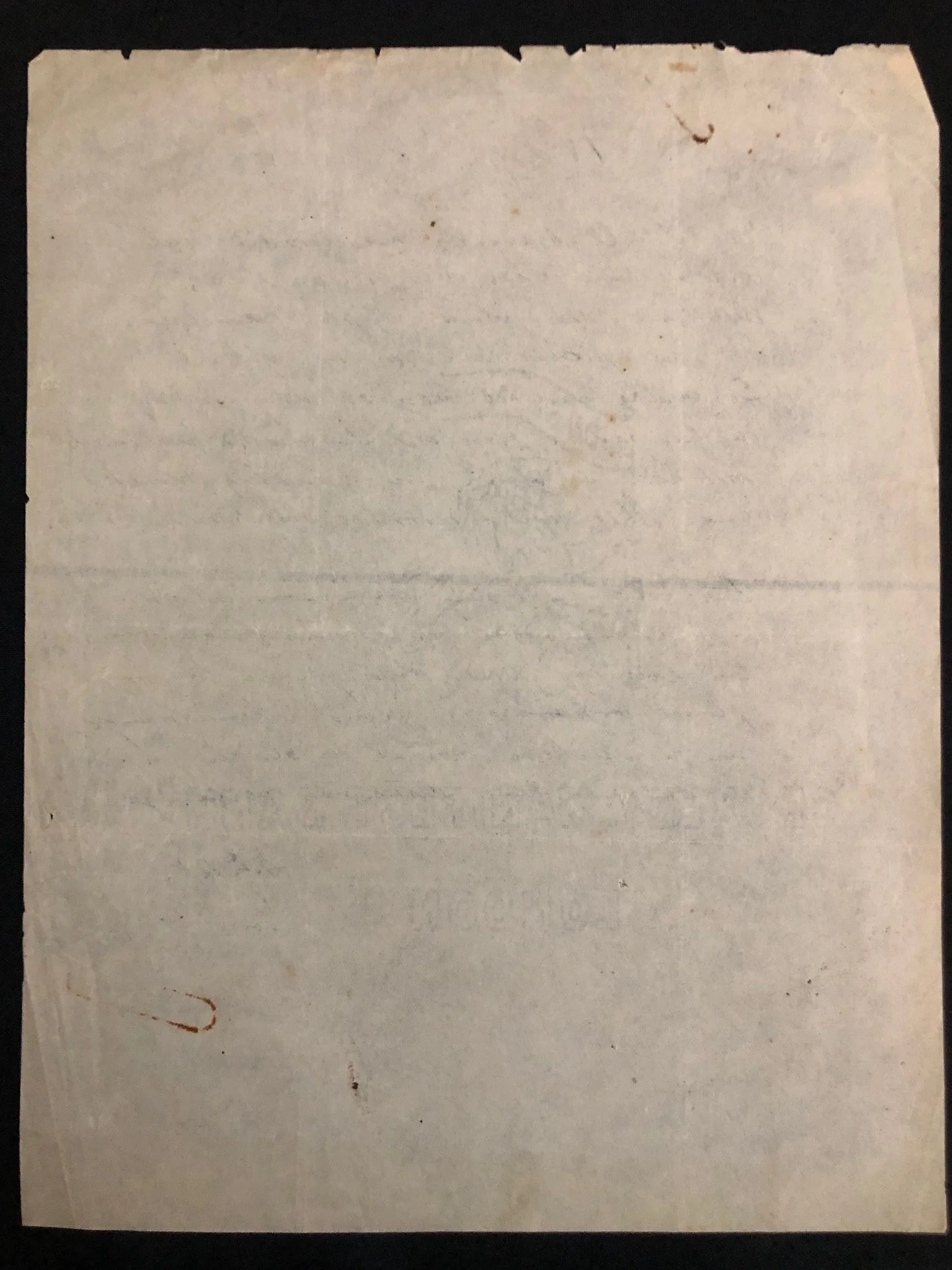
Manuscript Poem, "Wag" (Wait). By Prof. Daniël François Malherbe (c.1920)
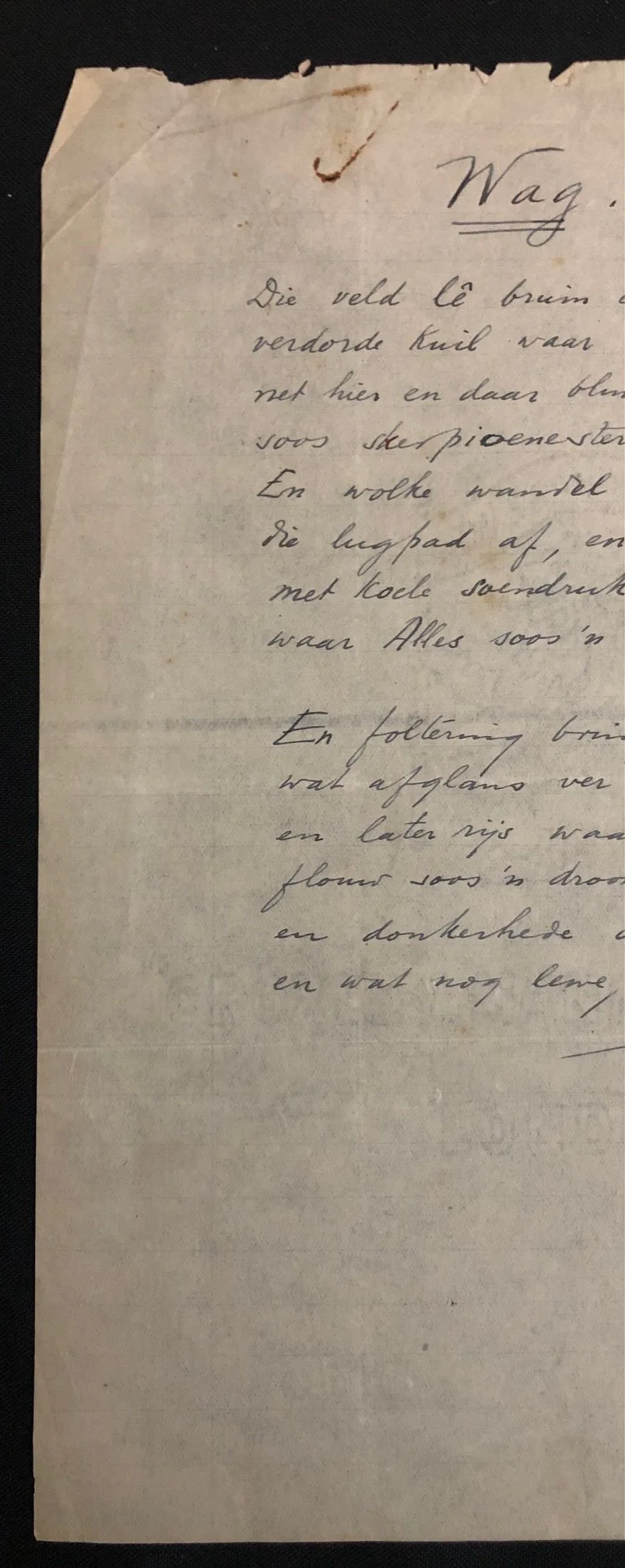
This handwritten manuscript is an artifact from the foundational era of Afrikaans literature.
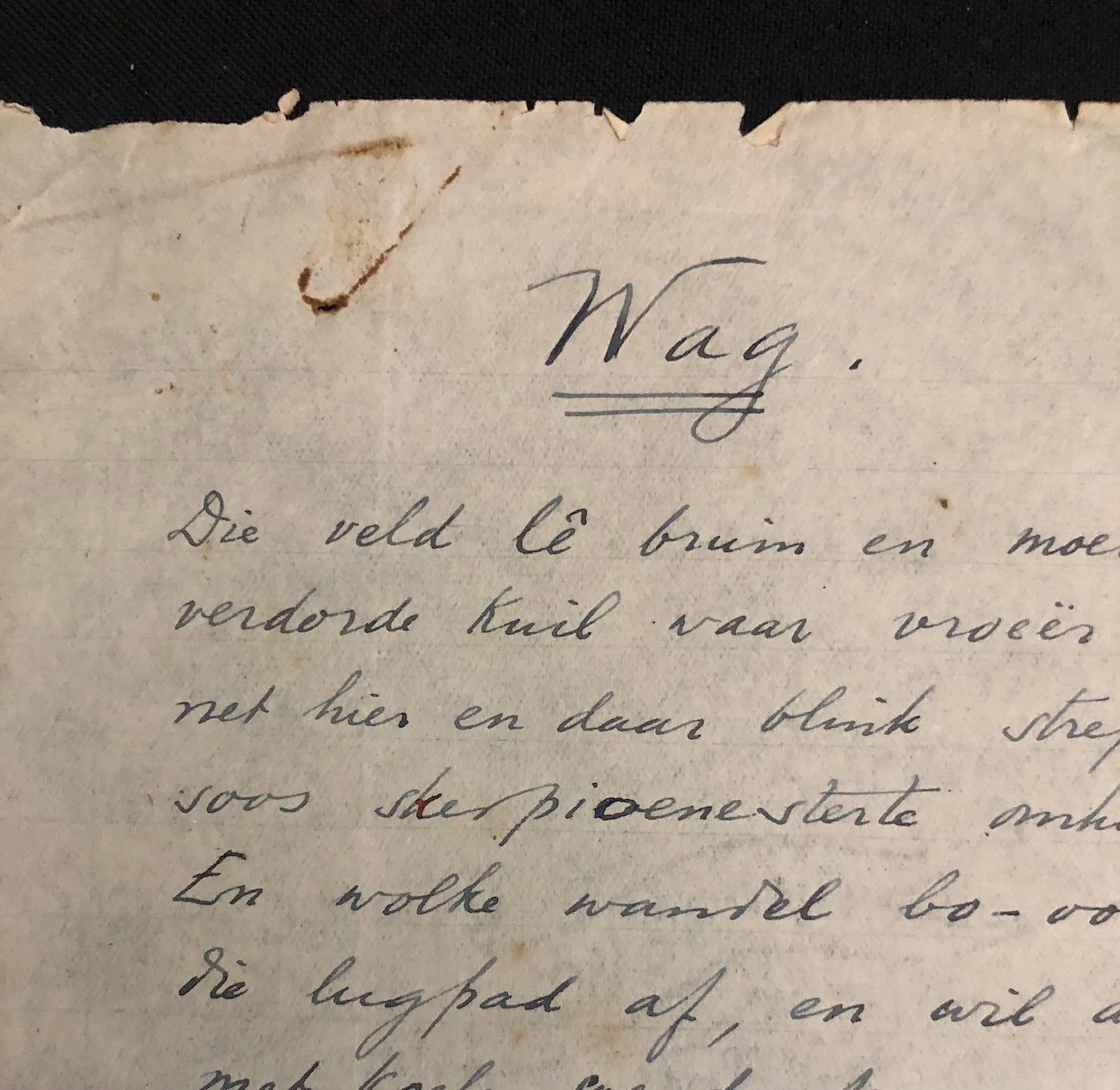
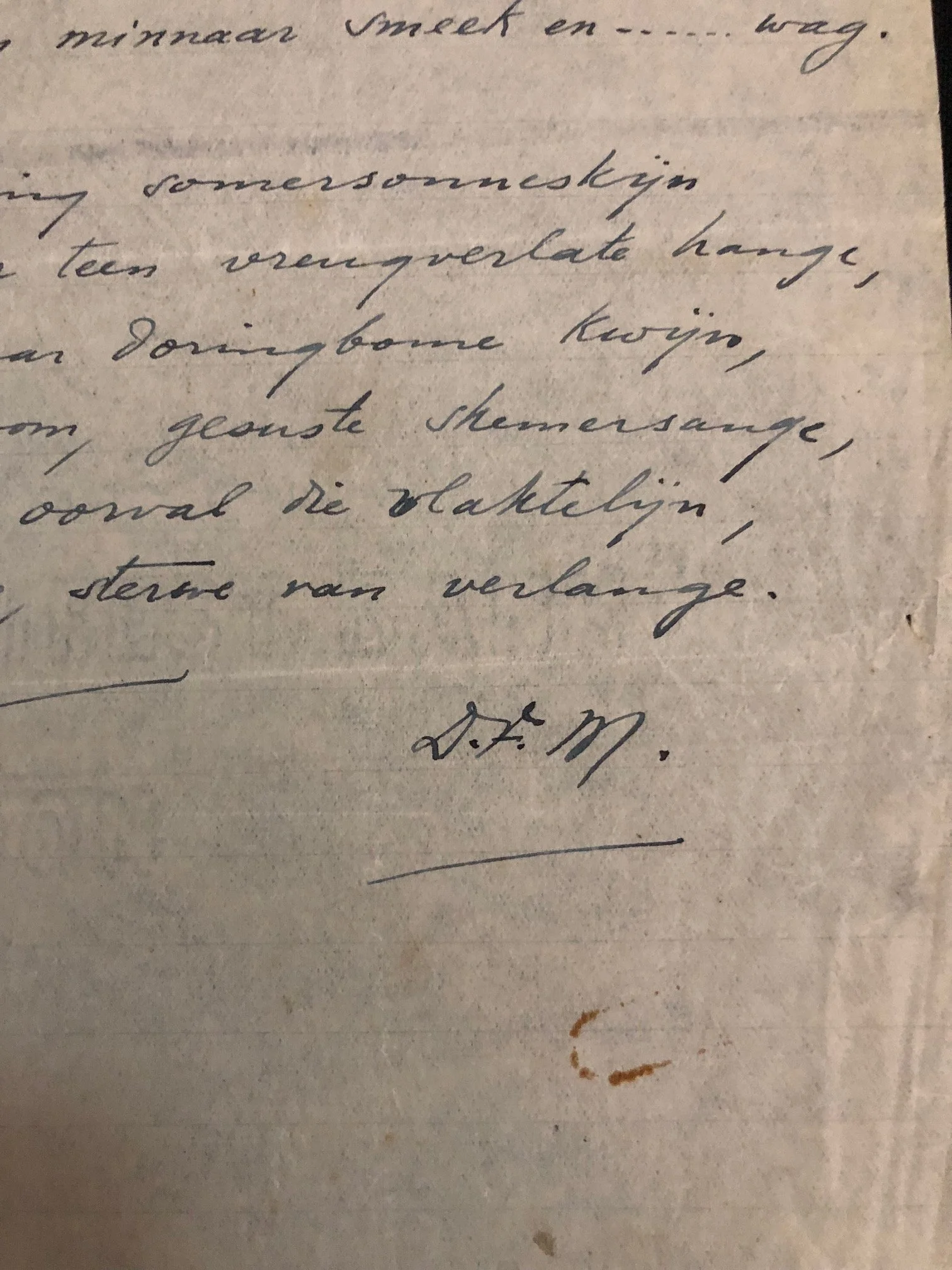
The poem is titled "Wag" (Wait) and features the stylized initials D.F.M. at the bottom right. These belong to Prof. Daniël François Malherbe (1881–1969), universally known as D.F. Malherbe, one of the ultimate heavyweights of the Tweede Afrikaanse Taalbeweging (Second Afrikaans Language Movement).
Several historically and culturally significant details stand out regarding this specific document:
The Author: A Architect of Academic Afrikaans
While other early poets of his generation focused purely on populist verse, D.F. Malherbe was the academic champion of the language.
He delivered the groundbreaking 1906 lecture "Is Afrikaans 'n dialekt?", offering the first rigorous, scientifically motivated defense of Afrikaans as a standalone language.
In 1918, he became the first-ever Professor of Afrikaans in South Africa (appointed at Grey University College, now the University of the Free State).
He was a primary architect of the original Afrikaanse Woordelys en Spelreëls (the standard spelling and grammar rules).
A Masterclass in Early Afrikaans Sonnetry
The text is structured as a classic Italian/Petrarchan sonnet, divided into an octave (the first eight lines) and a sestet (the final six lines).
Malherbe was obsessed with elevating Afrikaans from a simple spoken tongue into a vessel for high European art forms. Writing a technically flawless, emotionally heavy sonnet in Afrikaans during the early 1900s was a political statement: it proved the language could stand shoulder-to-shoulder with Dutch, English, or French.
Evocative Karoo Topography and Botanical Imagery
The opening lines are a beautifully somber description of the arid South African interior—most likely the Karoo—during a biting drought:
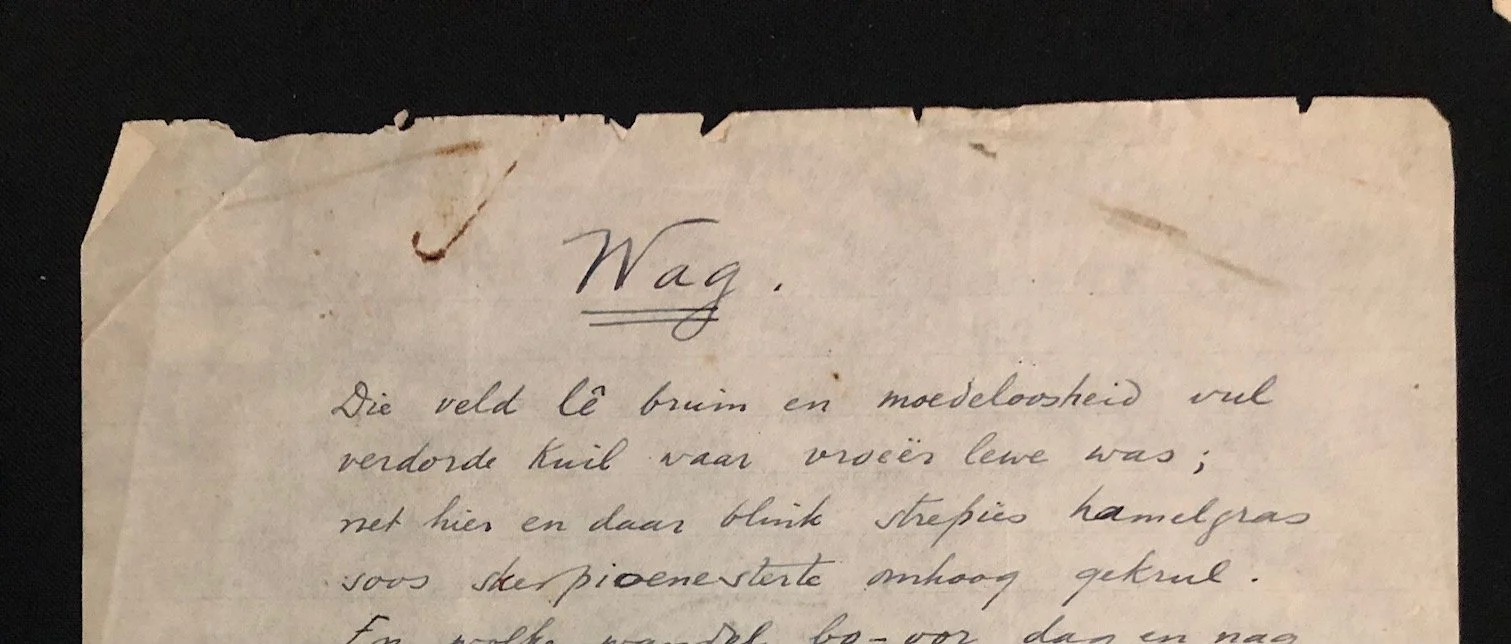
"Die veld lê bruin en moedeloosheid vul / verdorde kuil waar vroeër lewe was..."
(The veld lies brown and despondency fills / the withered waterhole where life used to be...)
A particularly fascinating historical and botanical detail is hidden in the third line:
"net hier en daar blink strepies hamelgras"
"Hamelgras" (specifically Eragrostis nindensis, commonly known as wether love grass or resurrection grass) is an incredibly hardy Karoo perennial. It looks completely dead and shriveled during a drought, but it possesses "resurrection" properties, springing back to vibrant green within days of a rainfall event.
Malherbe’s choice of hamelgras is not accidental; like Jan F.E. Celliers' nature imagery, it serves as a powerful post-Boer War metaphor. The shriveled grass, curling upward "soos skerpioenesterte" (like scorpion tails), represents a traumatized landscape and population waiting ("wag") for the literal and cultural "rain" that will bring rebirth and restoration.
Textual Variations and the Monogram
The clean, distinct handwriting and the sharp underline beneath his D.F.M. monogram suggest this was a presentation copy or a final ledger entry. Literary historians highly prize loose manuscript sheets like this because they frequently reveal slight variations in punctuation, spacing, and capitalization when compared to the final versions printed by early presses like Nasionale Pers.
Provenance: Out of the collection of Professor Johannes Jacobus "Jan" Smith (5 October 1883 − 18 June 1949). J.J. Smith was a leading figure in the Afrikaans language movement and the compiler of the first standard Afrikaans dictionary. He was an important member of the committee which first attempted to standardize Afrikaans spelling, and was made the founding editor of Die Huisgenoot, the family magazine of the Nasionale Pers, in which early Afrikaans literature was discussed. He was a professor of languages at Stellenbosch University from 1919 until his retirement in 1945.
200mm x 260mm
Manuscript; creased; minor stains; paperclip rust marks.
R20,000