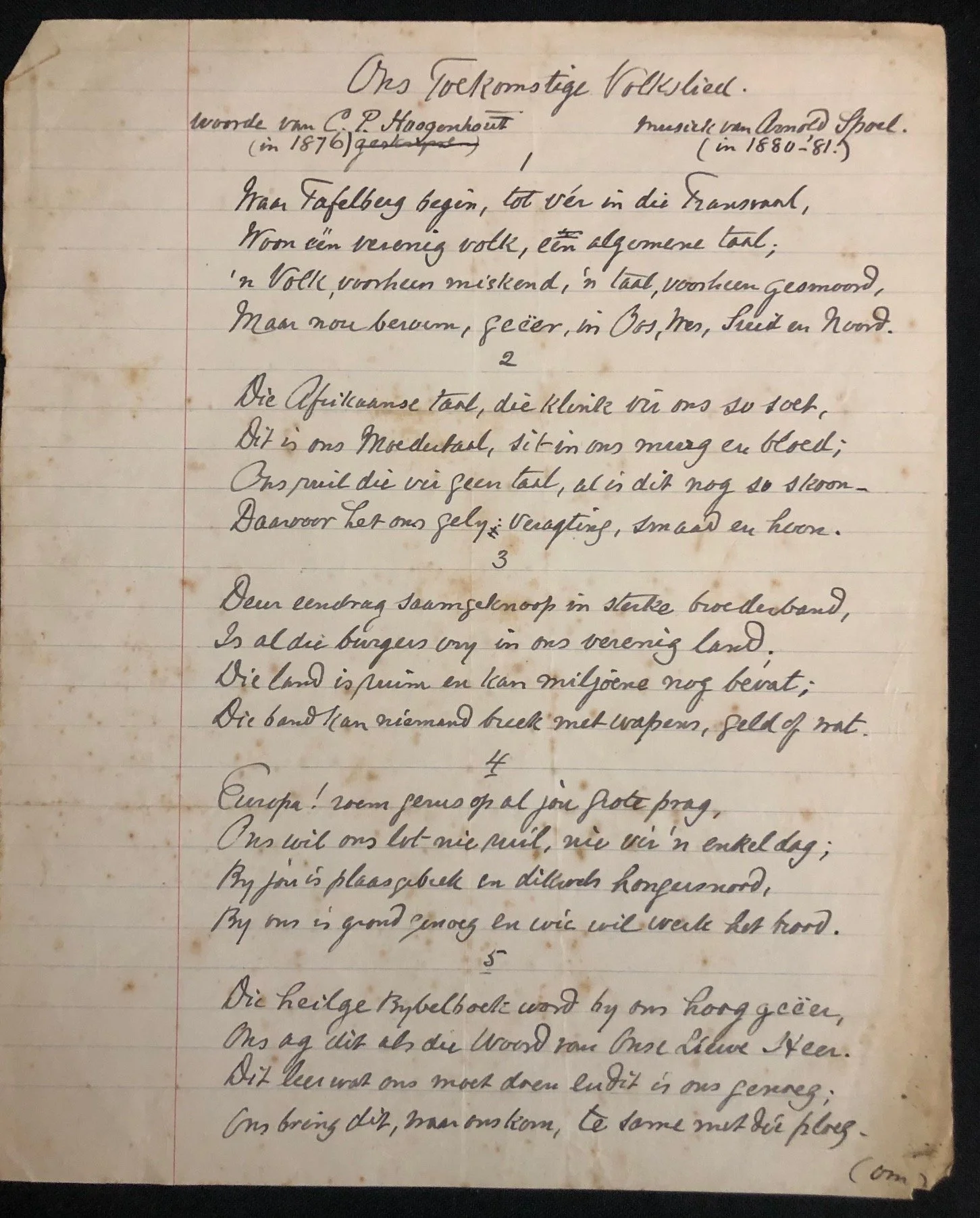
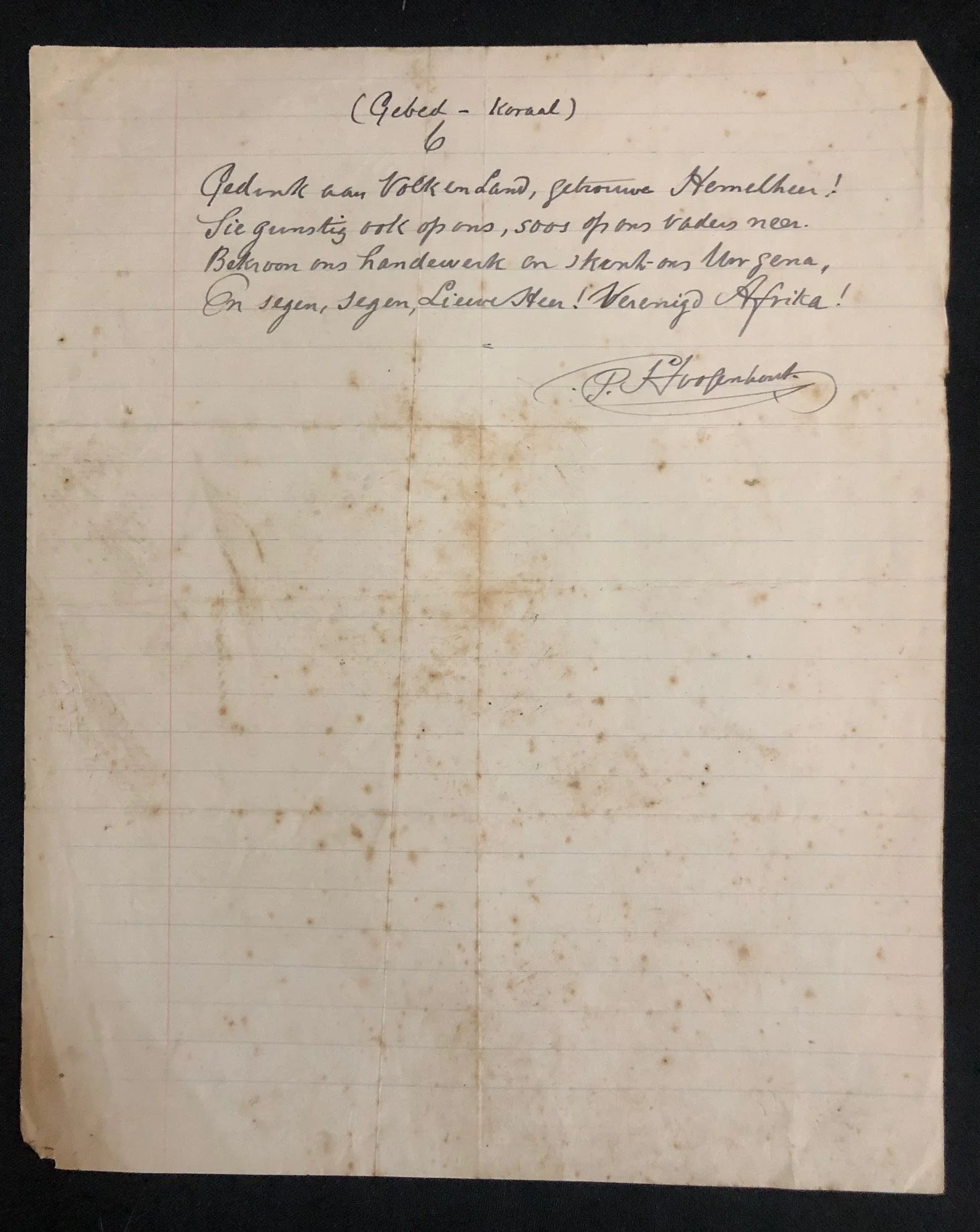
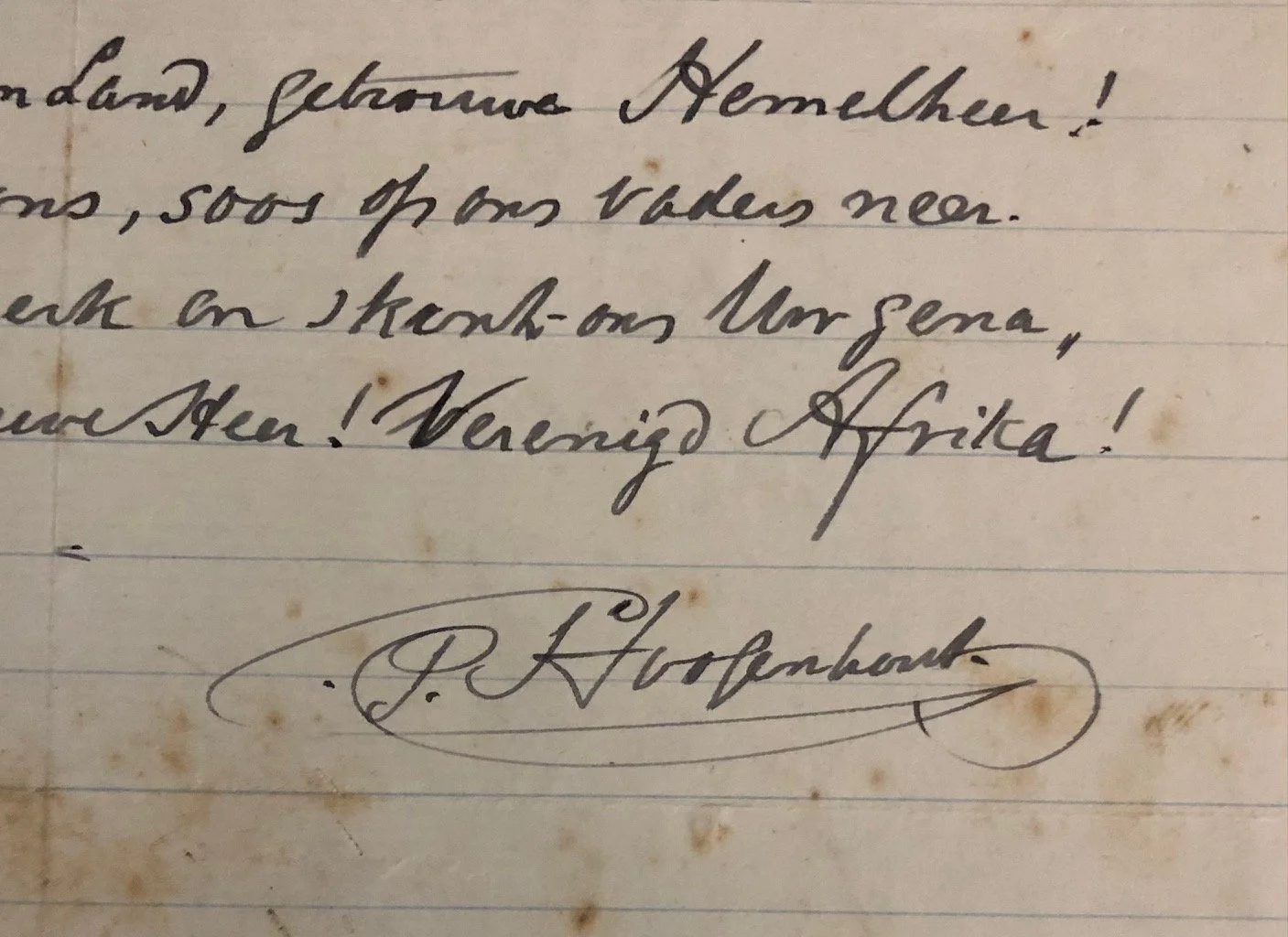
"Ons Toekomstige Volkslied" (Our Future National Anthem), with lyrics by C.P. Hoogenhout (c.1920)
Manuscript featuring a handwritten copy of "Ons Toekomstige Volkslied" (Our Future National Anthem), with lyrics by C.P. Hoogenhout and music by the Dutch composer Arnold Spoel. The annotations under the title capture the timeline: the words were written in 1876, and the music was composed in 1880–81.
A Blueprint for a United South Africa (1876)
When Claas Petrus Hoogenhout penned these words in 1876, the concept of a single, unified South African nation did not exist. The region was a fractured tapestry of British colonies (the Cape and Natal) and independent Boer Republics (the Transvaal and the Orange Free State).
The very first stanza lays out a prophetic, pan-nationalist vision:
"Van Tafelberg begin, tot vér in die Transvaal, Woon één verenig volk, één algemene taal..."
(Beginning from Table Mountain, unto far into the Transvaal, Lives one united people, one common language...)
To write a "Future National Anthem" spanning from Table Mountain to the Limpopo River in 1876 was a radical act of political imagination, pre-dating the formal unification of South Africa by more than three decades.
The Eerste Taalbeweging (First Language Movement)
Hoogenhout was one of the founding members of the Genootschap van Regte Afrikaners (GRA), established in Paarl in 1875. At this time, Afrikaans was widely dismissed by the ruling elite as a "patois" or a "kitchen language" unfit for high culture, literature, or governance. High Dutch or English were the only accepted written mediums.
This poem was one of the earliest deliberate attempts to prove that Afrikaans could handle lofty, patriotic, and spiritual concepts. The linguistic style here is fascinating: it is much closer to modern Afrikaans, yet it retains remnants of the GRA's early phonetic experiments (such as using "viir" instead of vir, and "ingesond" or "gesmoord").
The Provocative Stanza 4: Anti-European Sentiment
Stanza 4 offers a raw look at the socio-economic mindset of early Afrikaner nationalists, explicitly rejecting European societal norms:
"Europa! roem gerus op al jou grote prag... By jou is plaasgebrek en dikwils hongersnood, By ons is grond genoeg en wie wil werk het brood."
(Europe! boast freely of all your great splendor... With you there is a lack of land and often famine, With us there is land enough and whoever wants to work has bread.)
This stanza reflects a fierce pride in the agrarian isolation of southern Africa, directly contrasting the vastness and self-reliance of the subcontinent against the crowded, industrialized, and poverty-stricken urban centers of 19th-century Europe.
Out of the collection of Professor Johannes Jacobus "Jan" Smith (5 October 1883 − 18 June 1949). J.J. Smith was a leading figure in the Afrikaans language movement and the compiler of the first standard Afrikaans dictionary. He was an important member of the committee which first attempted to standardize Afrikaans spelling, and was made the founding editor of Die Huisgenoot, the family magazine of the Nasionale Pers, in which early Afrikaans literature was discussed. He was a professor of languages at Stellenbosch University from 1919 until his retirement in 1945.
R15,000