Letter to Charles Aken Fairbridge Regarding Dutch (Afrikaans) an official language in 1875
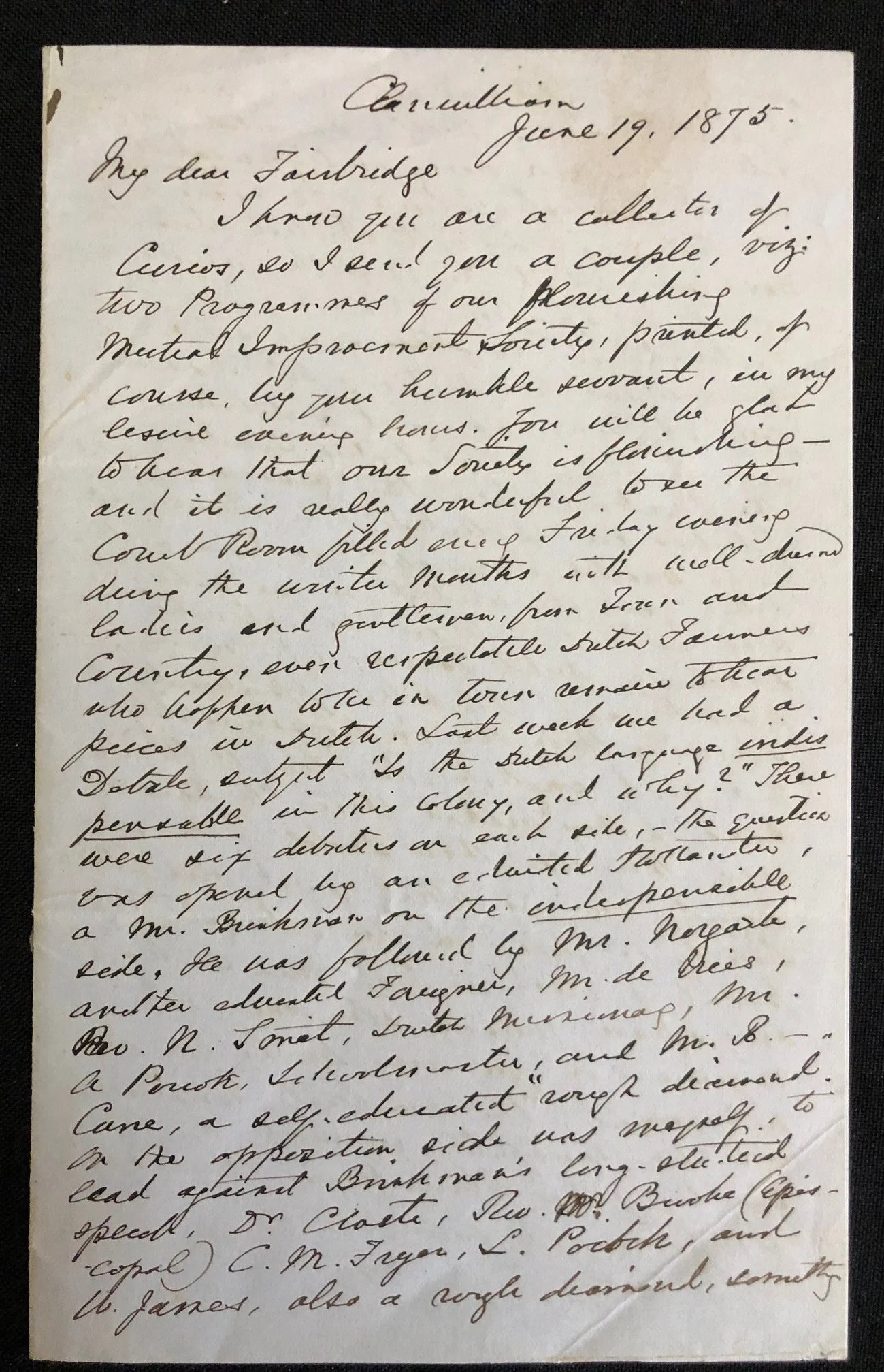
Four page manuscript (author unknown)This 1875 four-page letter is an extraordinary, deeply layered find. Written from Clanwilliam on June 19, 1875, it is addressed to "My dear Fairbridge"—almost certainly Charles Aken Fairbridge, the prominent Cape Town lawyer, parliamentarian, and one of the most legendary book and "curio" collectors in 19th-century South Africa (whose massive library formed the nucleus of the South African Library).
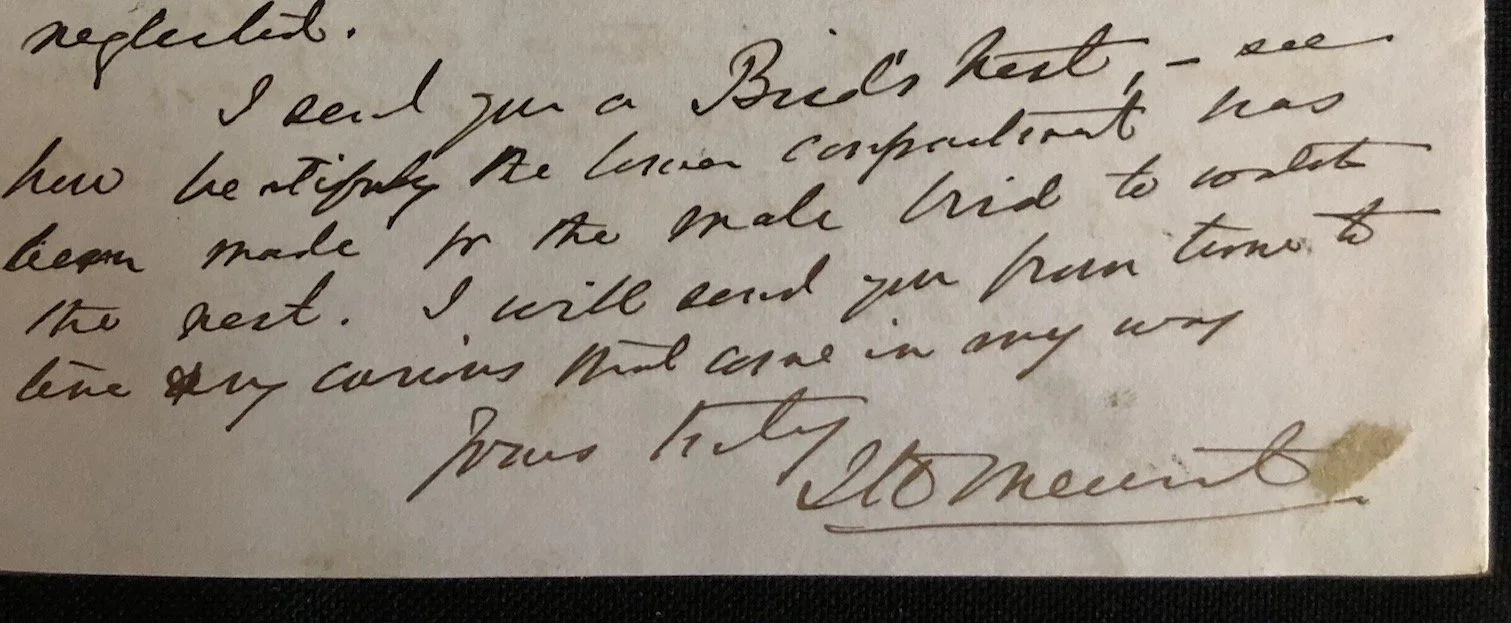
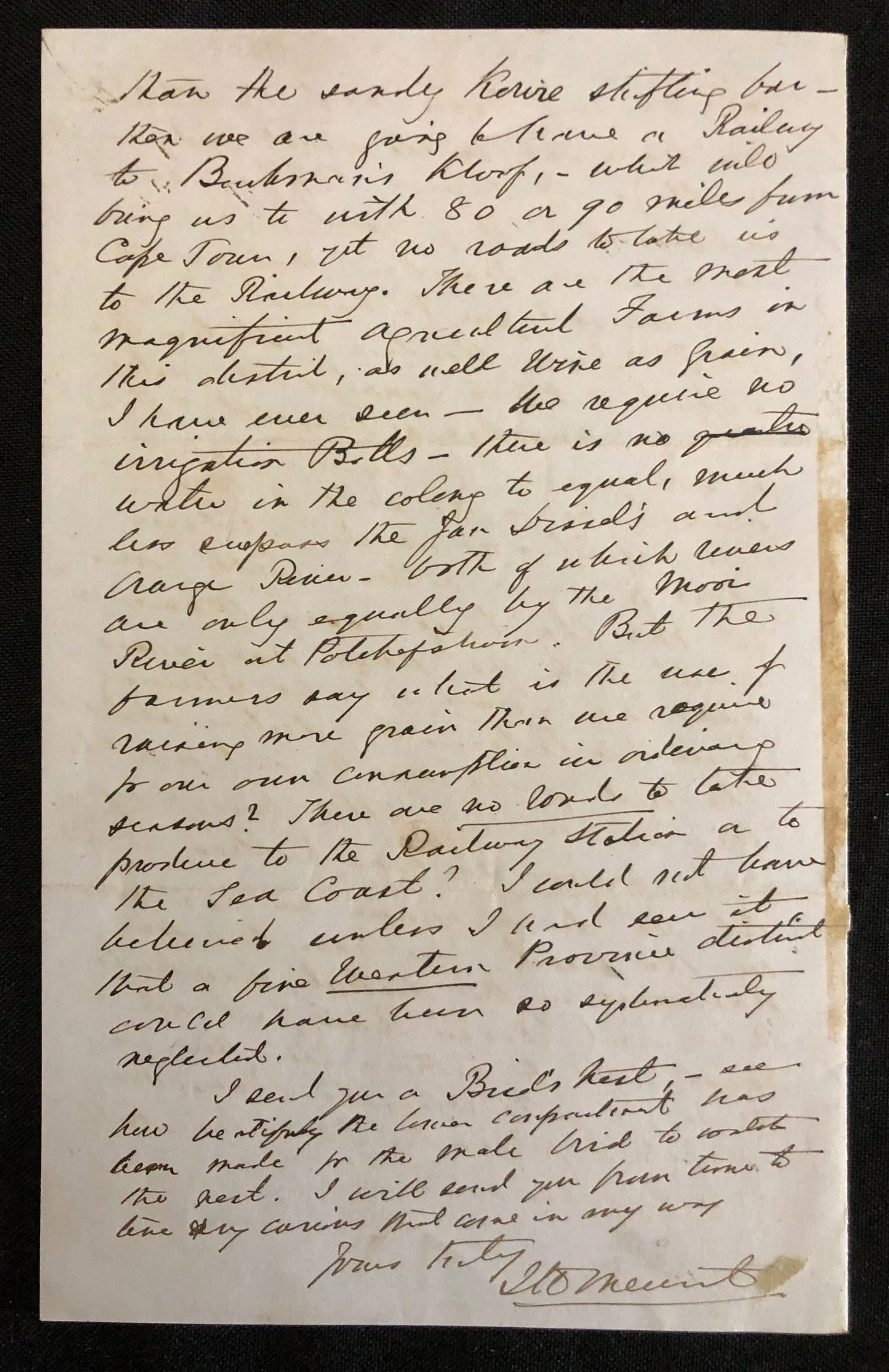
The letter is signed by an indecipherable signature.
Beyond its remarkable provenance, the letter is a goldmine of social, linguistic, and infrastructural history of the Western Cape during a volatile decade. Here are the most historically significant elements:
Ground Zero of the Language War: Is Dutch "Indispensable"?
The highlight of this letter is the detailed account of a debate held by the Clanwilliam Mutual Improvement Society on a burning political issue of the day:
"Last week we had a Debate, subject 'Is the Dutch language indispensable in this Colony, and why?'"
The Historical Context: In 1875, English was the sole official language of the Cape Colony, but the overwhelming majority of rural inhabitants spoke Cape Dutch or early Afrikaans. Just two months after this letter was written (August 1875), the Genootskap van Regte Afrikaners (Society of Real Afrikaners) was formed in Paarl, sparking the First Afrikaans Language Movement. This letter catches the exact cultural friction just before that explosion.
The Debaters: The writer lists the regional personalities involved, showcasing a fascinating mix of rural intelligentsia:
Pro-Dutch (Indispensable): Opened by "an educated Hollander, a Mr. Brinkman," followed by "Mr. Horak... Mr. de Vries, Rev. N. Smit (Dutch Minister), a Polish Schoolmaster, and M.B. Cane, a self-educated 'rough diamond'."
Pro-English/Anti-Dutch (The Opposition): Led by the writer himself, followed by Dr. Cloete, Rev. Mr. Burke (Episcopal), C.M. Fryer, L. Pocock, and W. James.
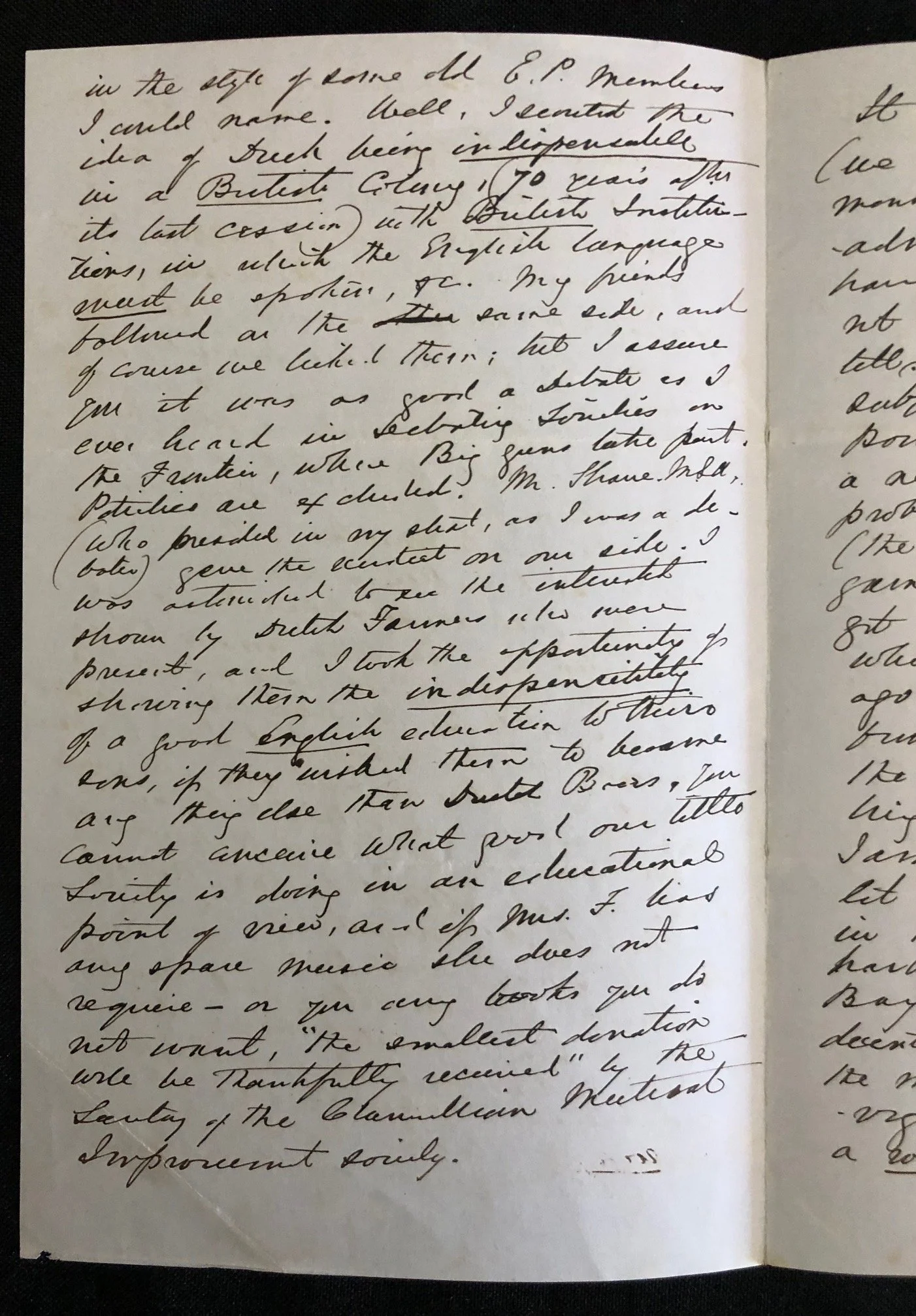
The Imperial Mindset: The writer proudly details how he "scouted the idea of Dutch being indispensable in a British Colony, 70 years after its last cession," arguing that Dutch farmers must give their sons a "good English education" if they wish them to become "anything else than Dutch Boers." He notes with satisfaction that even "respectable Dutch Farmers... remain[ed] to hear pieces in Dutch."
Infrastructure & "Splendid Neglect" of the West Coast
The latter half of the letter transforms into an impassioned grievance about the economic isolation and logistical nightmare of the Olifants River Valley and West Coast in the 1870s:
The Paradox of Wealth: The writer marvels at the agricultural richness of Clanwilliam, noting it has "the most magnificent agricultural Farms in this district, as well Wine as Grain, I have ever seen" requiring absolutely no artificial irrigation.
No Way Out: Despite the abundance, the farmers are despairing: "What is the use of raising more grain than we require for our own consumption... [when] there are no roads to take produce to the Railway Station or to the Sea Coast?"
The Transport Crisis: He mentions a proposed railway to "Brinkman's Kloof" (which would bring them within 80 or 90 miles of Cape Town), but laments that there are still no roads connecting the farms to the projected line. He lambasts the Cape government for how a "fine Western Province district could have been so systematically neglected."
The Unnavigable Rivers and Harbours: He outlines the regional geography, noting they have two fine natural harbors at Lambert's Bay and "Doorn Baai" (Doringbaai), but "not a decent road to either." He also mentions the mouth of the "Olifants River", which is navigable for nearly 30 miles inland, but blocked by a treacherous, shifting "rocky bar" that prevents shipping.
The 19th-Century "Mutual Improvement" Movement
The letter offers a vivid snapshot of colonial social life through the Clanwilliam Mutual Improvement Society.
These societies were Victorian engines of self-education, literature, and debate, acting as the cultural hubs of isolated rural towns.
The writer describes the Court Room being packed every Friday evening during the winter months with "well-dressed ladies and gentlemen from Town and Country." * Desperate for intellectual stimulation to avoid dying of "ennui in this oasis in the desert," he begs Fairbridge to donate any spare music or books, utilizing the classic charity line: "The smallest donation will be thankfully received."
Colonial Natural History Collecting
The letter closes with a wonderful nod to Fairbridge’s reputation as a collector of natural curiosities. The writer encloses a bird's nest (specifically pointing out how beautifully the lower compartment was constructed for the male bird to watch the nest) and promises to send more "curios that come in my way." This reflects the massive 19th-century amateur obsession with South African ornithology and botany, where rural residents constantly channeled specimens back to intellectual figures in Cape Town.
Why this is a rare collector's piece:
It anchors a highly specific, localized debate on the exact eve of the rise of Afrikaner nationalism and the Afrikaans language movement, written by a staunch British loyalist who is watching the local "Dutch" population closely. Paired with the vivid descriptions of early Lambert's Bay, Doringbaai, and the Olifants River before modern roads and railways transformed the West Coast, it is a spectacular piece of Western Cape history.
115mm x 185mm
Some marks to the edges; stain along the back edge.
Sold Sept '26