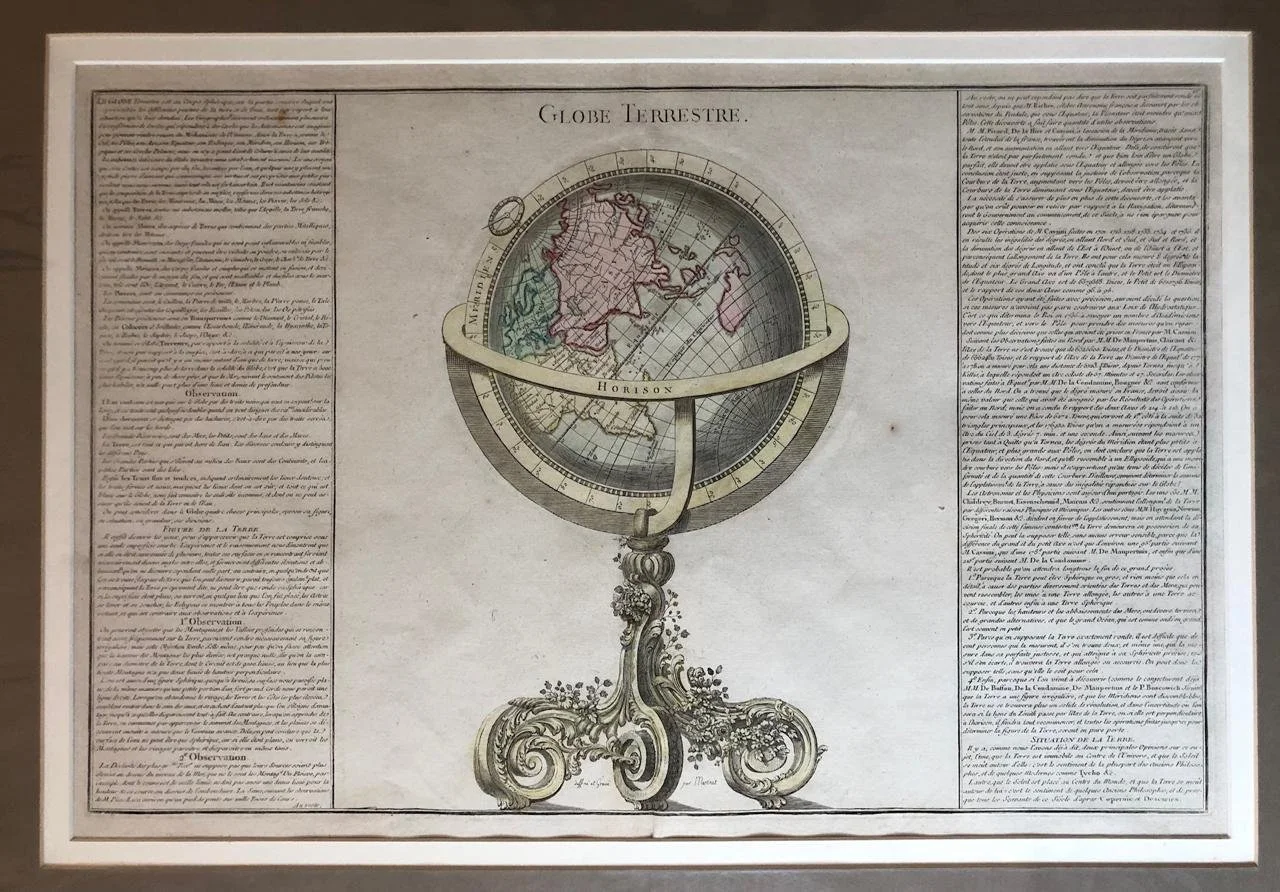
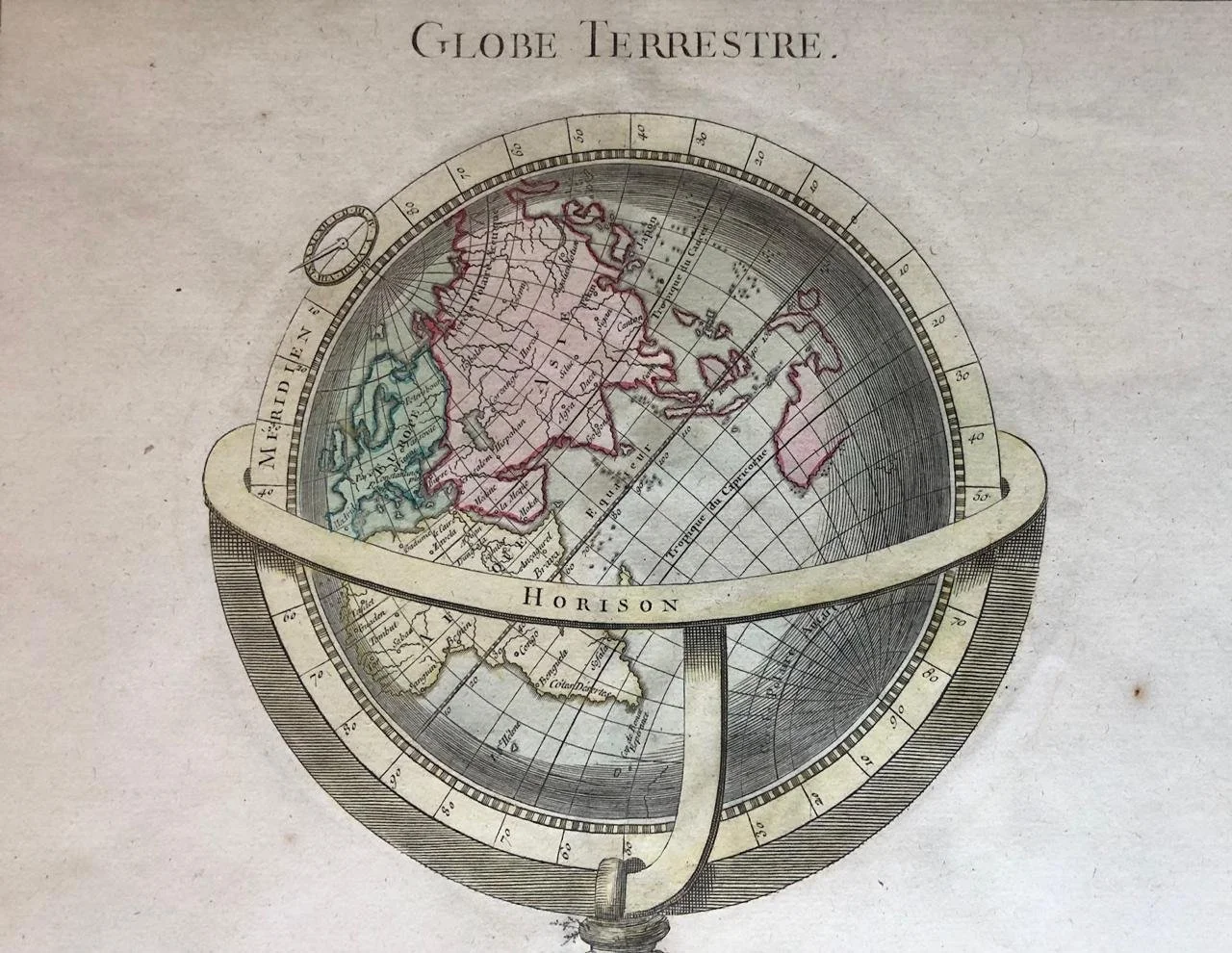
Terrestrial Globe of the Eastern Hemisphere
By Brion De La Tour (1757-1800) & Louis Desnos.
Hand coloured copperplate engraving. This double page globe is decorated with a lavish Rococo style base. The accompanying text on either side details the latest scientific information.
480mm x 350mm
R5,000
This mid-18th-century French engraving, titled Globe Terrestre (drawn and engraved by J. Mazeret), is historically fascinating because it is not merely a world map—it is a scientific visual manifesto recording one of the most famous intellectual feuds in the history of astronomy and geodesy: The Figure of the Earth Controversy.
Key Historical & Scientific Aspects
Newton vs. Cassini (Oblate vs. Prolate Spheroid): During the early-to-mid 18th century, European scientists were fiercely divided over the exact shape of the planet:
Sir Isaac Newton argued that Earth’s rotation creates centrifugal force, flattening it at the poles into an oblate spheroid (like an orange).
Jacques Cassini and the French Academy of Sciences claimed French meridian measurements proved the Earth was elongated at the poles into a prolate spheroid (like a lemon or football).
Recording the Historic Geodesic Expeditions: The dense French columns flanking the globe explicitly detail the results of the two landmark French Geodesic Missions sent by King Louis XV in the 1730s–1740s to settle the dispute:
The Lapland Expedition (1736): Led by Pierre Louis Maupertuis to Torne Valley near the Arctic Circle.
The Equatorial Expedition (1735–1743): Led by Charles Marie de La Condamine and Pierre Bouguer to the Viceroyalty of Peru (modern-day Ecuador).
The text cites Maupertuis and La Condamine, concluding that degree measurements near the Equator versus the Arctic proved Newton right—Earth is flattened at the poles. Voltaire famously mocked Maupertuis for having "flattened both the Earth and Cassini."
Ornate Rococo Armillary Stand: The globe is set within an elaborate Rococo three-legged stand decorated with scrolling acanthus leaves, flower garlands, and a wide horizon ring labeled HORISON. This reflects the mid-18th-century French aristocratic custom of displaying terrestrial and celestial globes in cabinet libraries as symbols of Enlightenment intellect and court prestige.
Transition from Geocentric to Heliocentric Theory: The final section at the bottom right (Situation de la Terre) summarizes the ongoing philosophical shift from Tycho Brahe’s geocentric system to Copernicus and Descartes’ heliocentric model, capturing the exact era when modern science reshaped Western education.