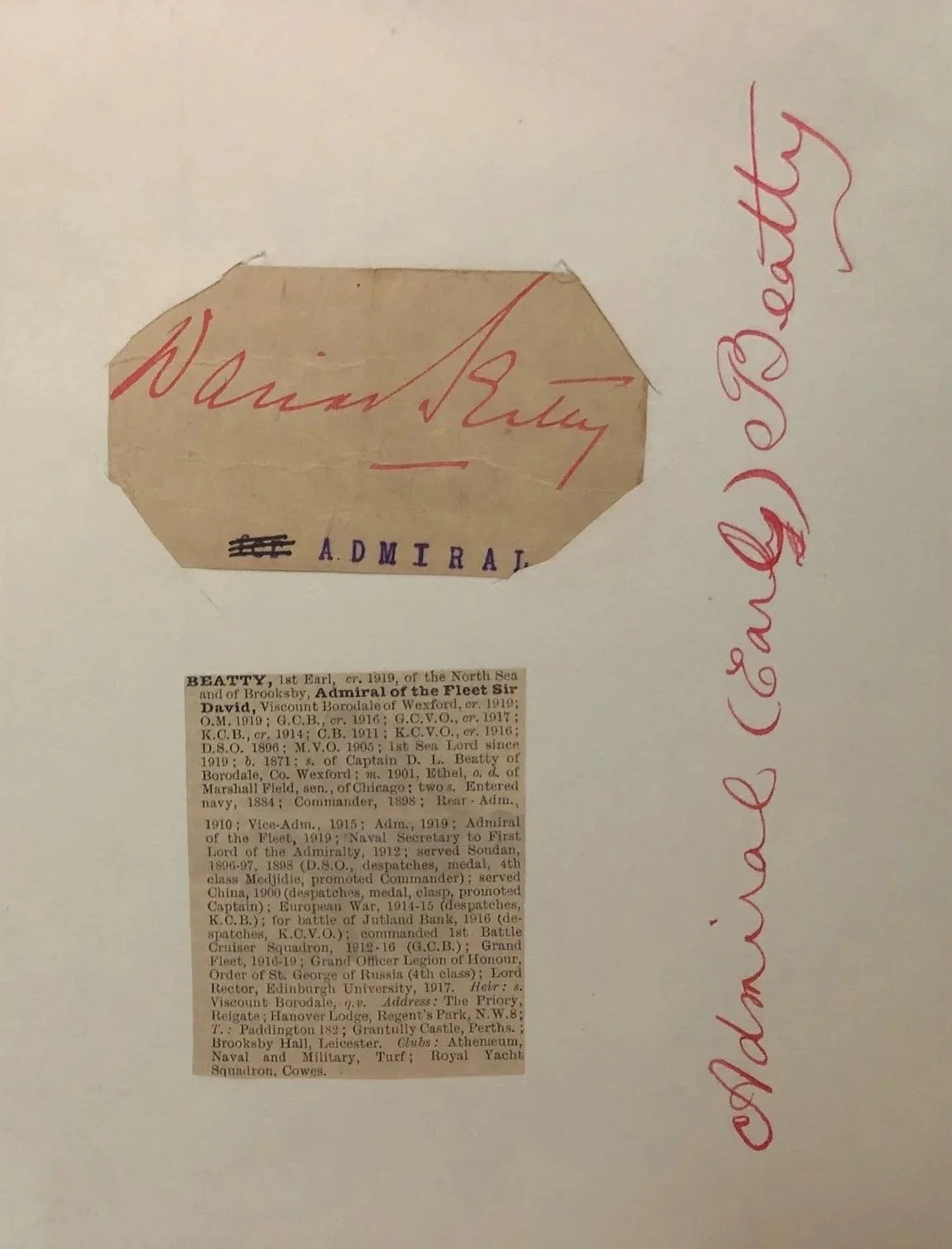
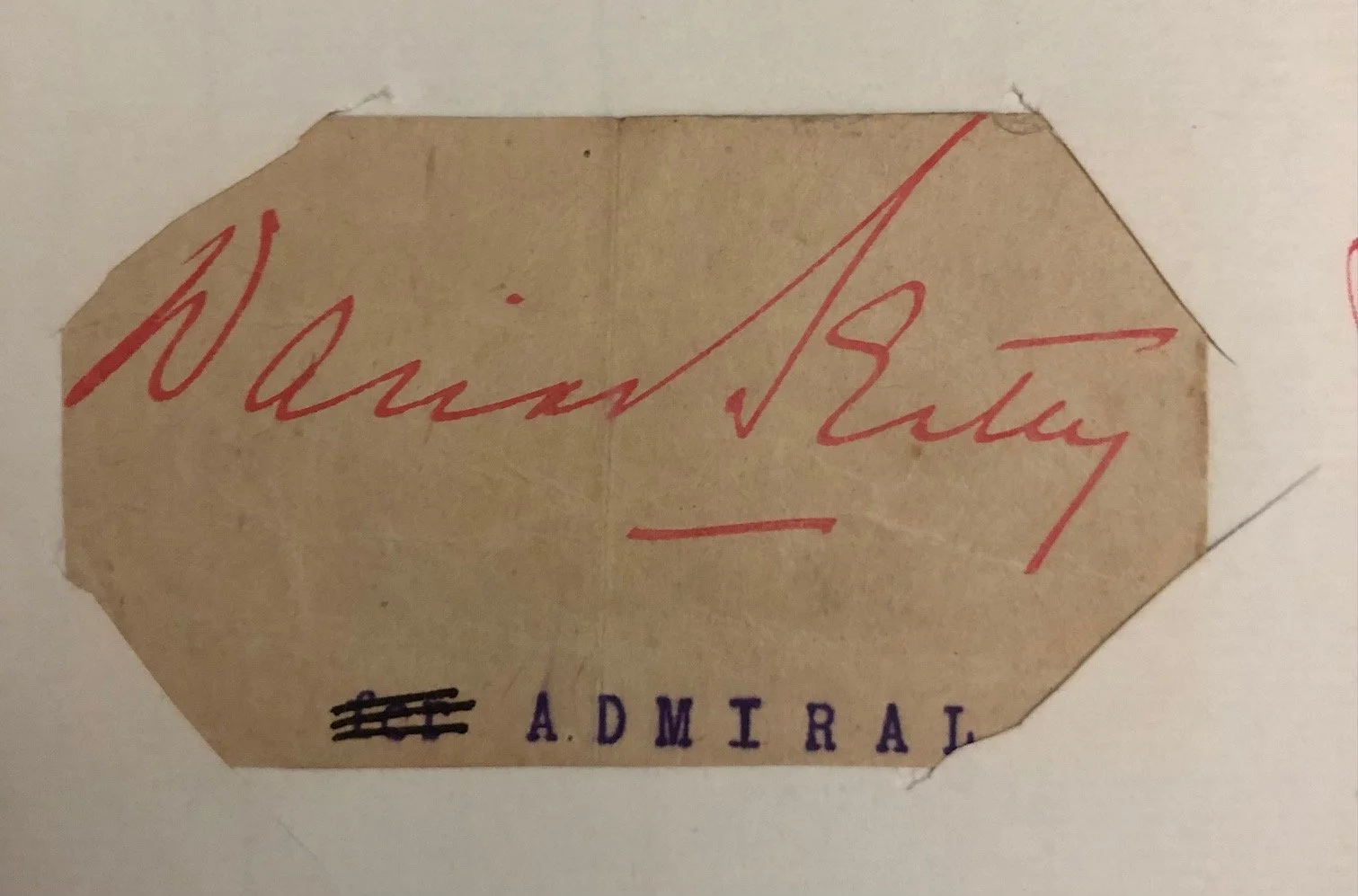
Autograph of Admiral of the Fleet David Beatty, 1st Earl Beatty (c.1920’s)
The clipping and signature scrap pasted in belong to one of the most polarizing, flamboyant, and historically significant naval figures of the 20th century: Admiral of the Fleet David Beatty, 1st Earl Beatty (1871–1936).
Distinctive signature in red ink, written vertically across a piece of official stationery that still bears part of his printed rank: "ADMIRAL".
Why Admiral Beatty remains a legendary figure of the First World War era:
The "Rockstar" of the Royal Navy
Unlike many of his stuffy Victorian-era peers, Beatty was a media sensation. He deliberately cultivated a dashing, non-conformist image that drove the British public wild:
The Non-Regulation Cap: He famously wore a bespoke naval cap with six gold-braid rings instead of the mandatory eight, tilted at a rakish, jaunty angle over his left eye.
The Six-Button Jacket: He wore a custom double-breasted uniform jacket with six buttons instead of the standard five, creating an iconically tailored silhouette.
A Fatalistic Wit under Fire
Beatty commanded the British Battlecruiser Fleet at the Battle of Jutland (1916), the largest naval clash of WWI. During the early stages of the battle, two of his massive battlecruisers (HMS Indefatigable and HMS Queen Mary) were catastrophic failures—both hit by German shells, exploding violently and sinking in minutes with almost total loss of life.
Upon watching his ships vanish, Beatty turned to his Flag Captain and uttered one of the most famous understatements in military history:
"There seems to be something wrong with our bloody ships today."
Despite these early losses, his aggressive, hard-charging style ultimately drew the German High Seas Fleet into the trap laid by the main British Grand Fleet.
The American Connection (Noted in the Text)
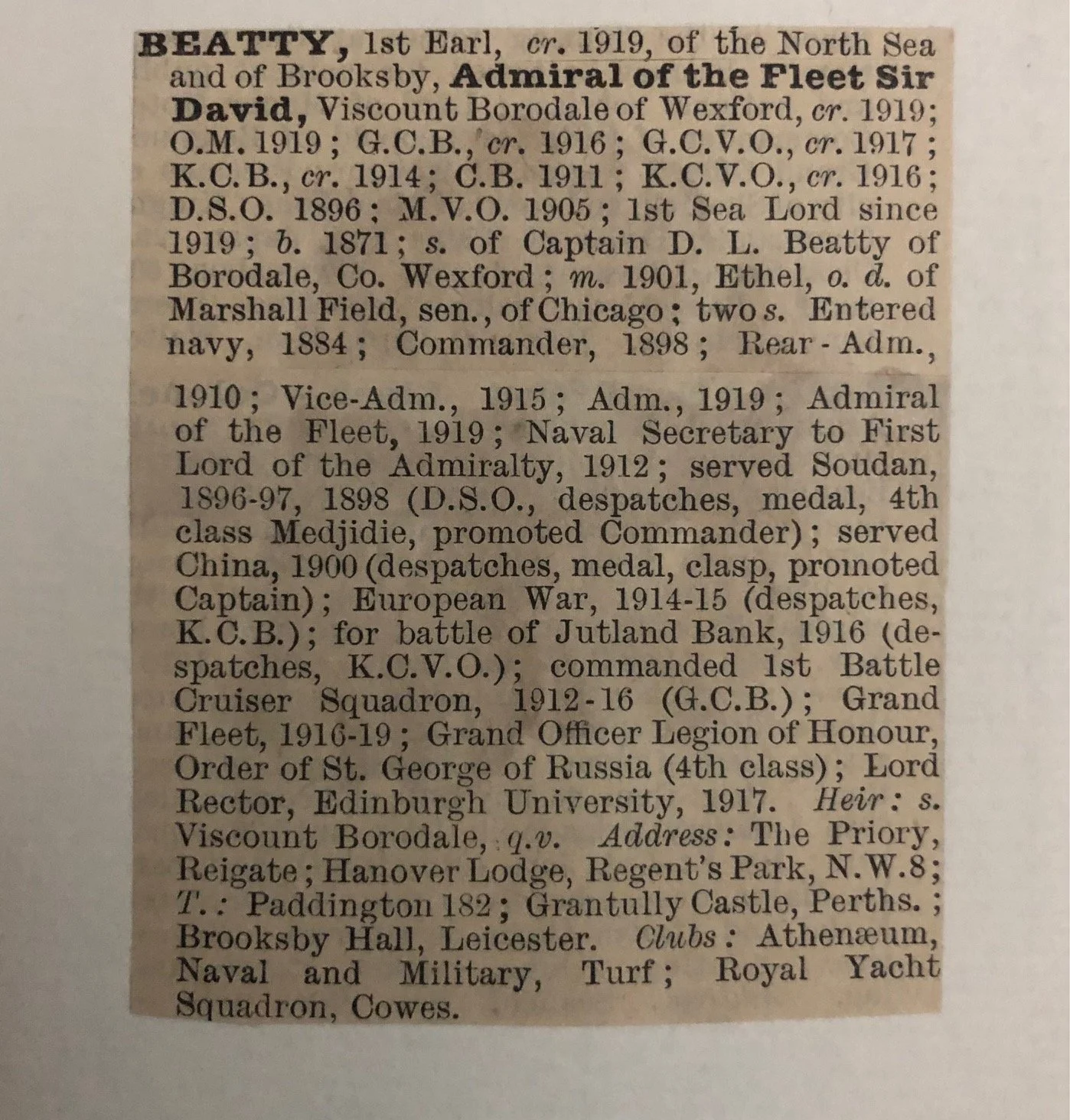
The printed biographical snippet mentions that he married "Ethel, a. d. of Marshall Field, sen., of Chicago" in 1901.
Ethel Field was a fabulously wealthy American heiress (her father founded the Marshall Field's department store empire). Her immense wealth funded Beatty's incredibly lavish lifestyle, allowing him to buy massive country estates (like Brooksby Hall, mentioned in the text), maintain yachts, and mix with the highest echelons of British society. This connection propelled his rapid rise through the navy, making him the youngest Admiral in the Royal Navy since Lord Nelson.
A Clue to the Scrap's Date
The red ink annotation at the bottom reads "Admiral (Earl) Beatty". This indicates a very specific timeline for whoever assembled this archive:
Beatty was promoted to Admiral of the Fleet and created Earl Beatty in 1919, following the conclusion of WWI.
Because the clipped biography lists his address as The Priory, Reigate and Hanover Lodge, Regent's Park, it was likely cut from a contemporary edition of Who's Who printed in the early 1920s, reflecting the peak of his post-war fame.
Page size: 240mm x 215mm
R1,000