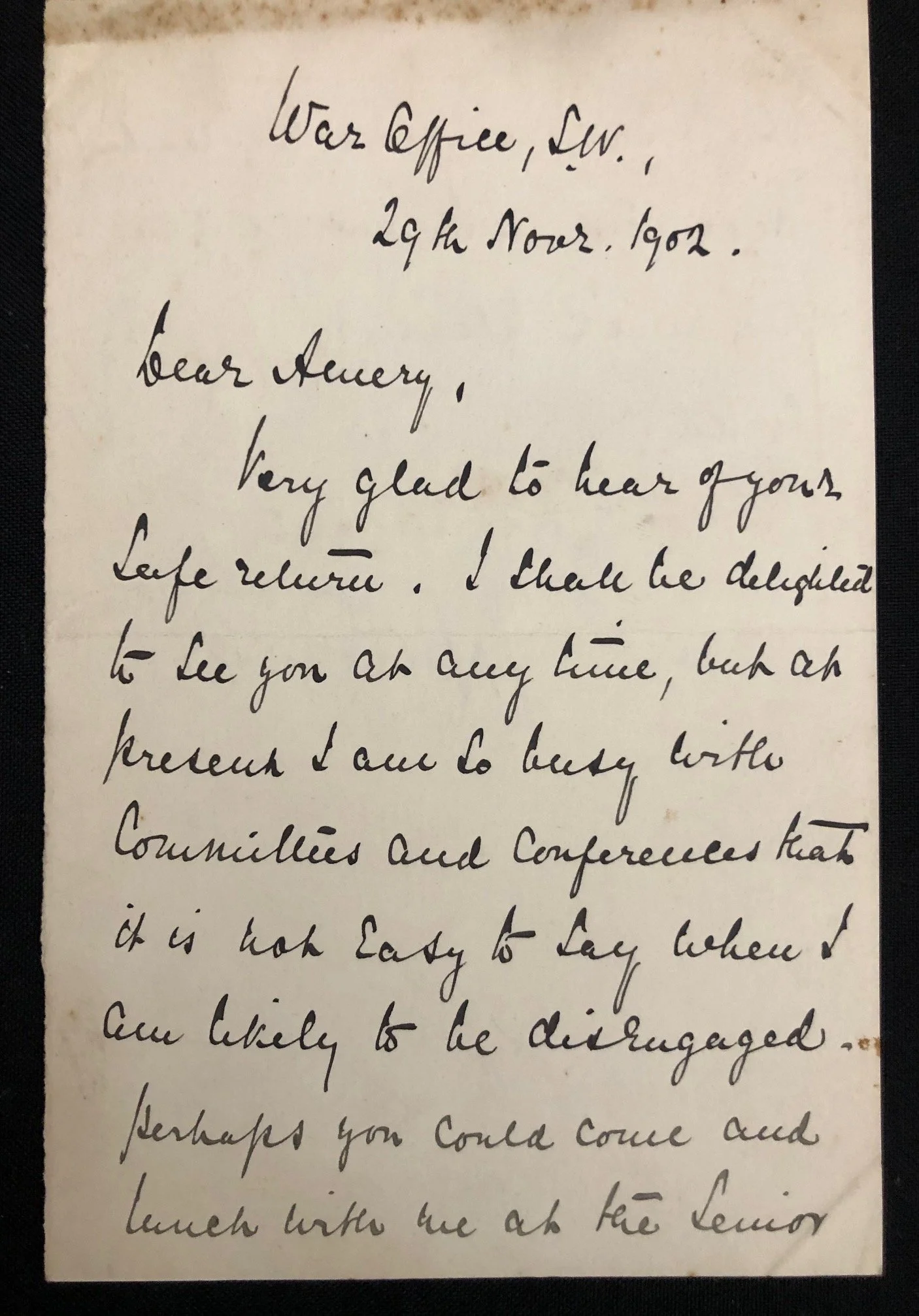
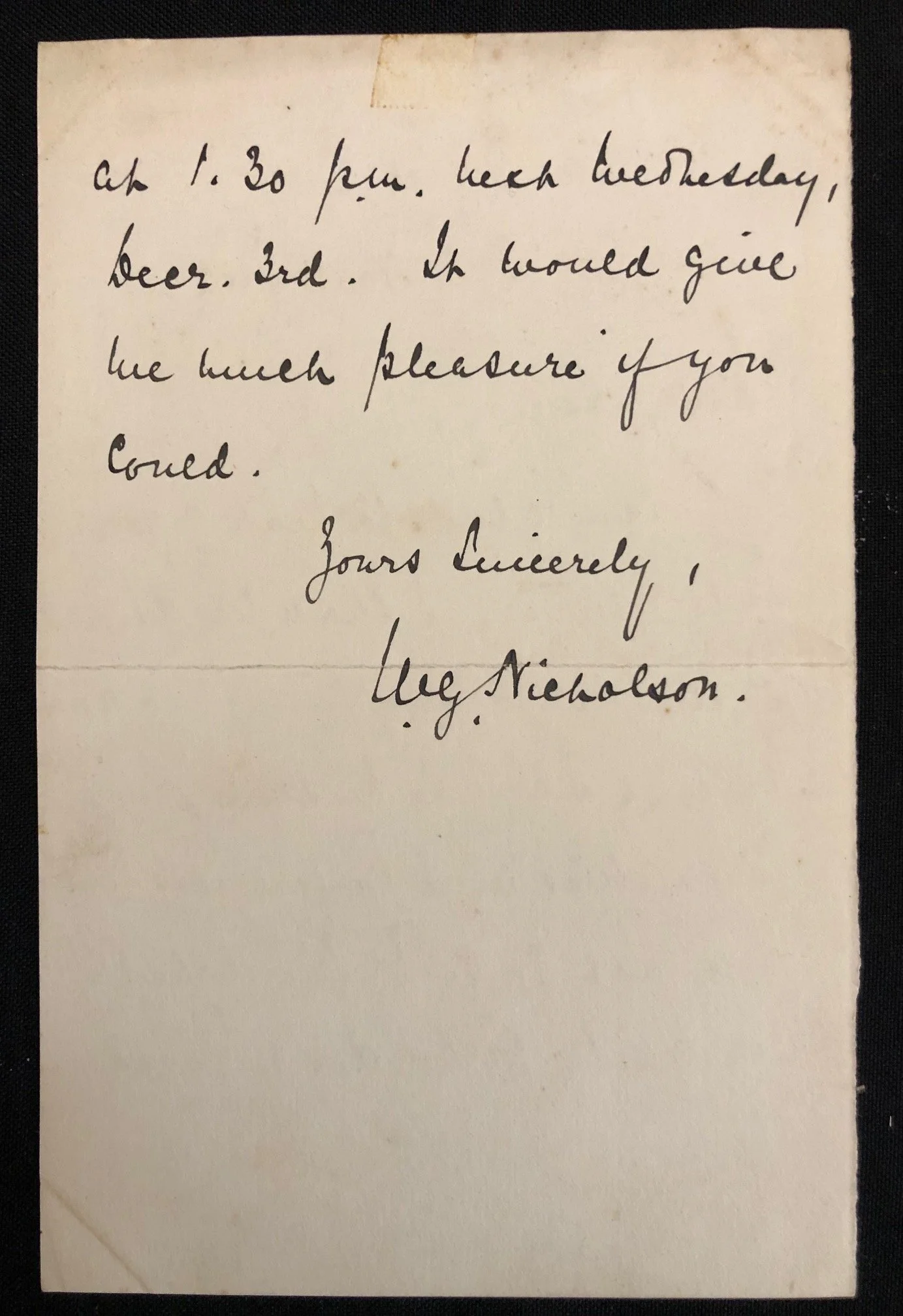
Letter: General Nicholson to Leo Amery (1902)
Two-page letter providing an intimate glimpse into the high-stakes machinery of the British Empire at a critical post-war turning point.
Written on November 29, 1902, from the War Office, it is addressed to "Dear Amery" and signed by W.G. Nicholson (William Gustavus Nicholson).
The Context: The Immediate Aftermath of the Anglo-Boer War
The letter is dated November 29, 1902—just six months after the signing of the Treaty of Vereeniging (May 1902), which concluded the grueling three-year South African War. Nicholson writes:
"Very glad to hear of your safe return."
This is a direct reference to Leo Amery returning to England from South Africa. Amery had spent the war on the ground as the chief war correspondent for The Times. He wasn't just reporting; he was gathering an immense amount of first-hand testimony, documents, and operational insights to compile what would become the definitive (and highly critical) multi-volume work, The Times History of the War in South Africa.
The Recipient: Leo Amery, the Architect of Reform
Leo Amery went on to become one of the most influential political and imperial figures of the early 20th century (later serving as First Lord of the Admiralty and Secretary of State for India). At the moment this note was penned, Amery was using his Times platform to relentlessly expose the systemic incompetence, outdated tactics, and logistical failures of the British Army during the Boer War. His writings single-handedly forced a public reckoning regarding the state of imperial defense.
The Sender: The "Whitehall Warrior" Under Pressure
In 1902, Major-General Sir William Gustavus Nicholson (later Field Marshal Lord Nicholson) was serving as the Director-General of Military Intelligence (DGMI) at the War Office.
In this letter Nicholson excuses his lack of immediate availability by saying:
"I shall be delighted to see you at any time, but at present I am so busy with Committees and Conferences that it is not easy to say when I am likely to be disengaged."
This "busyness" is an understatement. In late 1902, the War Office was under massive scrutiny. The Royal Commission on the War in South Africa (the Elgin Commission) was actively underway, investigating why the British military had been so woefully unprepared. As head of intelligence, Nicholson was routinely called to testify, defending his department's pre-war mapping failures, intelligence gathering, and logistical hurdles in the Transvaal and Orange Free State.
The British Military's Great Turning Point
The "Committees and Conferences" Nicholson mentions were part of the foundational steps toward the complete overhaul of the British military. The failures exposed by Amery and investigated by Nicholson's contemporaries directly led to the 1904 Esher Committee reforms. These reforms abolished the old command structure and established a modern General Staff—a body Nicholson would eventually head as Chief of the Imperial General Staff (CIGS) in 1908.
Summary of the Text
For archival reference, the note reads:
War Office, S.W.,
29th Novr. 1902.
Dear Amery,
Very glad to hear of your safe return. I shall be delighted to see you at any time, but at present I am so busy with Committees and Conferences that it is not easy to say when I am likely to be disengaged. Perhaps you could come and lunch with me at the Senior
at 1.30 p.m. next Wednesday, Decr. 3rd. It would give me much pleasure if you could.
Yours Sincerely,
W.G. Nicholson.
(Note: "The Senior" refers to the Senior United Service Club on Pall Mall, the traditional London club for high-ranking military officers).
Front and Back manuscript letter; creased; some staining.
115mm x 175mm
R2,000