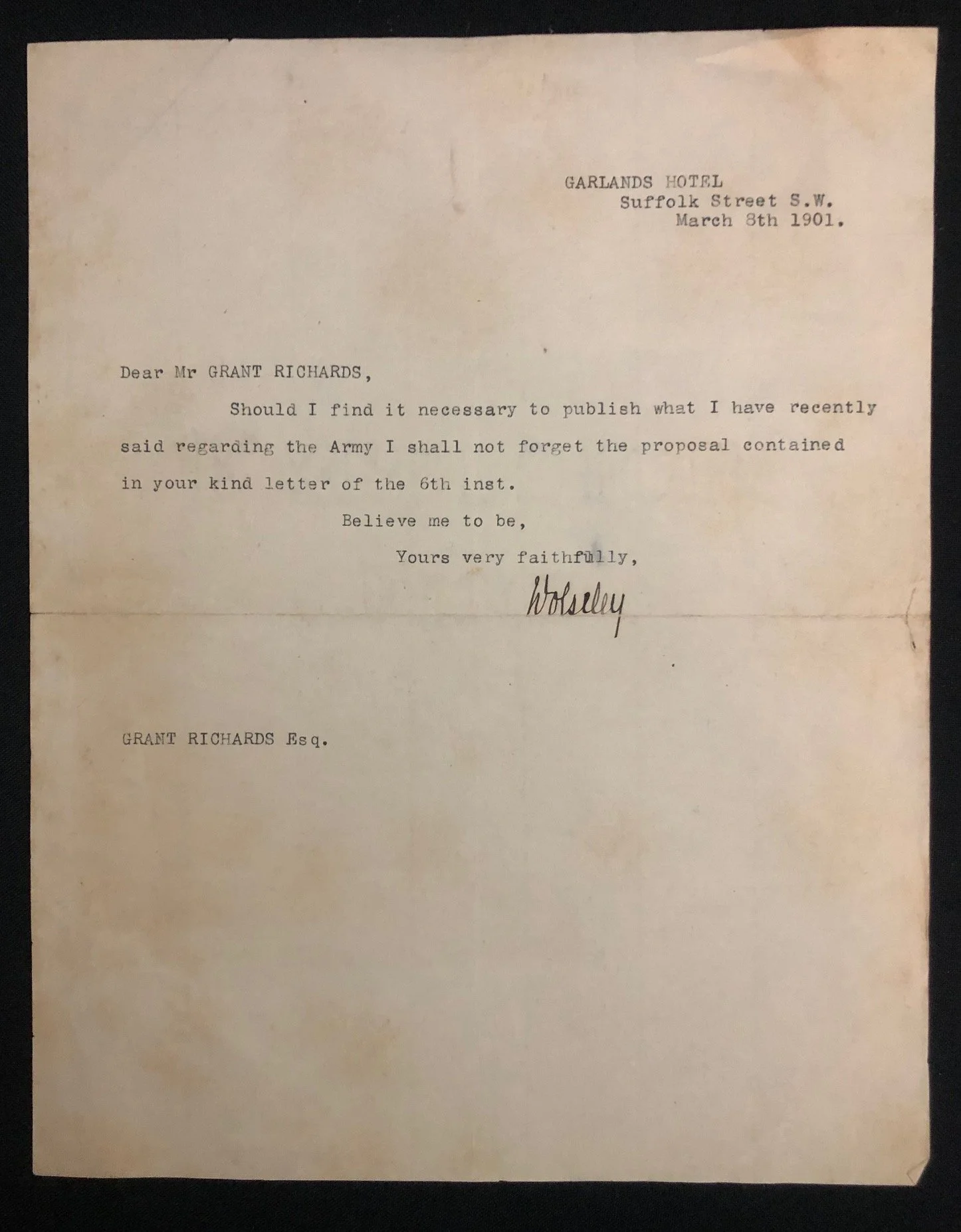
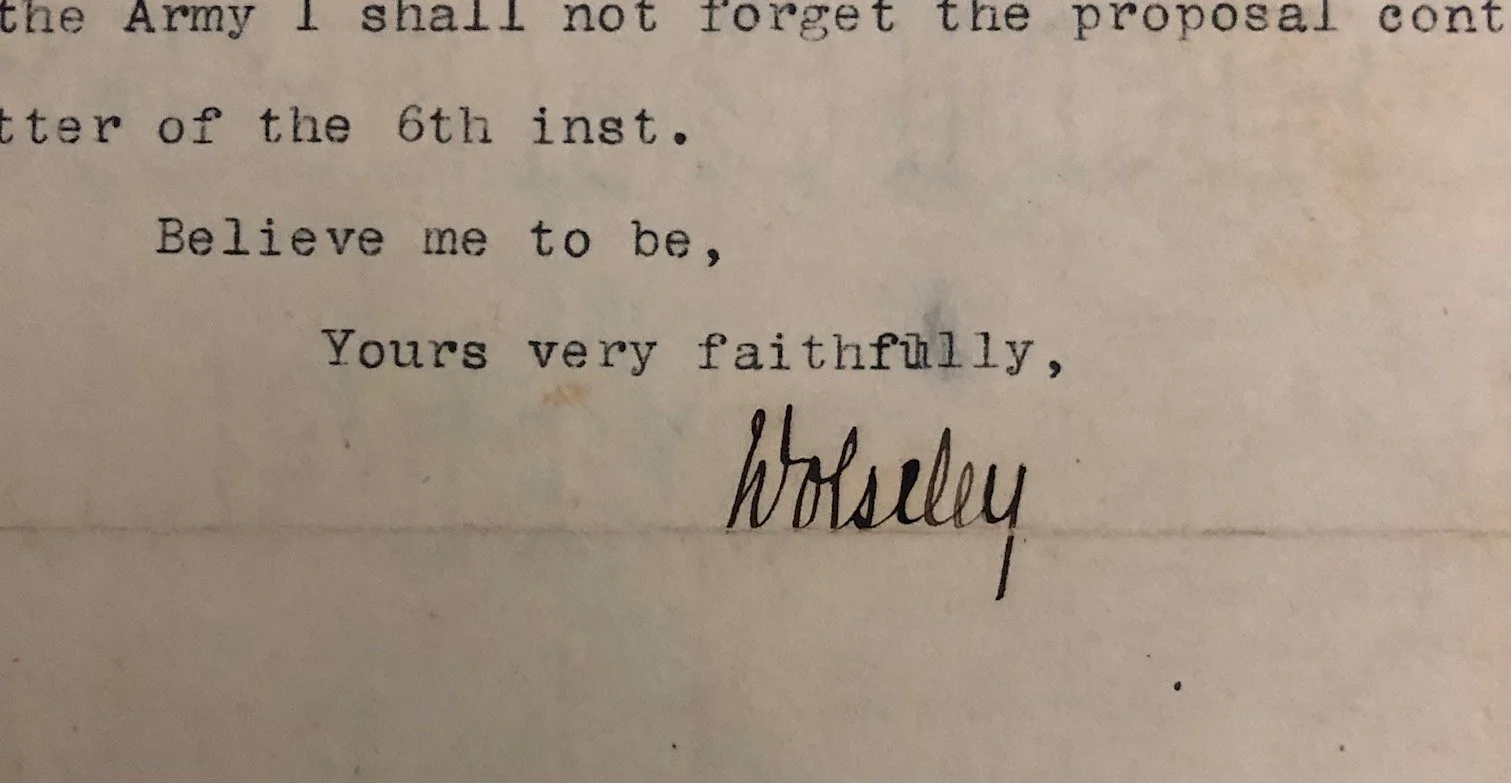
Letter signed by Field Marshal Garnet Wolseley - Boer War (1901)
The letter captures a moment of intense political drama and military scandal at the very height of the Second Anglo-Boer War.
Written on March 8th, 1901, from the Garlands Hotel in London, it is signed by Field Marshal Garnet Wolseley, 1st Viscount Wolseley, and addressed to the prominent avant-garde publisher Grant Richards.
The "Our Only General" Caught in a Political Firestorm
When Lord Wolseley wrote this letter, he had stepped down as Commander-in-Chief of the British Army only a few months prior (in late 1900), handing the reins over to Lord Roberts. Wolseley was one of the most famous British military figures of the 19th century—so famously efficient that the phrase "everything's Sir Garnet" became British slang for "everything is in perfect order."
However, by March 1901, everything was decidedly not in order. The British military was facing severe public and parliamentary criticism for its early, catastrophic blunders in South Africa (such as "Black Week"). To deflect blame, the Secretary of State for Foreign Affairs, Lord Lansdowne, stood up in the House of Lords and publicly accused Wolseley of failing to give proper military advice and neglecting the state of the army.
The Context of the Letter: A Silenced Expository?
Wolseley mentions to Grant Richards:
"Should I find it necessary to publish what I have recently said regarding the Army I shall not forget the proposal contained in your kind letter..."
The "what I have recently said" refers to a massive, ongoing constitutional row. Just days before this letter was written, a bitter debate erupted over a secret memorandum Wolseley had sent to Lord Salisbury, in which he fiercely condemned the War Office's civilian interference, calling the Commander-in-Chief a mere "fifth wheel to the coach".
Knowing that Wolseley was furious and looking to vindicate his reputation, the entrepreneurial publisher Grant Richards immediately pounced, writing to Wolseley on March 6th (the "6th inst." referenced in the letter) to offer him a book deal to publish his defense and expose the cracks in the British military system.
Why it Matters: The Birth of Modern Military Reform
Ultimately, Wolseley chose the floor of Parliament over Grant Richards' publishing house to air his grievances. Exactly one week after writing this letter, on March 15, 1901, Wolseley delivered a sensational speech in the House of Lords. He laid bare how obsolete the army's artillery was, warning that sending volunteers into action with such equipment was "a crime".
This bitter public spat between Wolseley and the government was a watershed moment. It forced the British state to reckon with the fact that its Victorian-era military administration was completely unfit for 20th-century warfare, directly paving the way for the sweeping Haldane Reforms that modernized the British Army before World War I.
The Recipient: Grant Richards
The recipient, Grant Richards, was not a traditional military publisher. He was a daring, often cash-strapped figure in the Edwardian literary scene who famously published George Bernard Shaw, G.K. Chesterton, and later, James Joyce’s Dubliners. Snagging the explosive memoirs or defense of Britain’s most famous living Field Marshal would have been an absolute coup for his firm, though Wolseley's caution kept the project from materializing at that moment. (Wolseley would eventually publish his broader memoirs, The Story of a Soldier's Life, with Constable & Co. in 1903).
205mm x 265mm
Creased; minor stains and folds.
R2,000