Joseph Chamberlain to "Captain Phillpotts" West Africa (1898)
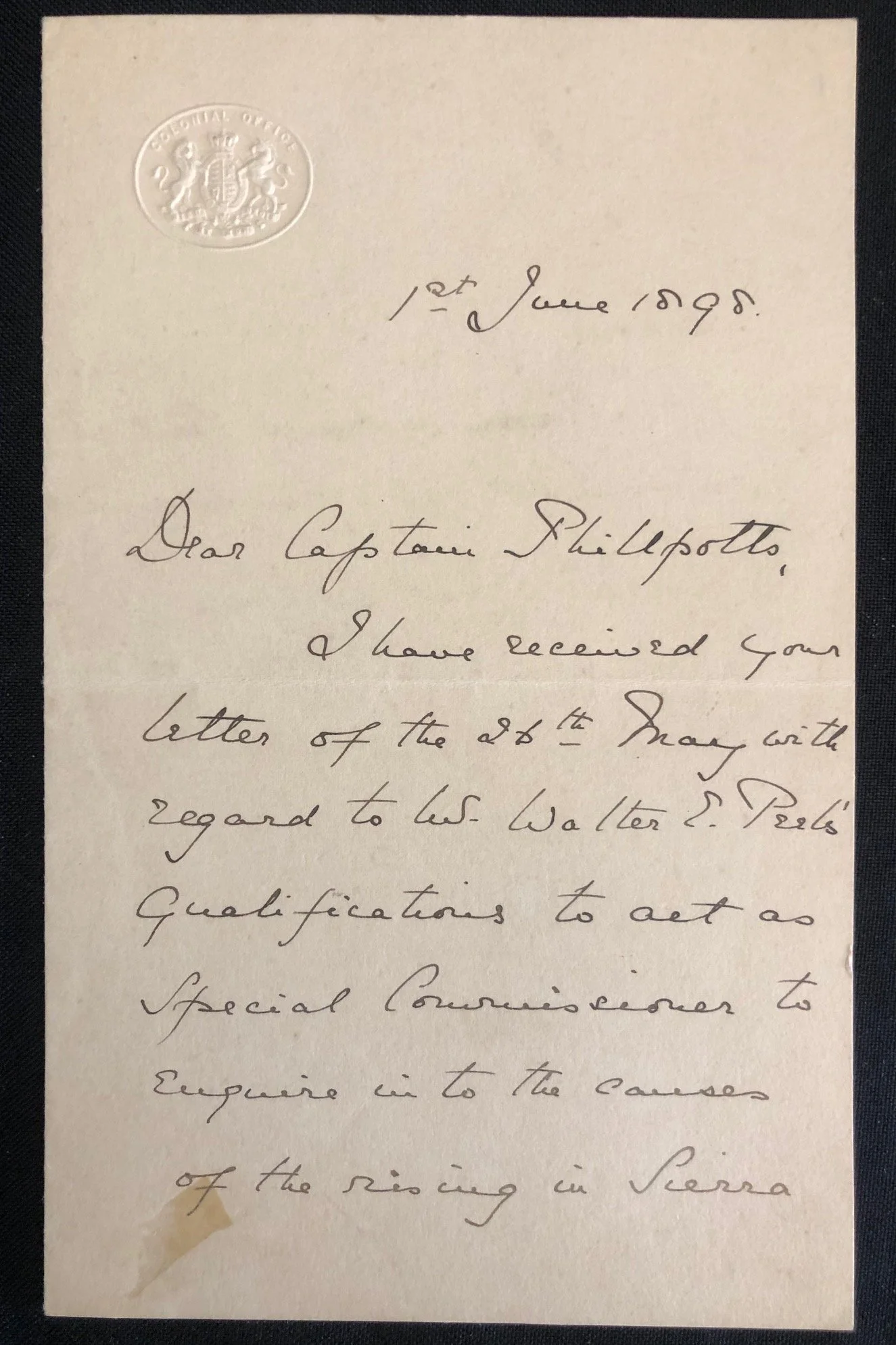
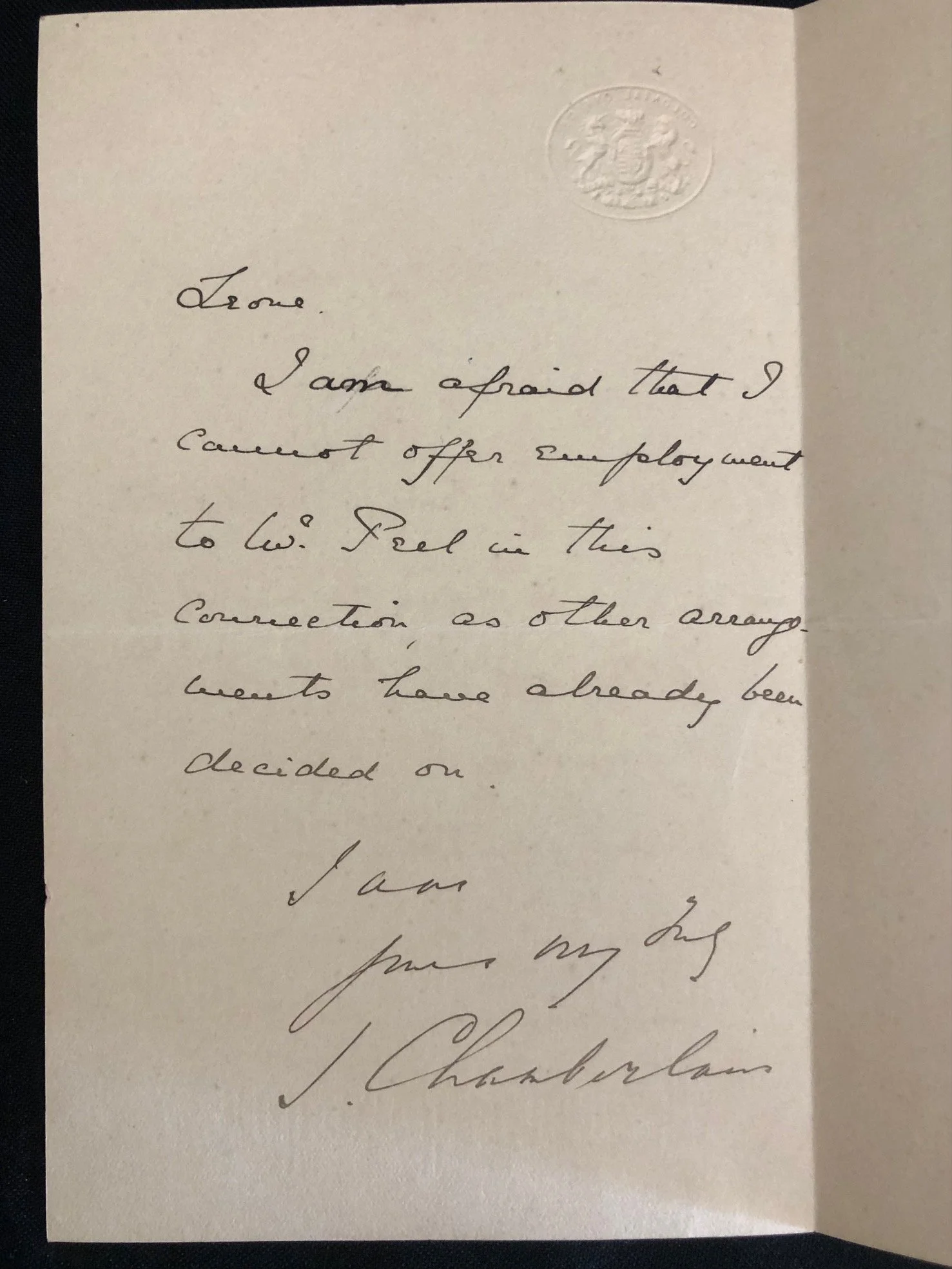
Two-page letter, spanning (the first page) and (the final page), is a remarkable piece of West African colonial history. Dated 1st June 1898 and bearing the crisp, embossed royal seal of the Colonial Office, it is written and signed by the Secretary of State for the Colonies, Joseph Chamberlain, to a "Captain Phillpotts."
The letter captures the immediate, behind-the-scenes administrative response to one of the most significant anti-colonial rebellions in West African history: The Hut Tax War of 1898 in Sierra Leone.
The Context: The Hut Tax Rebellion of 1898
Chamberlain addresses a recommendation for a candidate to investigate a crisis:
"...with regard to Mr. Walter E. Peel's Qualifications to act as Special Commissioner to Enquire into the causes of the rising in Sierra Leone."
The "rising" Chamberlain is referring to had broken out just months earlier, in February 1898. The British Governor of Sierra Leone, Sir Frederic Cardew, had imposed a highly unpopular tax on all native dwellings ("huts") to fund the extension of colonial administration and infrastructure into the protectorate interior.
The tax triggered a massive, highly coordinated armed resistance. It was led initially in the north by the formidable Temne chief Bai Bureh, and subsequently spread to the south among the Mende people. The conflict was brutal and costly, paralyzing the colony and causing a major political scandal back home in London.
The Political Pressure on Joseph Chamberlain
As Colonial Secretary, Joseph Chamberlain was under immense fire from the British public, humanitarian groups (like the Aborigines' Protection Society), and Manchester merchants whose West African trade had been completely disrupted by the war. Critics accused the local colonial government of harsh tax collection methods and unnecessary provocation.
To quiet the storm, Chamberlain had to quickly appoint an independent "Special Commissioner" to sail to Freetown, investigate the root causes of the rebellion, and determine if Governor Cardew's tax policy was entirely to blame.
The Rejection of Peel and the Appointment of Chalmers
Chamberlain politely but firmly shuts down Captain Phillpotts’ recommendation for Walter E. Peel:
"...I am afraid that I cannot offer employment to Mr. Peel in this connection as other arrangements have already been decided on."
Historically, we know exactly what those "other arrangements" were. Just around the time this letter was penned, Chamberlain officially selected Sir David Chalmers, a seasoned former Chief Justice of the Gold Coast and British Guiana, to head the royal commission.
When Chalmers eventually delivered his massive report later that year, he completely vindicated the native population, fiercely criticized Governor Cardew's aggressive administration, and recommended that the Hut Tax be abolished. (In a classic move of imperial self-defense, however, Chamberlain ultimately ignored his own commissioner's advice, sided with the Governor, and maintained the tax to avoid looking weak).
The Recipient: A Naval Connection
The recipient, Captain Phillpotts, was likely Captain Arthur S. Phillpotts, a Royal Navy officer who also served as a Member of Parliament (MP) for Torquay during this exact period (1895–1900). It was incredibly common for well-connected military officers and MPs to lobby Chamberlain for lucrative colonial appointments or commissions on behalf of friends and relatives—a practice Chamberlain manages here with practiced diplomatic brevity.
Summary of the Text
For archival reference, the complete text reads:
Colonial Office [Embossed Seal]
1st June 1898.
Dear Captain Phillpotts,
I have received your letter of the 26th May with regard to Mr. Walter E. Peel's Qualifications to act as Special Commissioner to Enquire into the causes of the rising in Sierra Leone.
I am afraid that I cannot offer employment to Mr. Peel in this connection as other arrangements have already been decided on.
I am
yours very truly
J. Chamberlain
Manuscript letter on 2 pages. Some minor stains.
110mm x 180mm
R2,000