Sir James Wellwood Moncreiff, 9th Baronet, Scotland (1815)
Original 1815 transatlantic stampless folded letter written in the immediate aftermath of the Napoleonic Wars.
"The Famous Scotch Pleader"
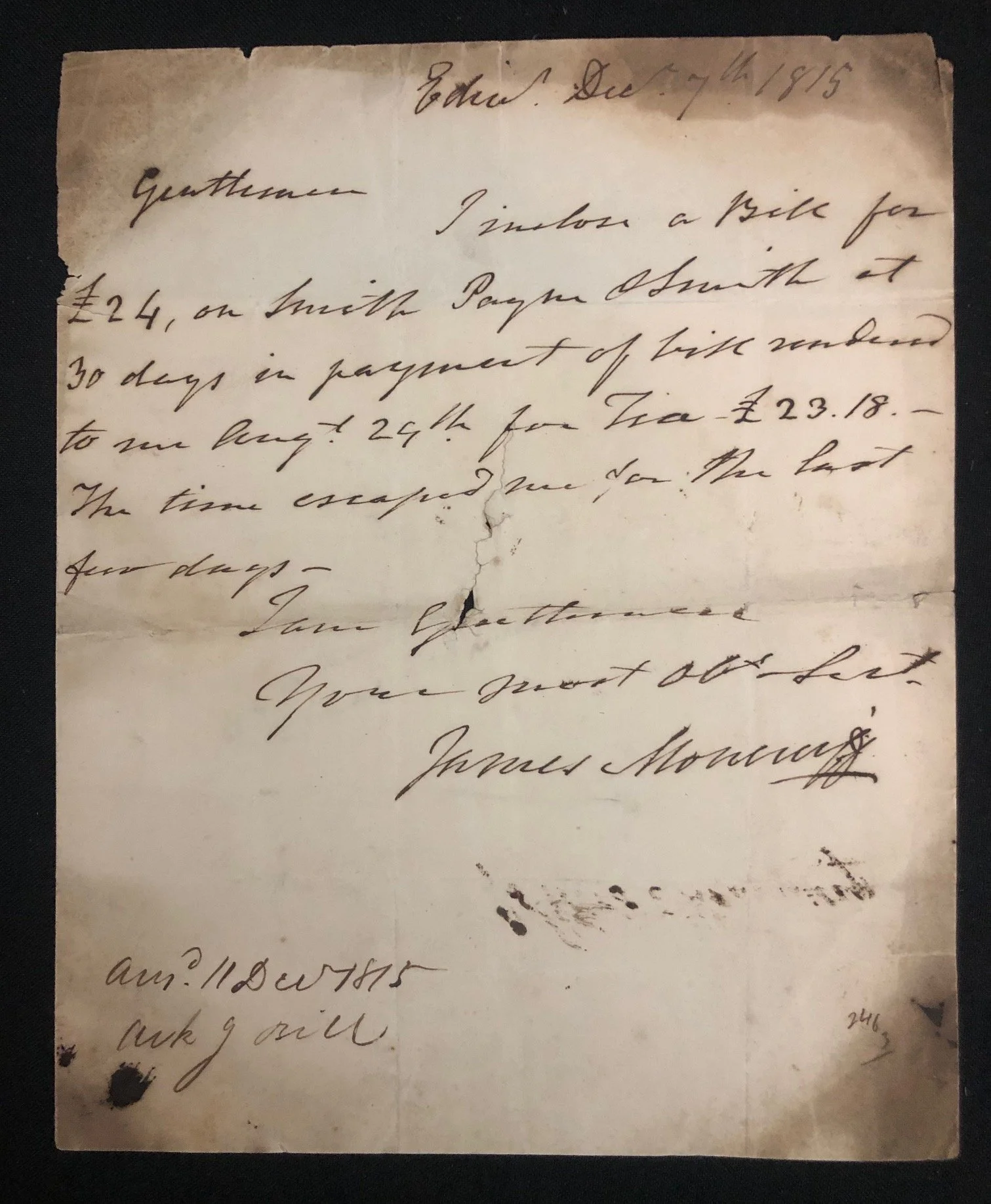
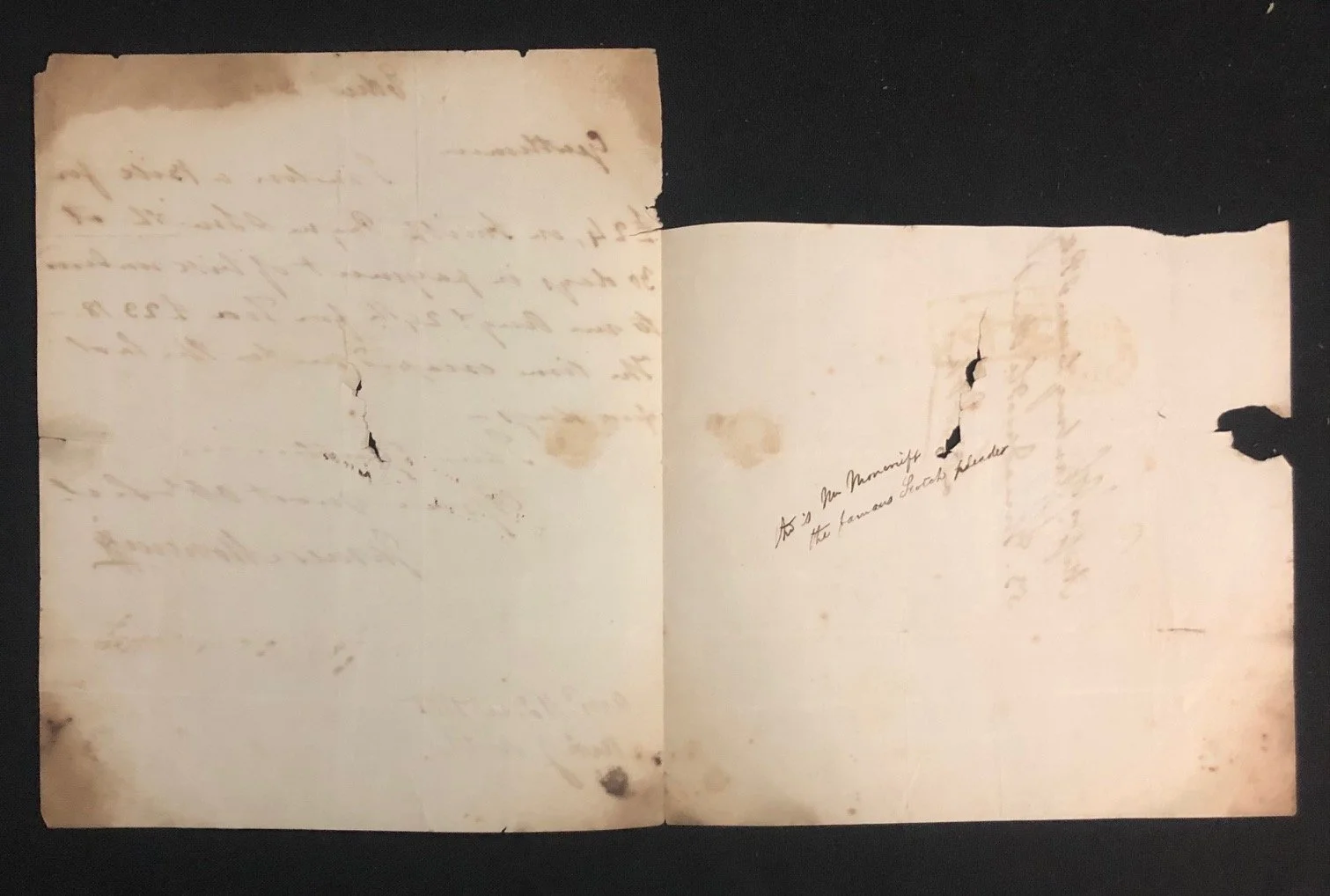
As noted by the penciled archival inscription on the interior leaf ("This is Jm Moncrieff the famous Scotch pleader"), the letter is signed by James Moncreiff (later Sir James Wellwood Moncreiff, 9th Baronet, 1776–1851).
Moncreiff was one of the brightest legal minds of 19th-century Scotland. A staunch Whig and a brilliant advocate, he rose to become a Lord of Session and Justiciary (taking the judicial title Lord Moncreiff). He was famously close friends with literary giant Sir Walter Scott and legal reformer Lord Jeffrey. Seeing an everyday, practical note written in his own hand provides a rare look at the domestic life of a man usually remembered for weighty constitutional judgments and dramatic courtroom battles.
A Fortune Spent on Tea in 1815
Writing from Edinburgh on December 4th, 1815 Moncreiff writes to his merchant correspondents:
"Gentlemen, I enclose a Bill for £24... in payment of bill rendered to me Augt 24th for Tea £23.18. — The time escaped me for the last few days—"
To modern eyes, a tea bill of nearly £24 seems ordinary, but in 1815, this was an astronomical sum—roughly equivalent to £2,000 to £2,500 today, or the equivalent of several months' wages for a working-class laborer.
During the Georgian era, high-quality Chinese tea was a heavily taxed, luxury status symbol enjoyed by the upper echelons of society. Moncreiff was ordering his tea in bulk directly from elite London importers. The fact that he apologizes for letting the payment date "escape" him shows that even the most meticulous legal minds of Scotland could be forgetful when it came to settling their luxury household accounts.
The Target: Threadneedle Street and the Banking Elite
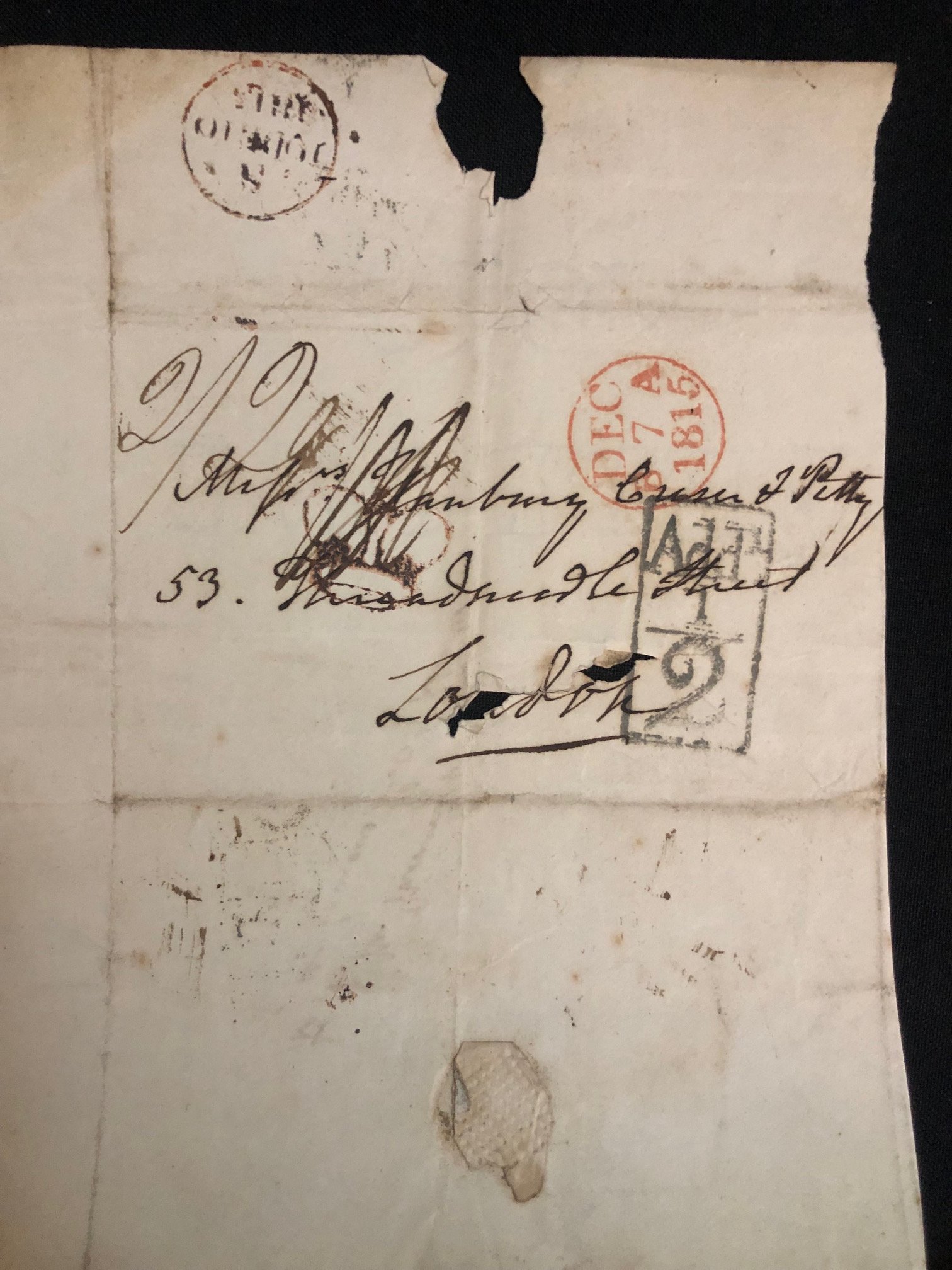
Sent to Messrs. Hanbury, Taylor & Lloyd at 53 Threadneedle Street, London, a substantial name in British financial history. This firm was an early incarnation of what would ultimately become Lloyds Bank, one of the "Big Four" clearing banks in the United Kingdom. Threadneedle Street was the absolute beating heart of global finance (dominated by the Bank of England), and Moncreiff specifies that his payment is drawn on another legendary banking house, Smith, Payne & Smiths. This single piece of paper connects the pinnacle of the Scottish legal system with the powerhouse of London’s merchant banking boom.
Postal History at a Glance
Because this was written decades before the invention of the adhesive postage stamp (which arrived with the Penny Black in 1840), the letter itself was the envelope. It was folded, sealed with wax (the residue of which is visible at the bottom), and rated by the post office based on the distance traveled and the number of sheets.
The front panel features beautiful postal archaeology:
A crisp, red, circular "DEC 7 A 1815" arrival datestamp, showing it took exactly three days to travel from Edinburgh to London via horse-drawn mail coach.
A black "Add'l 1/2" stamp, which represents the additional halfpenny mail coach tax levied on Scottish mail crossing the border into England—a tax originally introduced to help maintain Great Britain's post roads during the toll crises of the era.
Worn; chipped and discoloured.
185mm x 230mm
R2,000