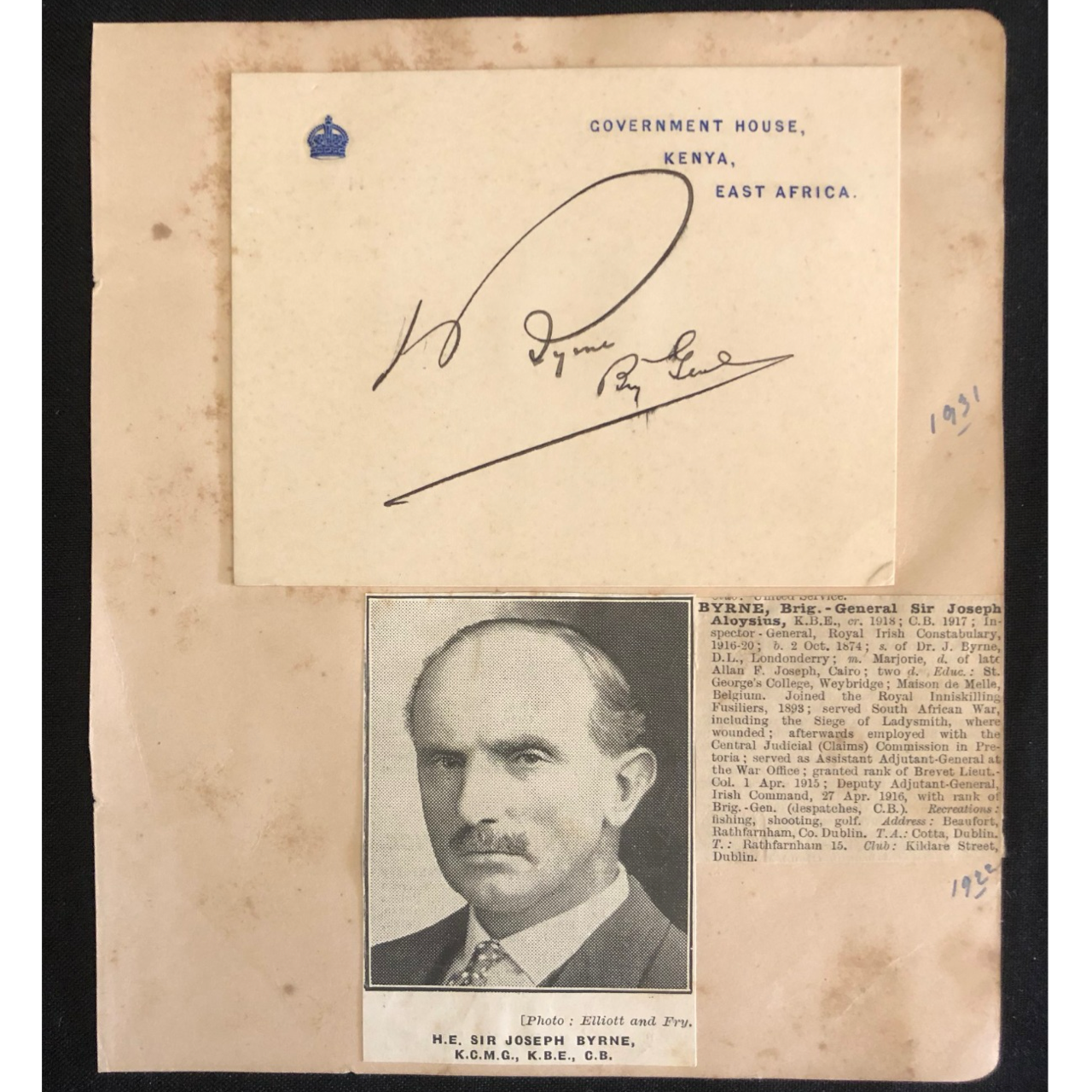
Brigadier-General Sir Joseph Aloysius Byrne, Kenya (1931)
This pasted-down assembly functions as an extra-illustrated or personalized biographical insert, likely tipped into a book regarding colonial administration or East African history.
Brigadier-General Sir Joseph Aloysius Byrne (1874–1942) was a fascinatingly polarizing figure who served as the Governor of Kenya from 1931 to 1936.
The Signature from a Besieged Government House (1931)
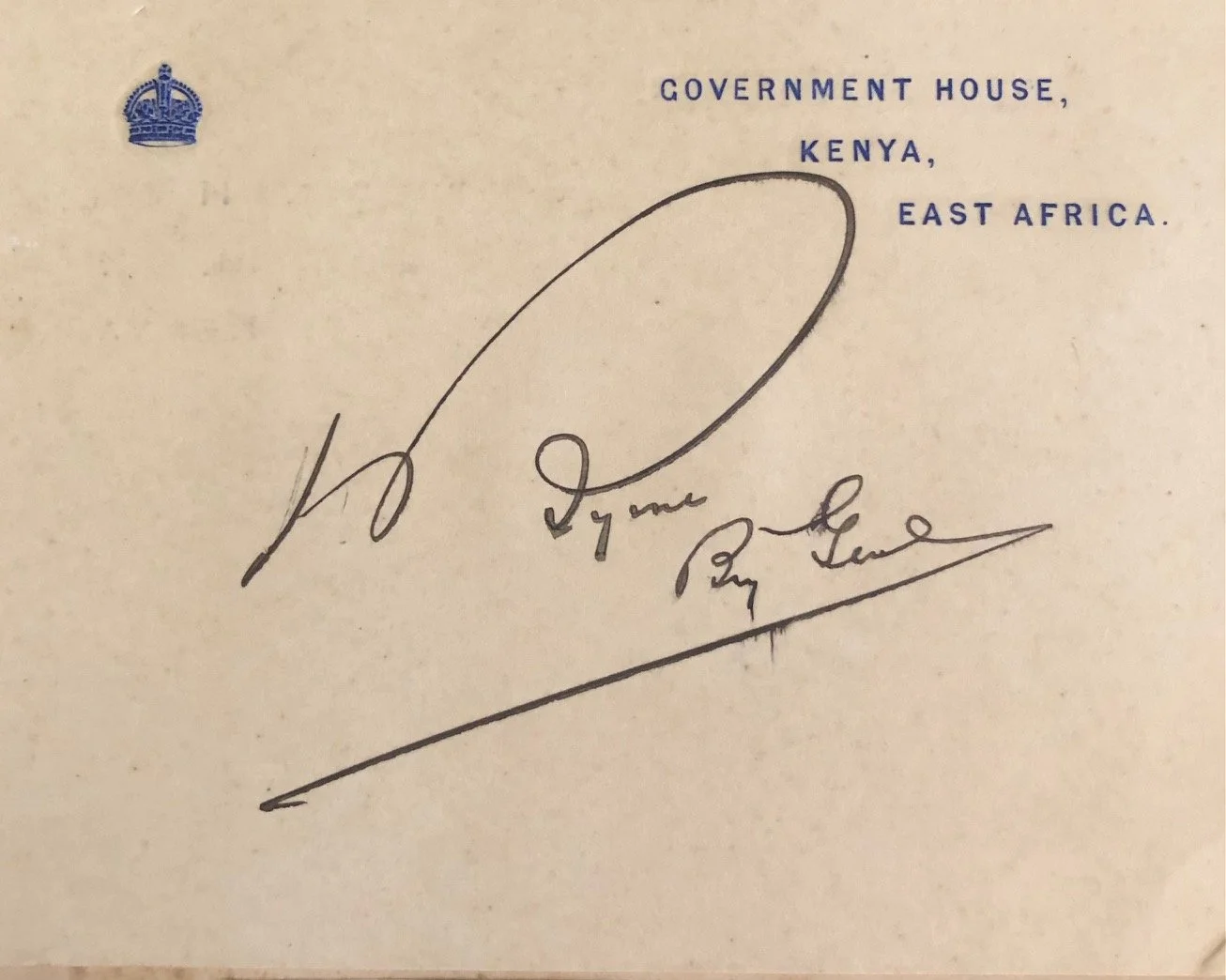
The centerpiece of the page is an official piece of stationery with a blue imperial crown, reading "Government House, Kenya, East Africa," signed with a sweeping flourish: "J.A. Byrne, Brig. Genl."
The date 1931 indicates the catastrophic year Byrne arrived in Nairobi to take up the governorship. The Great Depression had just hit East Africa, decimating the prices of primary exports like coffee, sisal, and maize. Byrne's entire tenure became an uphill battle against economic ruin, forcing him to implement deeply unpopular civil service salary cuts and push for a highly controversial income tax.
The Battle with the "Happy Valley" Settlers
While Byrne was a disciplined military man, his strict, unyielding administrative style put him on a direct collision course with Kenya’s notoriously entitled white settler elite—the infamous "Happy Valley" set led by figures like Lord Delamere and Lord Erroll.
The settlers were accustomed to governors they could easily bully or influence to secure cheap labor and favorable tax exemptions. Byrne, a staunchly independent outsider, openly despised their political entitlement and refused to cater to them. The settlers retaliated with fierce political campaigns, burning effigies, and even threatening a taxpayer strike. Byrne's signature on this official card represents the very executive power the settlers spent five years trying to break.
An Extraordinary Backstory: The Irish Connection
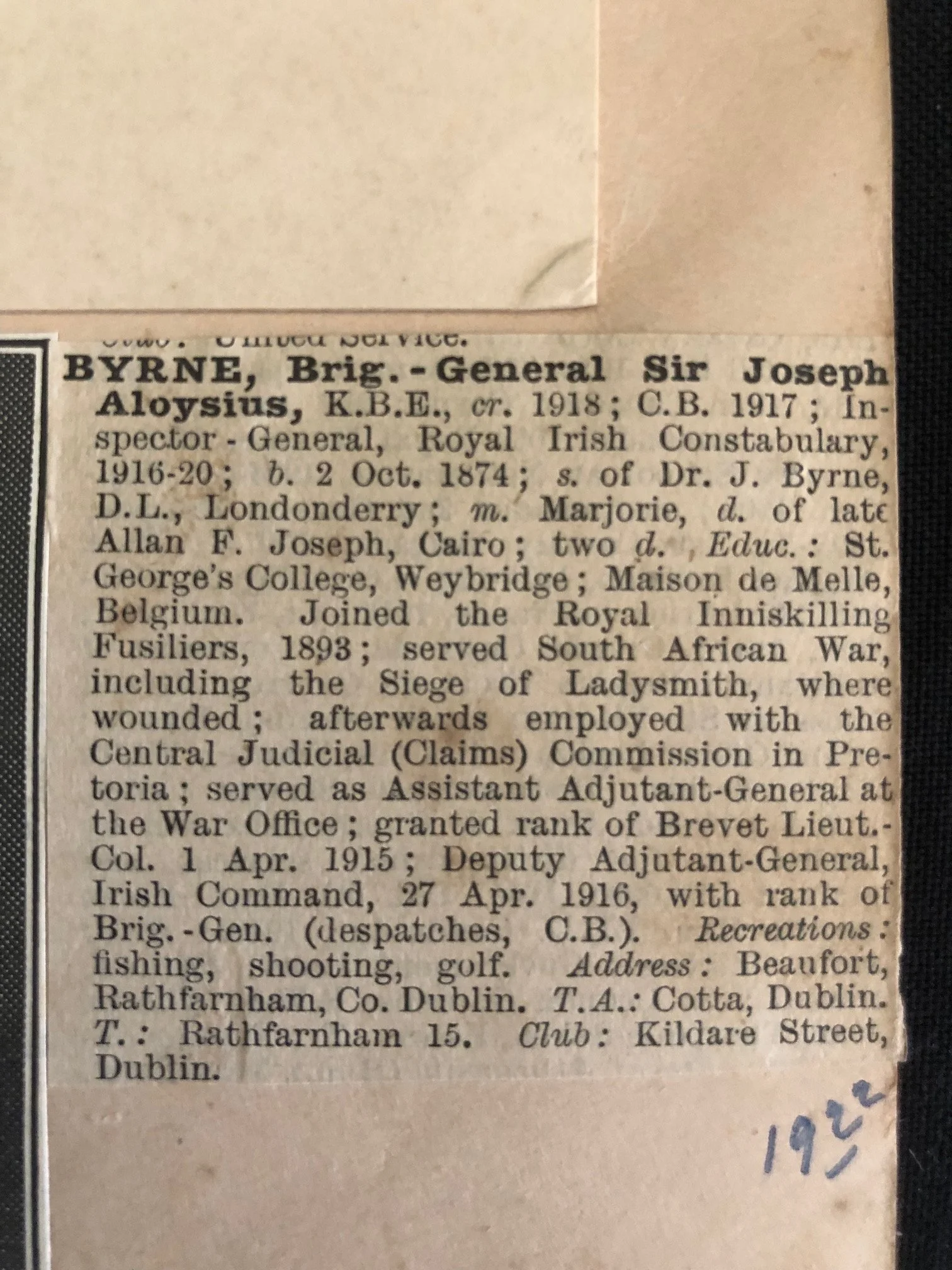
The newspaper clipping pasted below the signature provides a dense summary of Byrne’s highly unusual career before he ever set foot in East Africa:
The Anglo-Boer War: The text notes he joined the Royal Inniskilling Fusiliers in 1893 and served in South Africa, where he was wounded during the iconic Siege of Ladysmith (1899–1900).
The Irish War of Independence: In an extraordinary twist for a man who would later govern British colonies, Byrne was appointed Inspector-General of the Royal Irish Constabulary (RIC) in 1916. He held this incredibly dangerous post during the height of the Irish revolutionary period. Remarkably, in 1920, Byrne was sidelined by the British administration because he was deemed too moderate—he preferred a police response over the brutal, unchecked retaliations carried out by the notorious "Black and Tans."
The Anatomy of an Autograph Collector’s Page
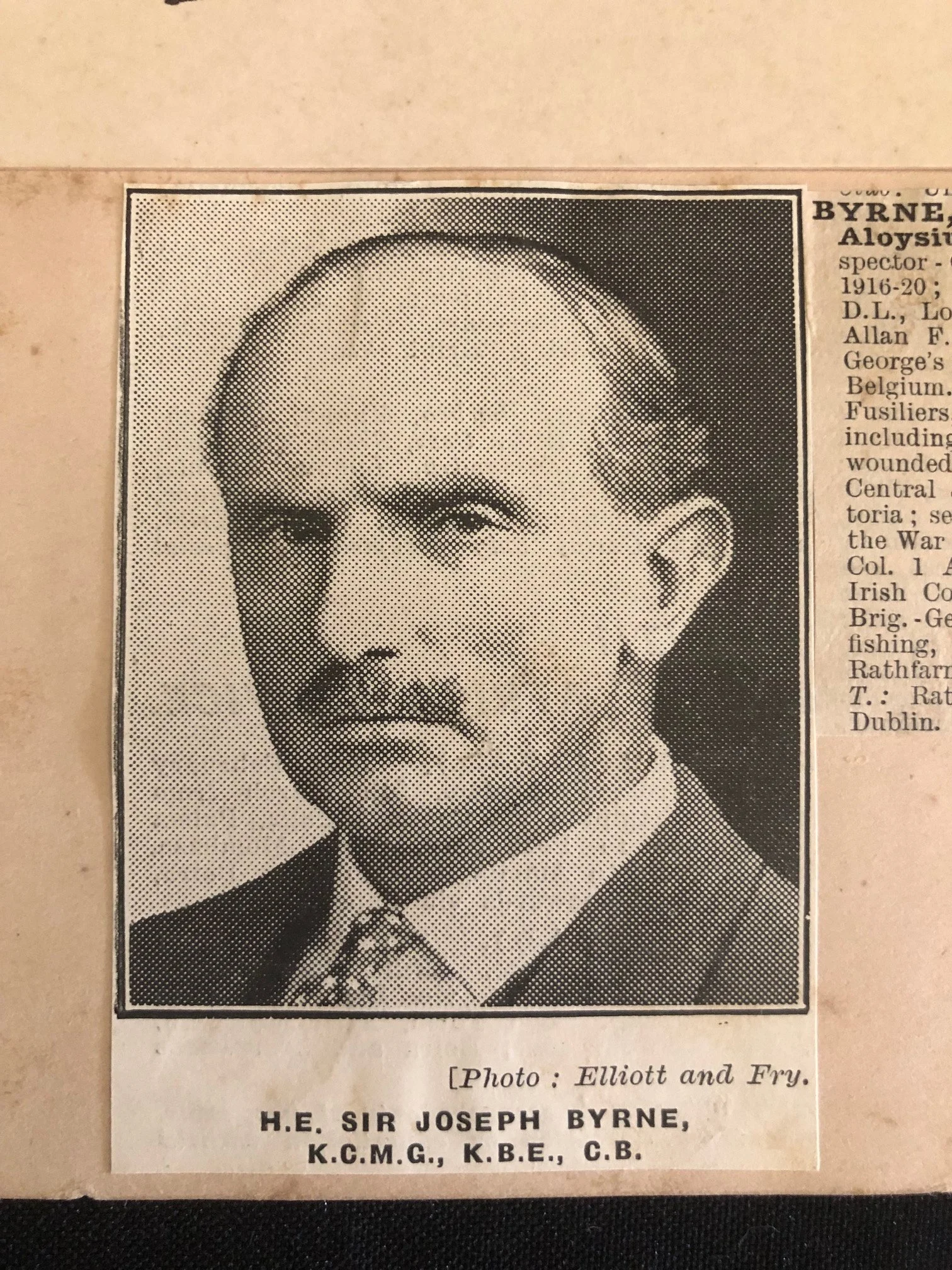
From a book-history perspective, this layout tells us how 20th-century collectors personalized their libraries. A previous owner took a genuine piece of correspondence signed by the Governor at Government House, paired it with a clipped obituary or contemporary biographical profile from Who's Who, and anchored it with a formal photographic portrait by the celebrated London studio Elliott & Fry.
Laid down, minor foxing.
Card: 155mm x 185mm
R1,000