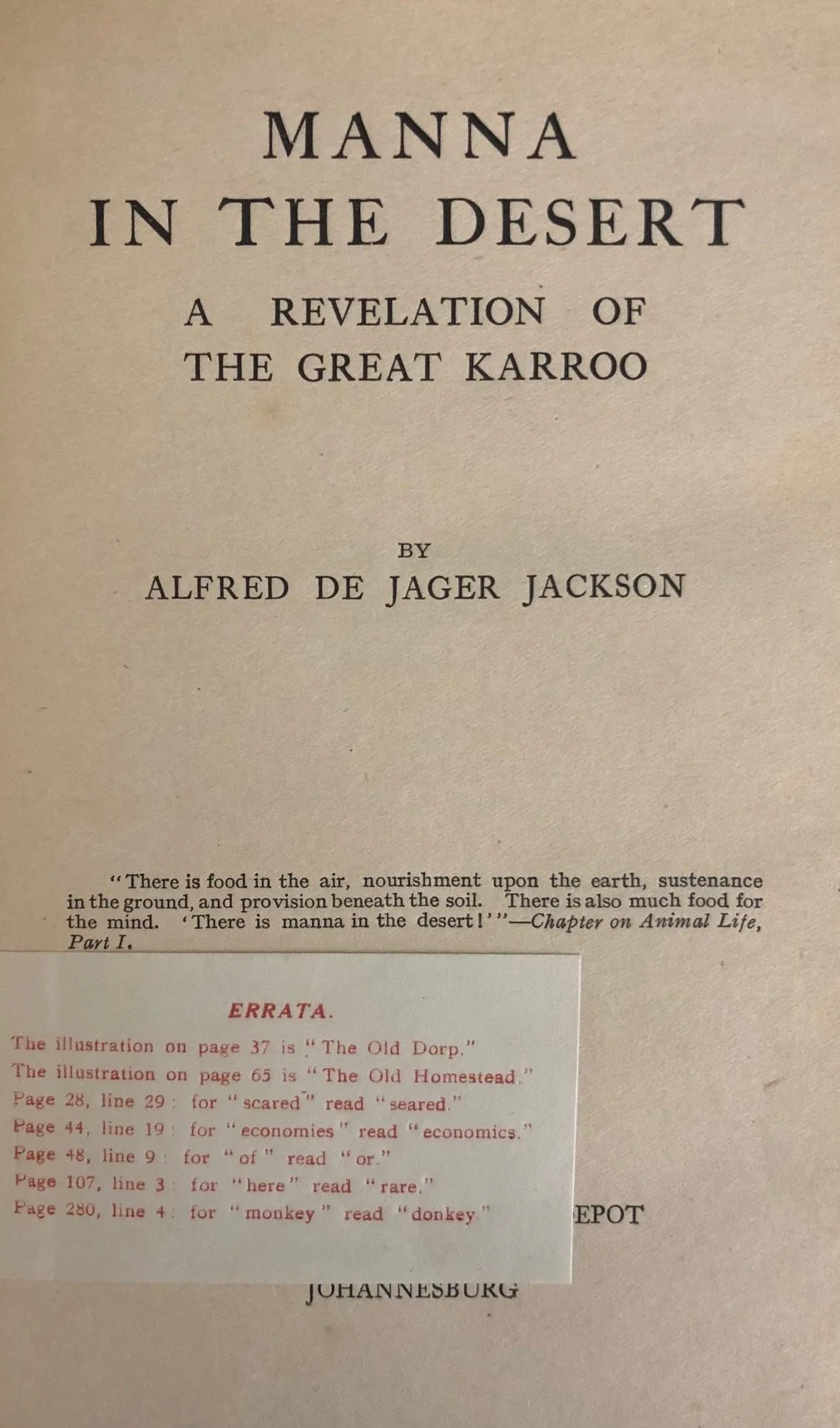
Alfred de Jager Jackson’s Manna in the Desert: A Revelation of the Great Karroo (first edition) 1920
What makes Alfred de Jager Jackson’s Manna in the Desert: A Revelation of the Great Karroo (first published in 1920 by the Christian Literature Depot in Johannesburg) so compelling is the deeply personal, harsh reality that sits right beneath its poetic, almost romantic title.
While the title suggests a spiritual or idyllic appreciation of the landscape, the book is actually one of the most vivid, firsthand accounts of the brutal realities of farming life in the Karoo during the late 19th century—written by a man who was ultimately broken by it.
The Reality Behind the Prose
Jackson was born in Beaufort West in 1860. As a young boy, he and his brothers endured immense hardships helping their father manage a Karoo farm owned by their cousin, Sir John Molteno (who became the first Prime Minister of the Cape Colony).
The book captures a legendary period of environmental devastation in the region:
The Great Drought of 1877: Jackson lived through a catastrophic dry spell where livestock died in droves, birds literally dropped dead from the sky, and farmers had to slaughter thousands of newborn lambs just to save the starving ewes.
The Irony of 1879: Following the drought, torrential floods tore through the region, wiping out what little infrastructure was left.
The trauma of these years was so intense that Alfred left the farm for good in 1879, completely unable to stomach the unpredictability of Karoo farming. He eventually moved to the Transvaal and became a stockbroker, writing this book decades later as a retrospective look at a vanished era of Cape frontier life.
Cult Classic Status
Though it started as a relatively obscure regional memoir, Manna in the Desert has long been prized by Africana collectors and historians for its granular detail on early colonial farming, local ecology, and Karoo folklore. It is considered a foundational text for understanding the social and environmental history of the Western and Northern Cape, so much so that it was given a limited-edition reprint in the 2000s to satisfy demand from modern historians and researchers.
Complete; all plate’s present; rebound in quarter leather; new end papers.
150mm x 225mm
R2,000