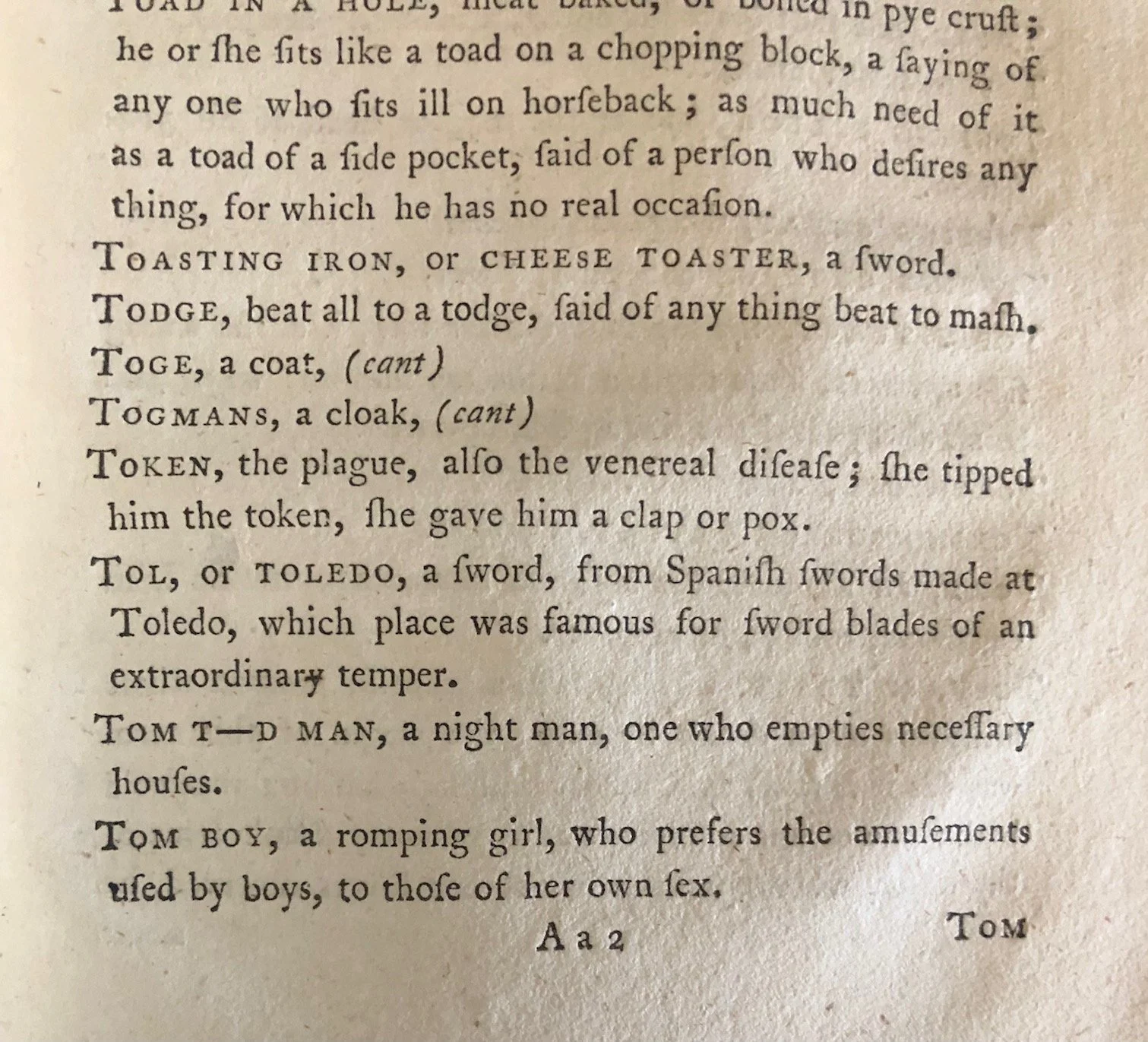
Francis Grose’s A Classical Dictionary of the Vulgar Tongue, published in 1785
Francis Grose’s A Classical Dictionary of the Vulgar Tongue, published in 1785 (MDCCLXXXV) by Samuel Hooper, is the foundational pioneer of English slang lexicography and criminal cant.
The Counterpart to Samuel Johnson
Thirty years after Samuel Johnson attempted to purify and standardize "polite" English in his 1755 dictionary, Captain Francis Grose set out to record everything Johnson deliberately omitted. Grose documented the unvarnished vernacular of London’s underworld, taverns, brothels, and docks.
Immersive Fieldwork
Grose—an eccentric antiquary and former militia officer—gathered his material through direct immersion. He frequented low-end alehouses, cockpits, and dark alleys in London, notebook in hand, collecting terms directly from thieves, prostitutes, sailors, pickpockets, and gamblers. He systematically categorized criminal "flash" language, slang, and ribald euphemisms.
Bibliographical Significance of the 1785 First Edition
The 1785 imprint printed for S. Hooper at No. 212 High Holborn (referenced by the pencil note citing Lowndes’ Bibliographer's Manual) represents the true first edition. It was published anonymously, as Grose initially kept his name off the title page to protect his standing as a fellow of the Society of Antiquaries. While later editions (such as the 1788 second edition) were expanded, the 1785 original remains the scarcer and most historically significant printing.
Preservation of Georgian Subculture
Beyond its linguistic value, the book serves as a vital social document of Georgian street culture. Without Grose’s preservation of 18th-century cant terms, large portions of Old Bailey court trial transcripts, broadside ballads, and period literature would remain unintelligible to modern historians.
155mm x 235mm
Rebound in full vellum; first edition 1785; new end papers; lacking half title page; ii / viii / 205 pages; some annotations throughout; bounds bowing slightly.mm
R16,000