An Incunabula Leaf from a German Translation of (The chapter on hunting) c.1500
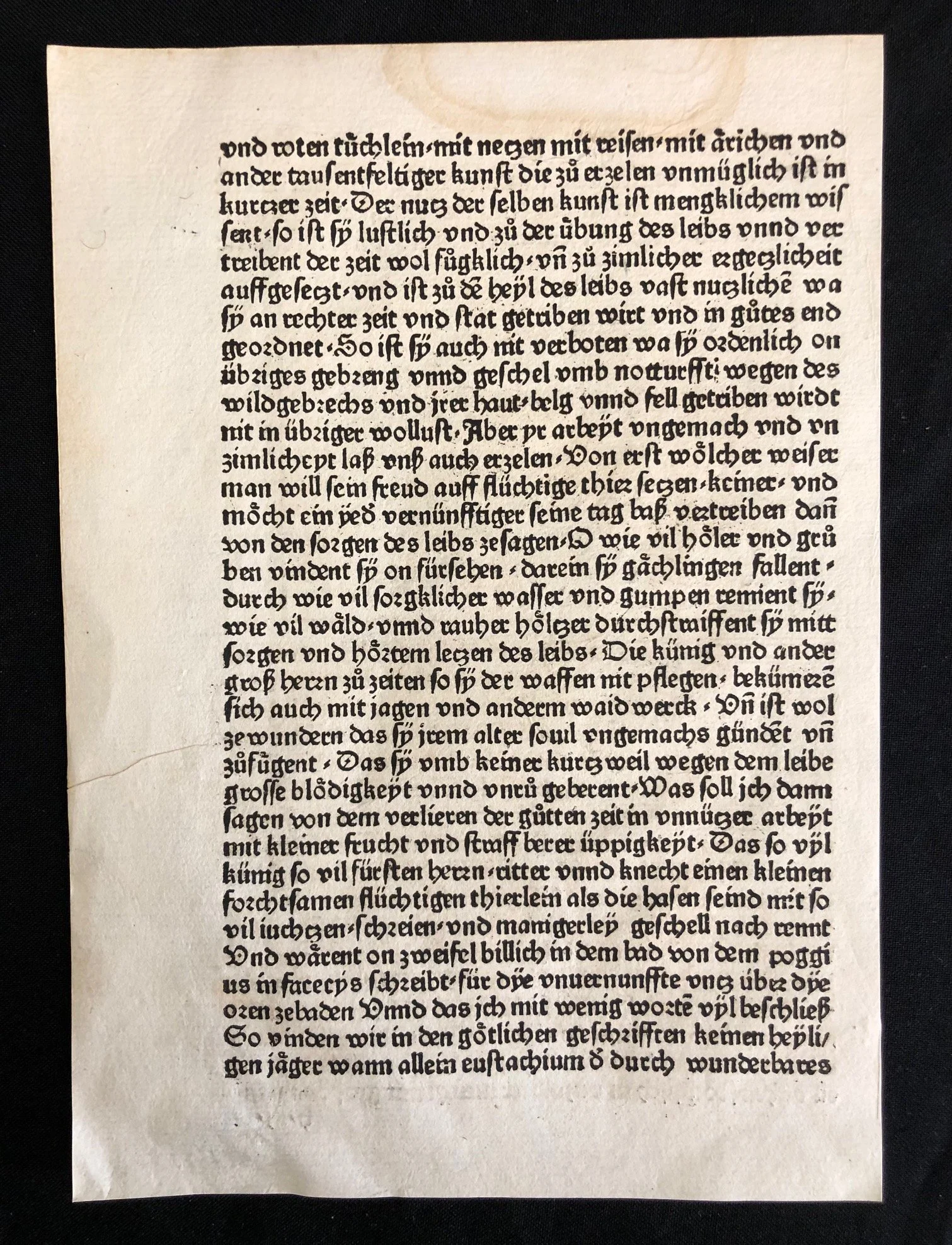
This is an incunabulum or very early 16th-century post-incunabulum leaf, printed in an early German Schwabacher or Gothic type. It is a page from a German translation of one of the most famous medieval texts on hunting, land management, and courtly life: Petrus de Crescentiis’ (Pietro de' Crescenzi) Ruralia Commoda (often translated into German as Das Buch von der Feldarbeit or Von dem Nutz der Ding, die in Äckern gebaut werden).
Specifically, the heading reads:
“Das xxviij capitel von dem vierten handwerck das ist jägerei…” > (The 28th chapter of the fourth handicraft, which is hunting...)
The Medieval Debate: Is Hunting a Sin or a Virtue?
The text on the reverse side captures a fascinating late-medieval psychological and moral dilemma. The author addresses the physical and spiritual dangers of hunting.
It notes that while hunting is useful for the health of the body ("zu de[r] heyl des leibs"), it can drive men to excessive passion ("übriger wollust"). The text mentions how kings and great lords ("Künig vnd ander groß herzen") choose to afflict their bodies with so much hardship and peril ("vngemachs gündet vñ züfügent") just for the sake of a short amusement ("kurzweil wegen").
It concludes with a famous historical-religious observation: "So finden wir in den göttlichen geschrifften keinen heyligen jäger wann allein eustachium..." ("Thus we find in the holy scriptures no holy hunter, except only Eustace..."). In medieval theology, hunters were often viewed with suspicion (like Nimrod or Esau), and Saint Eustace (and later Hubert) was the rare exception—the hunter who converted after seeing a crucifix between the antlers of a stag.
A Taxonomy of Specialized Hunting Dogs
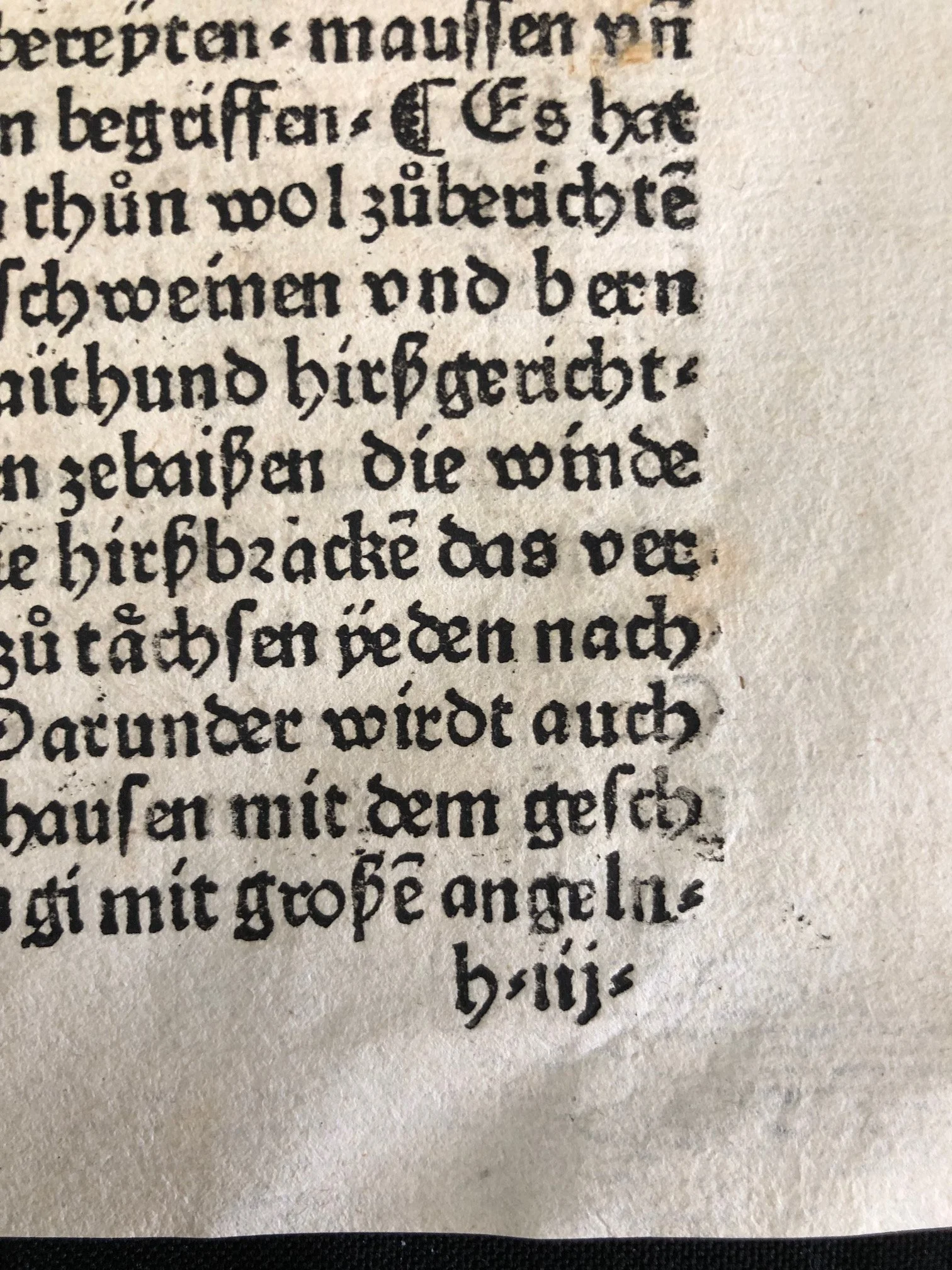
The text beneath the woodcut acts as a vivid 15th-century manual for working animals. It breaks down the exact roles of different hunting hounds, serving as a linguistic time capsule for early canine terminology:
Dogs for high game, swine, and bears ("schweinen vnd bærn").
"laithund" (Leithund / Leash hounds) for tracking stags ("hirßgericht").
"iaghund" (Jagdhunde / Chasing hounds).
"winde" (Windhunde / Greyhounds) noted for their speed ("zelauffen").
"vogelhund" (Bird dogs / Spaniels or setting dogs) to search for birds ("zefüchen").
"schlieffer" (Terriers/Earth dogs) specifically designated to go into the earth after badgers ("zü dächsen").
Early Falconry and Bird-Catching References
Right at the start of the lower paragraph, the text defines jägerei broadly, stating it includes all waidwerck (woodcraft/hunting), explicitly mentioning:
"...vogeln mit dem netz oder kloben baissen von d[er] hand oder zü dem lüder..."
This is an early vernacular description of falconry and fowling: catching birds with nets or traps (kloben), and "baissen von der hand"—hawking directly from the hand, or using a lure (lüder).
The Woodcut and the Signature
The woodcut itself is a classic piece of early German secular illustration, depicting a hunter in late-medieval garb blowing a hunting horn (Hifthorn), holding a leash of running hounds, while a stag flees into a fenced enclosure or thicket.
Note the signature mark h iij. This leaf was the third leaf of the 'H' signature gathering of the book, a vital piece of evidence for analytical bibliography when identifying the exact edition and printer (such as Peter Schöffer or Heinrich Gran) from the late 1490s or early 1500s.
175mm x 245mm
Stain top of the page; paged creased (during the printing process).
R5,000