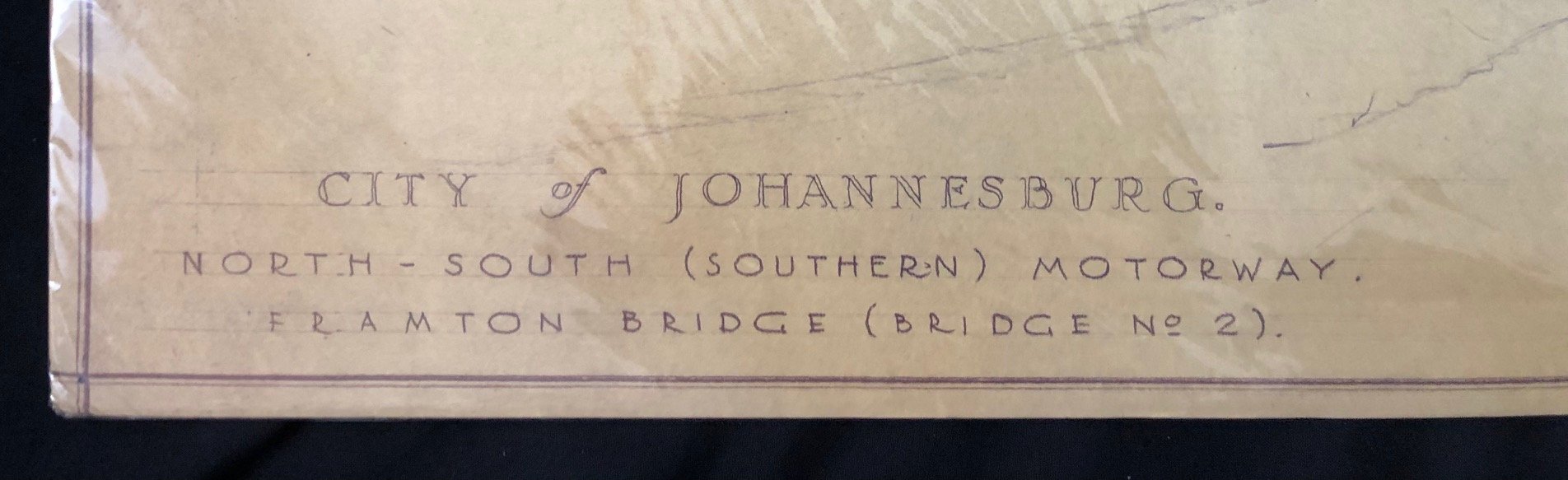
Architecture blueprint of the Johannesburg Motorway (1971)
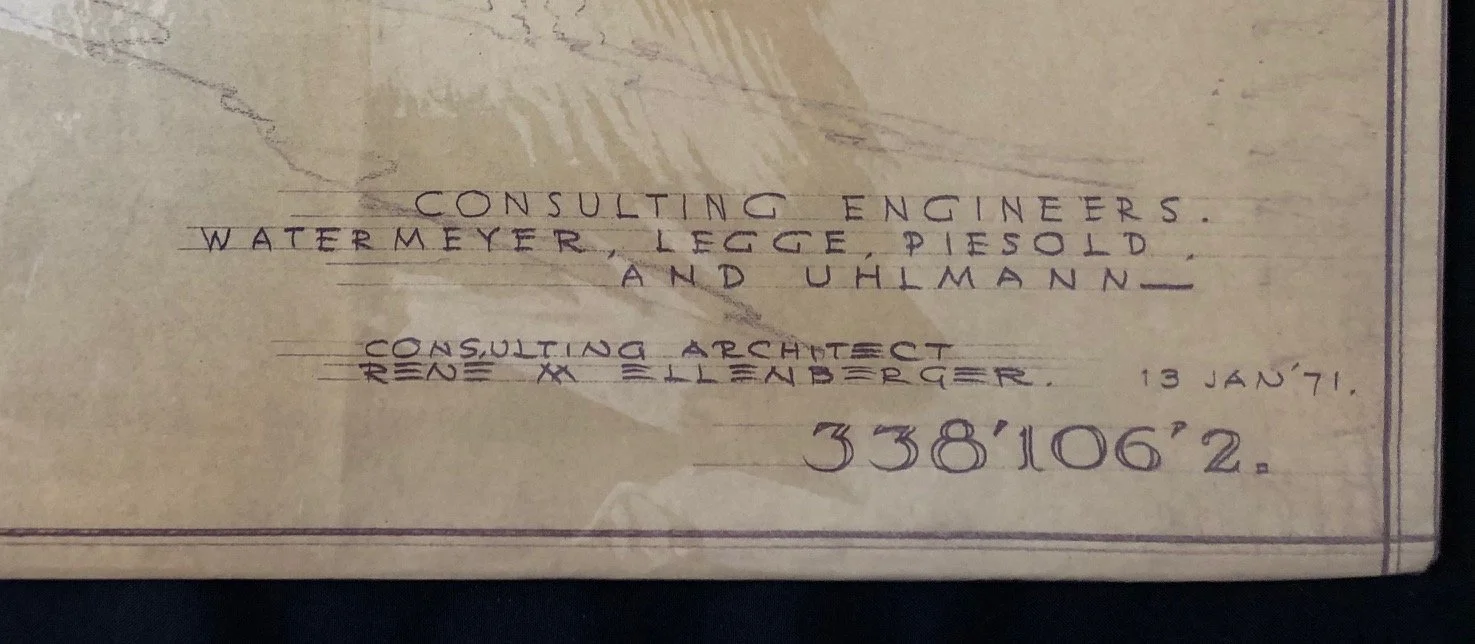
Dated 13 January 1971.
The engineering firm credited—Watermeyer, Legge, Piesold, and Uhlmann (WLPU)— was founded in South Africa, and became globally renowned for large, highly complex structural projects.
While they were famous worldwide for massive hydroelectric dams, cooling towers, and mining infrastructure across Africa and the UK, their contribution to Johannesburg's highways was a technical marvel. Building elevated freeways through Johannesburg in the 1960s and early '70s required engineering around a number of hidden obstacle: a subterranean labyrinth of century-old, abandoned gold mining tunnels and unstable undermined ground. WLPU’s structural calculations had to ensure that massive concrete bridge piers wouldn't trigger a catastrophic collapse into old mine stopes.
The drawing is signed by Consulting Architect René M. Ellenberger. Ellenberger was an influential architect in mid-century South Africa, noted for his modernist, sculptural sensibilities.
His involvement highlights an important historical trend from the late 1960s: the desire to make monumental concrete infrastructure look aesthetically sophisticated, rather than purely utilitarian. Look closely at the central bridge piers in the sketch—instead of standard concrete pillars, Ellenberger designed sharp, faceted, geometric V-shaped columns. This architectural choice is a classic nod to Brutalist architecture, celebrating the raw, expressive, sculptural power of reinforced concrete (béton brut) that defined the urban aesthetic of the 1970s.
In the background of the drawing, just beneath the bridge spans, you can see the distinct, geometric silhouettes of mine dumps.
This detail is incredibly evocative of Johannesburg’s unique topography. The North-South Motorway (which became the M2) was deliberately constructed along the historic "mining belt"—the East-West geological reef where gold was first discovered in 1886. By 1971, many of these central mines were closing down, and the city was aggressively repurposing the industrial wasteland into a high-speed transit corridor to connect the expanding industrial south with the commercial center. The sketch beautifully documents that transitional landscape where industrial mining heritage met the modern automobile age.
The drawing contains two wonderfully sketched vehicles that ground the piece firmly in its era:
On the elevated bridge rides a classic mid-century sedan (resembling a Ford Cortina or a dynamic British saloon of the late 60s).
On the lower loop sits a beautifully detailed, retro panel van or light delivery vehicle with prominent separate fenders, typical of the classic commercial fleet vehicles that serviced Johannesburg's bustling central business district.
Very slight edge wear.
1020mm x 630mm (large landscape format).
R6,500