The Colenso Controversy (1865)
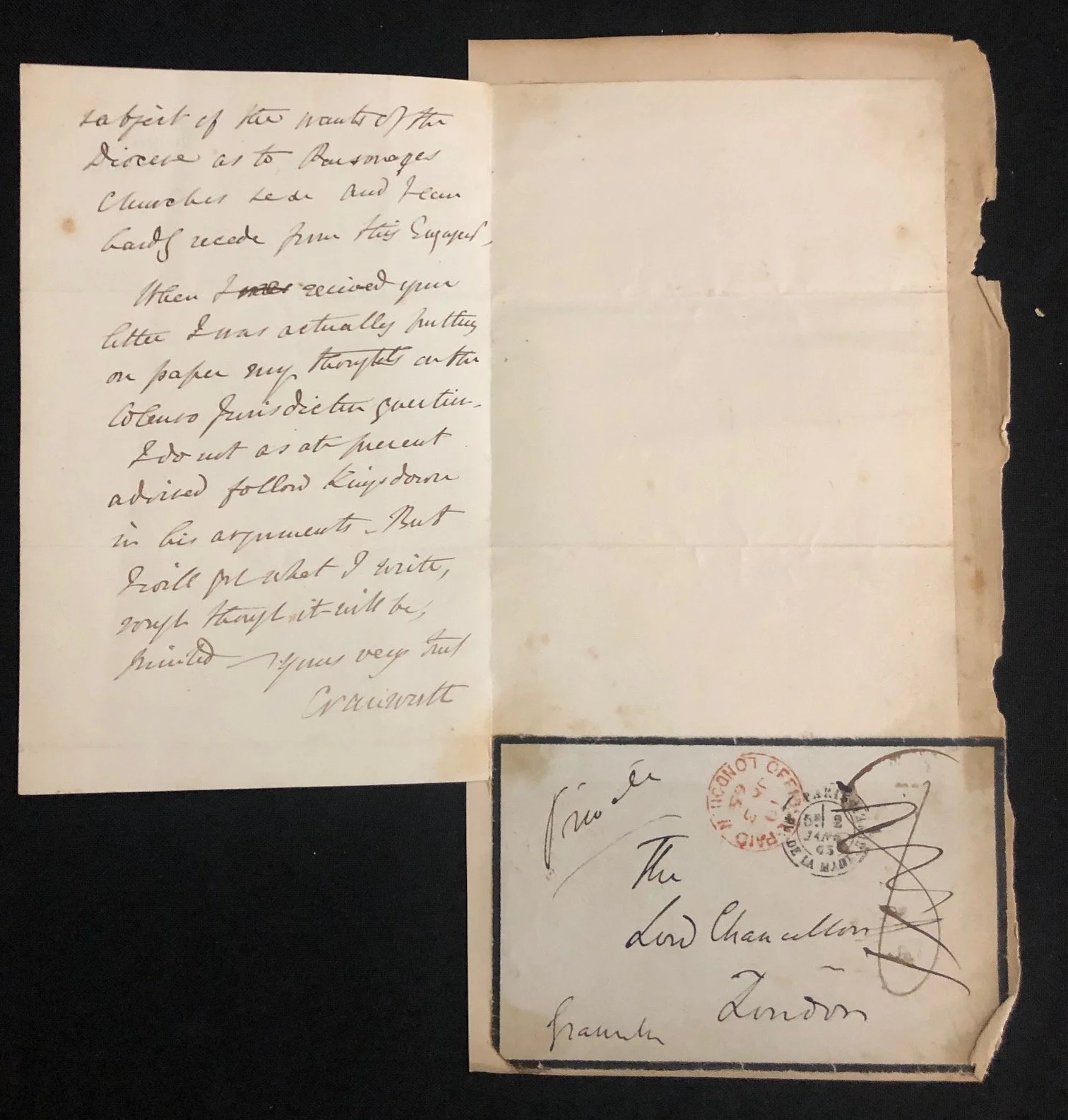
This letter and its accompanying envelope wrapper represent an extraordinary piece of legal and colonial history. It catches two of the nineteenth century's greatest legal minds debating behind the scenes of one of the British Empire's most explosive ecclesiastical scandals: The Colenso Controversy.
The Writer and Recipient: A Conclave of Lord Chancellors
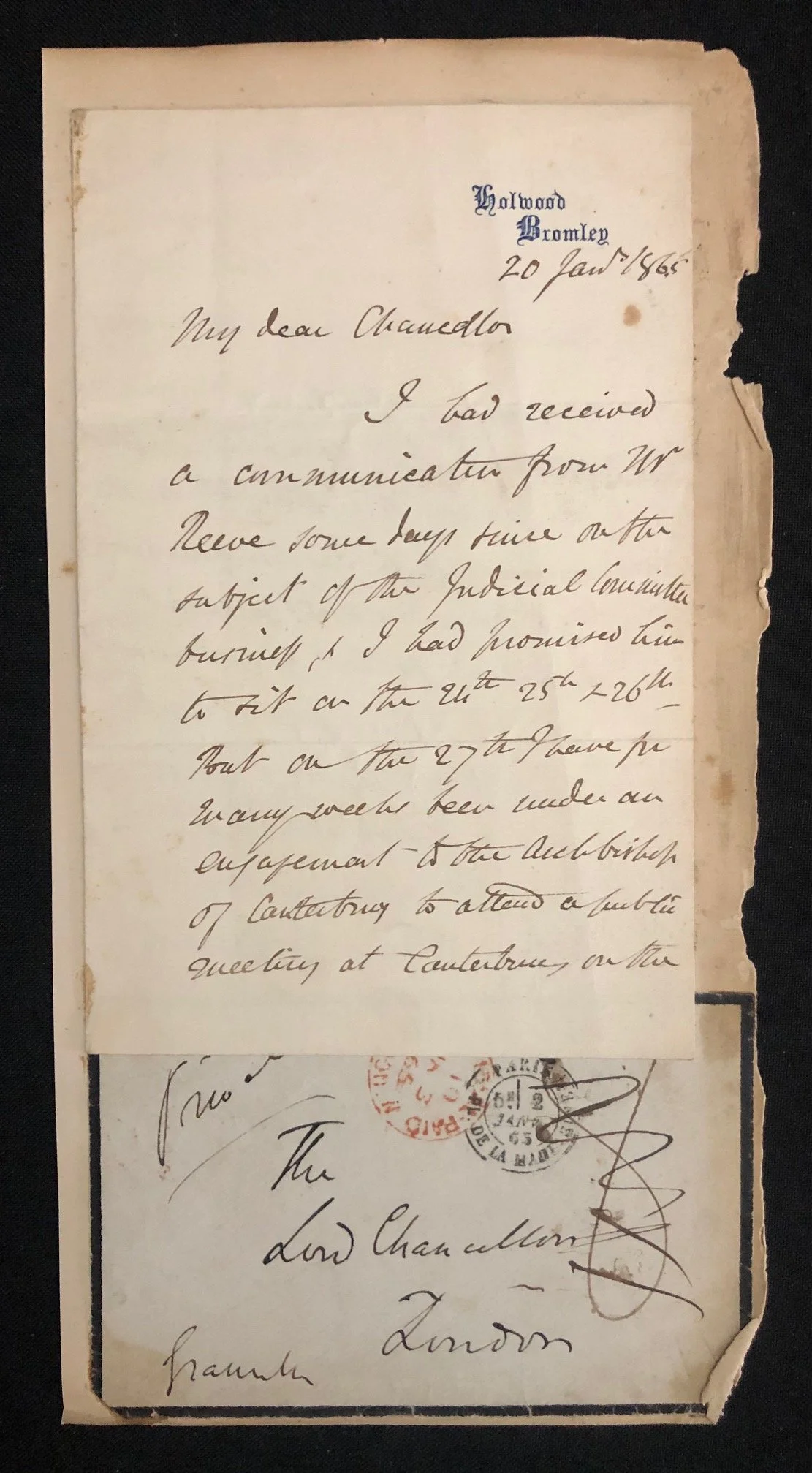
The letter is dated 20 January 1865 from Holwood, Bromley, and is signed "Cranworth" (Robert Rolfe, 1st Baron Cranworth). Cranworth was a towering legal figure who served as Lord Chancellor of Great Britain twice.
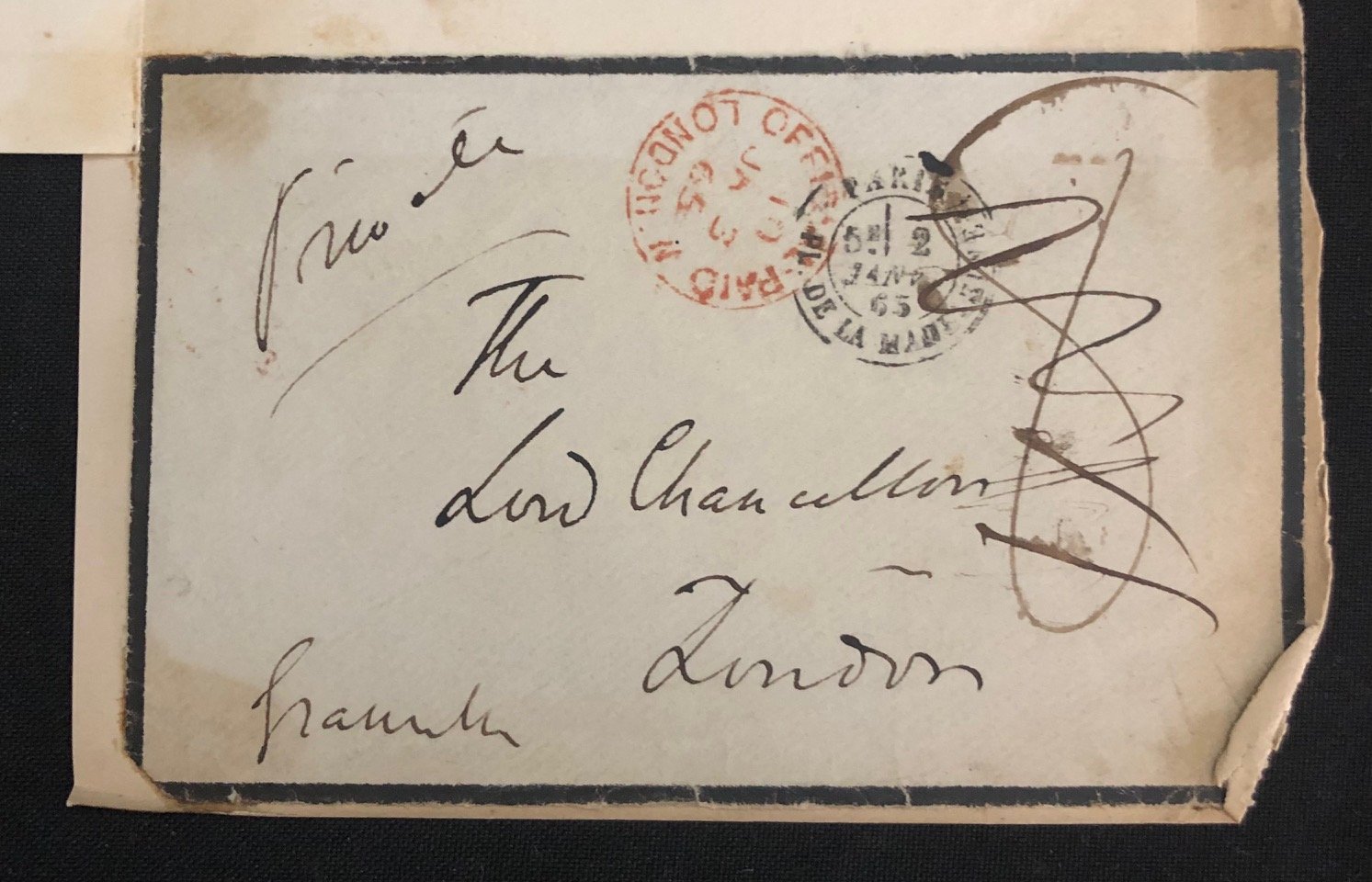
He is writing to the current Lord Chancellor in January 1865, Richard Bethell, 1st Baron Westbury (addressed on the black-bordered envelope as "The Lord Chancellor, London"). Cranworth would actually succeed Westbury as Lord Chancellor just a few months later in July 1865 following Westbury's resignation.
The Core Subject: The Landmark "Colenso Jurisdiction" Case
Cranworth writes a line of massive historical significance to South African and imperial history:
"When I received your letter I was actually putting on paper my thoughts on the Colenso Jurisdiction question."
This refers to John William Colenso, the pioneering and controversial Anglican Bishop of Natal. Colenso had shocked the Victorian establishment by publishing radical biblical criticism that questioned the literal truth of the Pentateuch and defending Zulu cultural practices (including polygamy).
In response, the orthodox Bishop of Cape Town, Robert Gray, put Colenso on trial for heresy in 1863, deposed him, and excommunicated him. Colenso fiercely rejected Gray’s authority and appealed directly to the Crown via the Judicial Committee of the Privy Council in London. The legal question was monumental: Did a metropolitan bishop in a self-governing colony have the imperial legal jurisdiction to depose another crown-appointed bishop?
A Behind-the-Scenes Legal Disagreement
Cranworth goes on to note an explicit disagreement with a colleague we encountered previously:
"I do not as at present advised follow Kingsdown in his arguments. But will put what I write, rough though it will be, printed."
This reveals that Lord Kingsdown (Thomas Pemberton Leigh, the writer of the letter) was actively drafting arguments on the Colenso case that Cranworth originally resisted. The judges of the Privy Council were furiously circulating drafts and printing memoranda to resolve how to handle this constitutional crisis.
Ultimately, just two months after this letter was written, on March 20, 1865, the Privy Council issued its historic landmark ruling in favor of Colenso. They decreed that the Crown had no legal power to grant coercive jurisdiction to Bishop Gray in a colony with its own independent legislature. Colenso was reinstated, splitting the South African church into two separate factions for decades.
Postal and Social Details
The Mourning Border: The envelope features a prominent black mourning border. Given the date of January 1865, this likely reflects official or personal mourning within the British upper classes (such as the lingering national mourning for Prince Albert, or a specific aristocratic connection).
The Transit Marks: Despite being a piece of British government business, the envelope bears a prominent red "LONDON PAID" stamp alongside a French postmark from "PARIS / DE LA MADE[LAINE]", indicating Cranworth or his dispatch courier was moving through France when this urgent private correspondence was sent back to London to meet the Privy Council's tight schedule ("to sit on the 24th 25th & 26th").
Size of the card: 130mm x 255mm
Laid onto card; some staining; markings etc.
R2,500