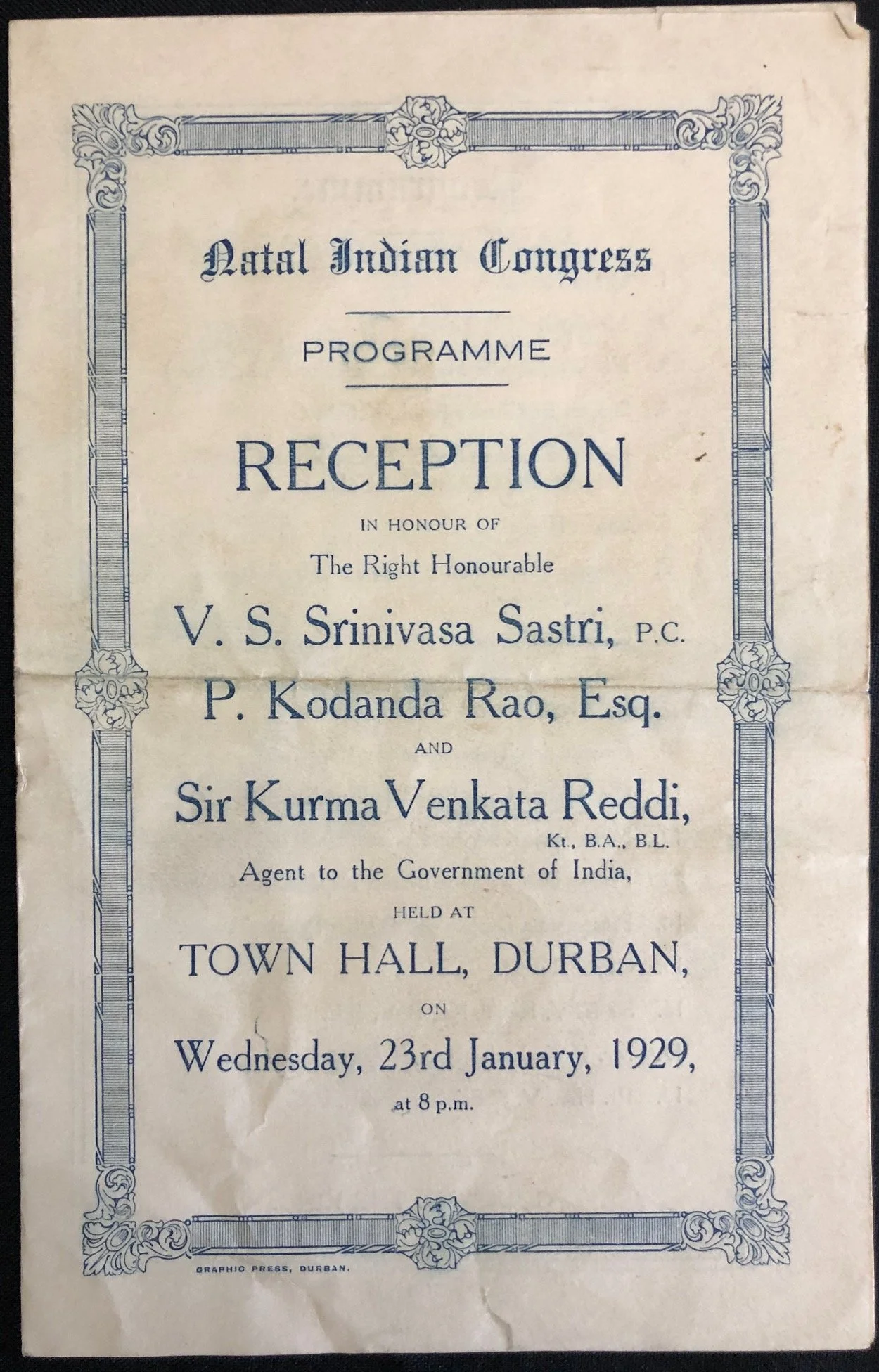
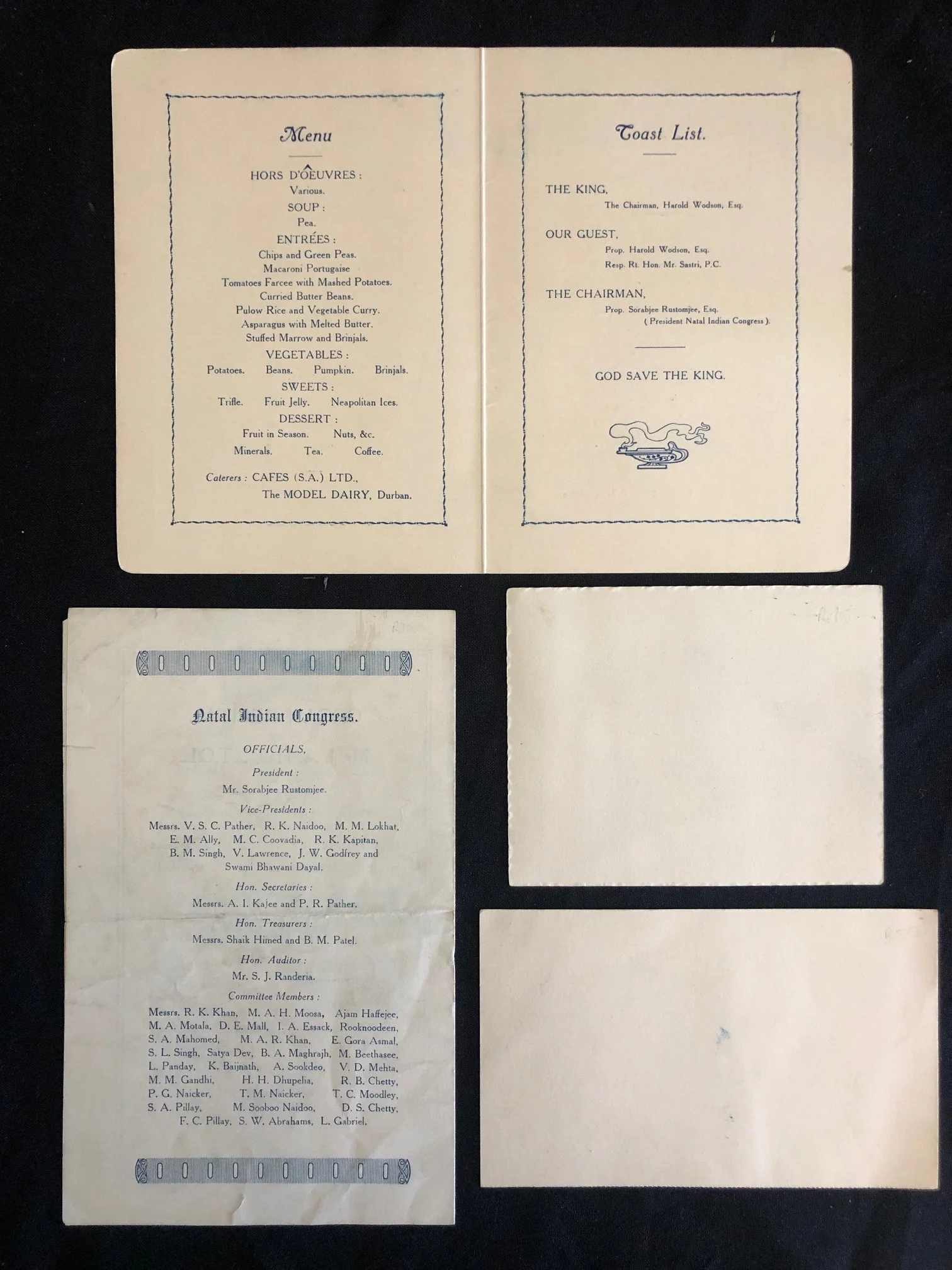
Natal Indian Congress Ephemera c.1928. (4)
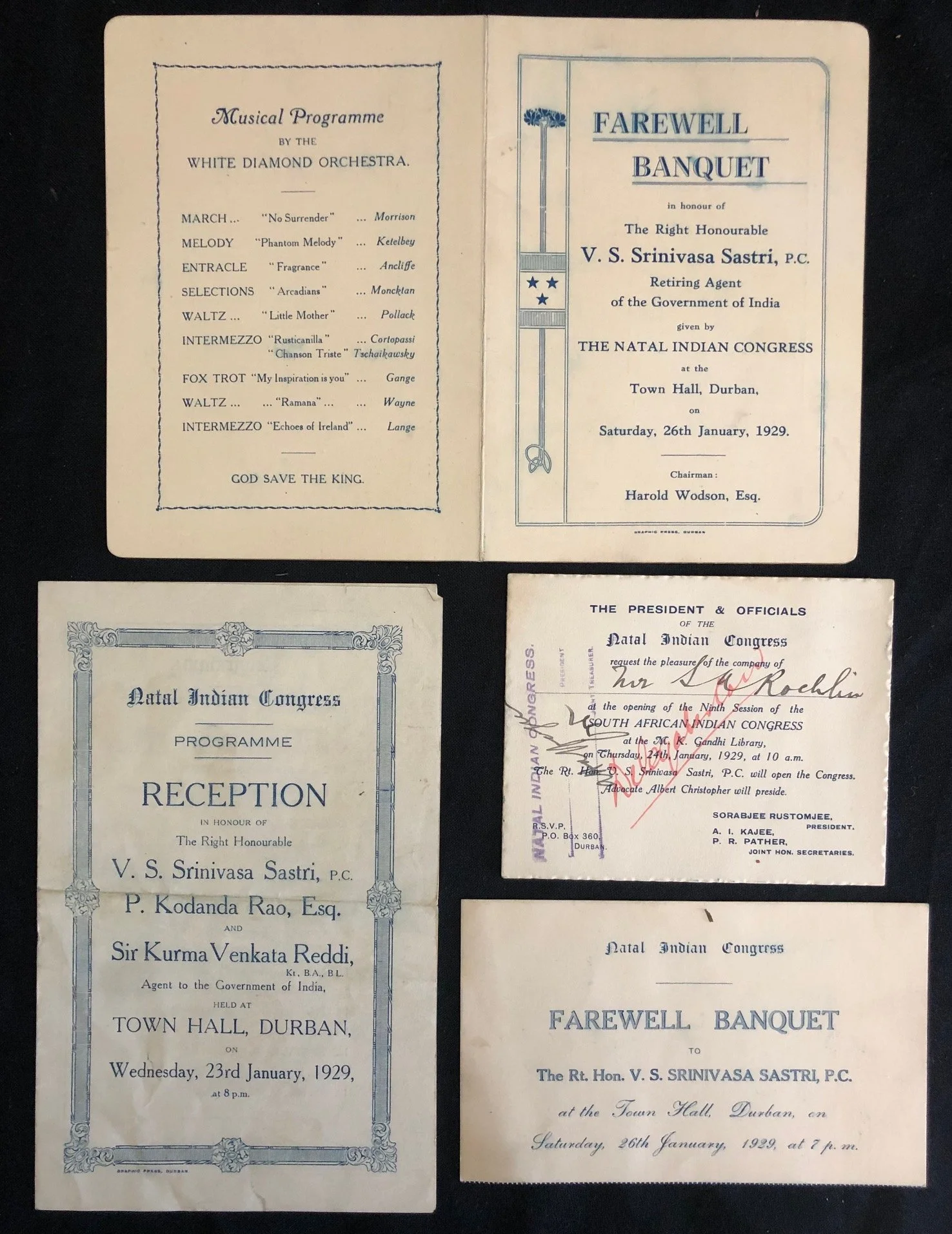
This collection of ephemera captures an incredibly significant, highly charged geopolitical moment in South African history: the conclusion of the very first diplomatic intervention by the Government of India on South African soil, orchestrated through the Cape Town Agreement of 1927.
Here is why these specific programs and invitations from January 1929 are historically remarkable:
The Advent of the "Agent-General" (Sastri’s Groundbreaking Role)
The man being honored across these documents, V. S. Srinivasa Sastri, was a brilliant orator, a close associate of Mahatma Gandhi, and a member of the Privy Council (hence the "P.C." after his name).
In the mid-1920s, the South African government under J.B.M. Hertzog attempted to introduce the Class Areas Bill, a segregationist measure designed to force Indian South Africans into designated locations and encourage their "repatriation" to India. To prevent this, the Indian Government negotiated the Cape Town Agreement of 1927. South Africa dropped the bill, and in return, India agreed to appoint an "Agent" (later Agent-General) to South Africa to look after Indian interests and ensure the "upliftment" of the local community. Sastri was personally chosen by Mahatma Gandhi and Lord Irwin to be the very first Agent.
A Crucial Leadership Handover
The larger program on the bottom left highlights a major historical transition. It dates to Wednesday, 23rd January, 1929, and welcomes Sir Kurma Venkata Reddi, who arrived to take over the mantle as the second Agent to the Government of India. Sastri was exhausted by the immense political tightrope walk and deteriorating health, making this week in Durban the official passing of the diplomatic torch.
The Natal Indian Congress (NIC) and the S.A.I.C. Conference
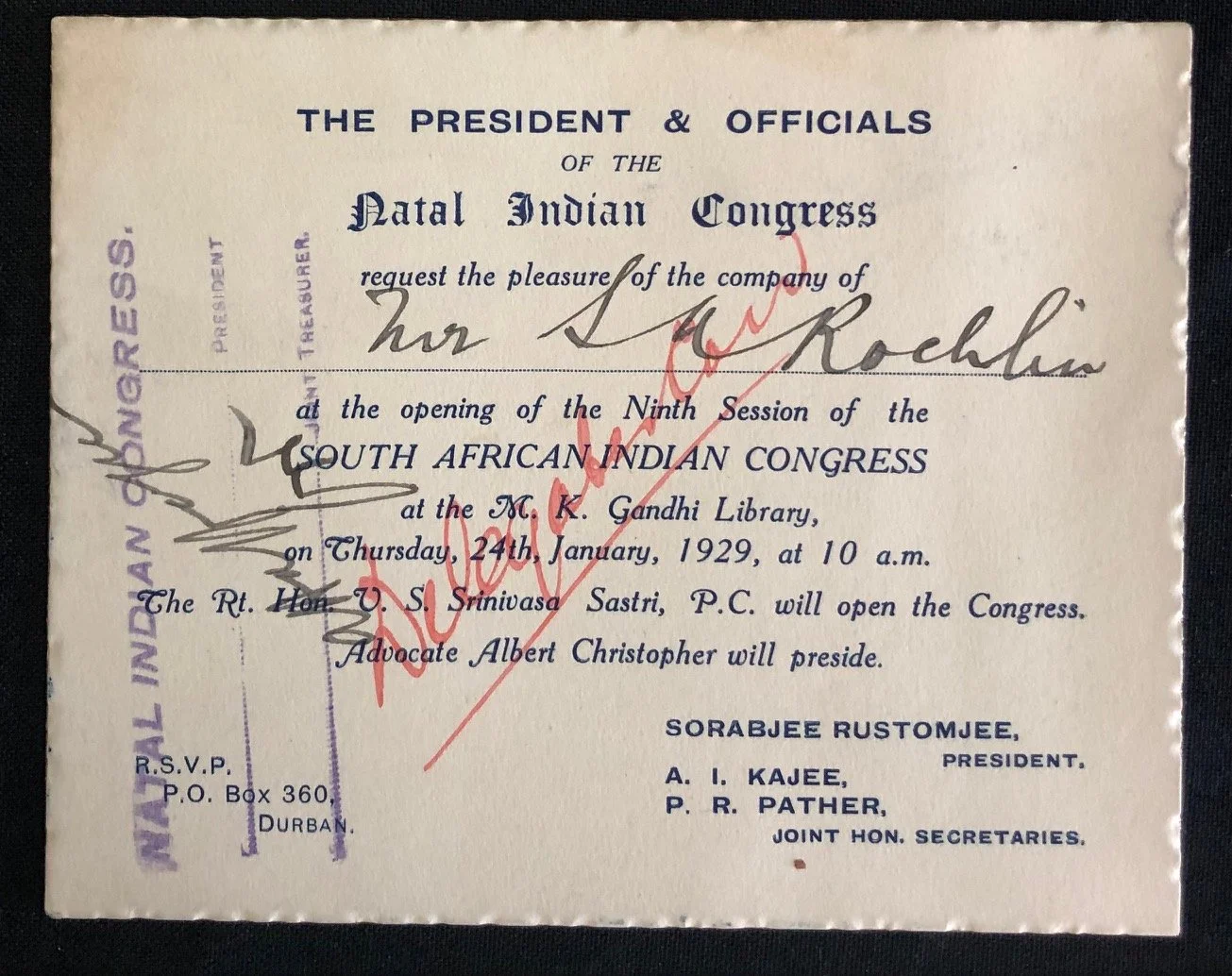
The invitation on the middle right is particularly fascinating. It is a request sent to a Mr. S. A. Rochlin (a prominent early South African Jewish historian and writer who documented minority histories) to attend the Ninth Session of the South African Indian Congress (SAIC).
Remarkably, it notes that the opening will take place at the "M. K. Gandhi Library" on January 24, 1929. The NIC—originally founded by Mahatma Gandhi in 1894—was the driving force behind organizing these grand banquets at the Durban Town Hall. These events were deliberately high-profile, designed to show the white municipal authorities the sophistication, intellectual weight, and diplomatic backing of the Indian community.
Cultural Syncretism: The Musical Programme
The inner leaf of the Farewell Banquet card (top left) shows a striking snapshot of colonial-era cultural blending. While the banquet was thrown by the Natal Indian Congress for an elite Indian statesman, the musical entertainment was provided by the "White Diamond Orchestra."
Their repertoire consists entirely of British and European drawing-room music—featuring marches, waltzes, a fox-trot ("My Inspiration is You"), and classical intermezzos by Tchaikovsky and Cortopassi—culminating in the mandatory anthem of the British Empire: "God Save the King." It perfectly reflects the elite, constitutionalist approach of the NIC at the time, fighting for their rights within the framework of the British Empire by emphasizing their status as civilized Imperial citizens.
The Chairman: Harold Wodson
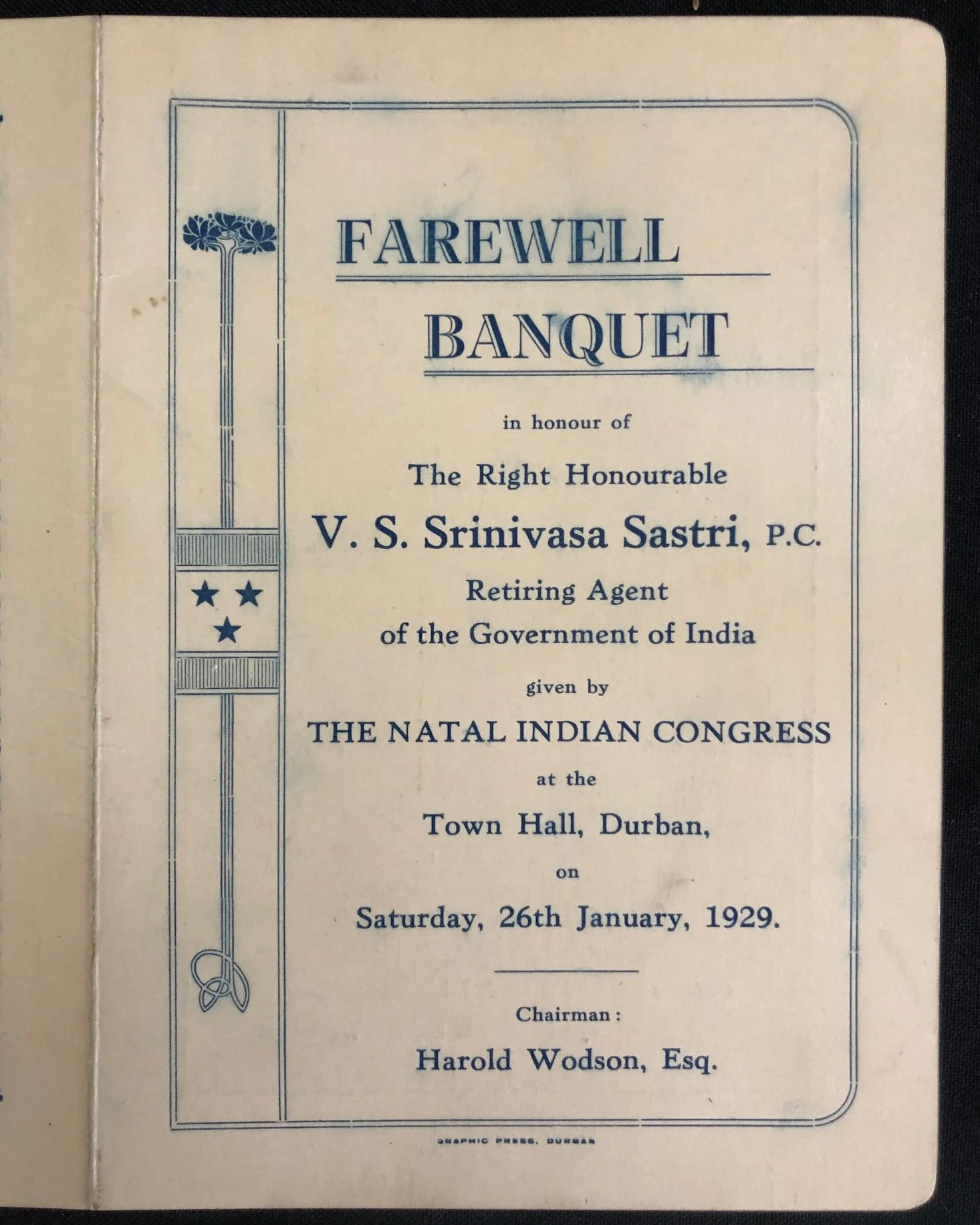
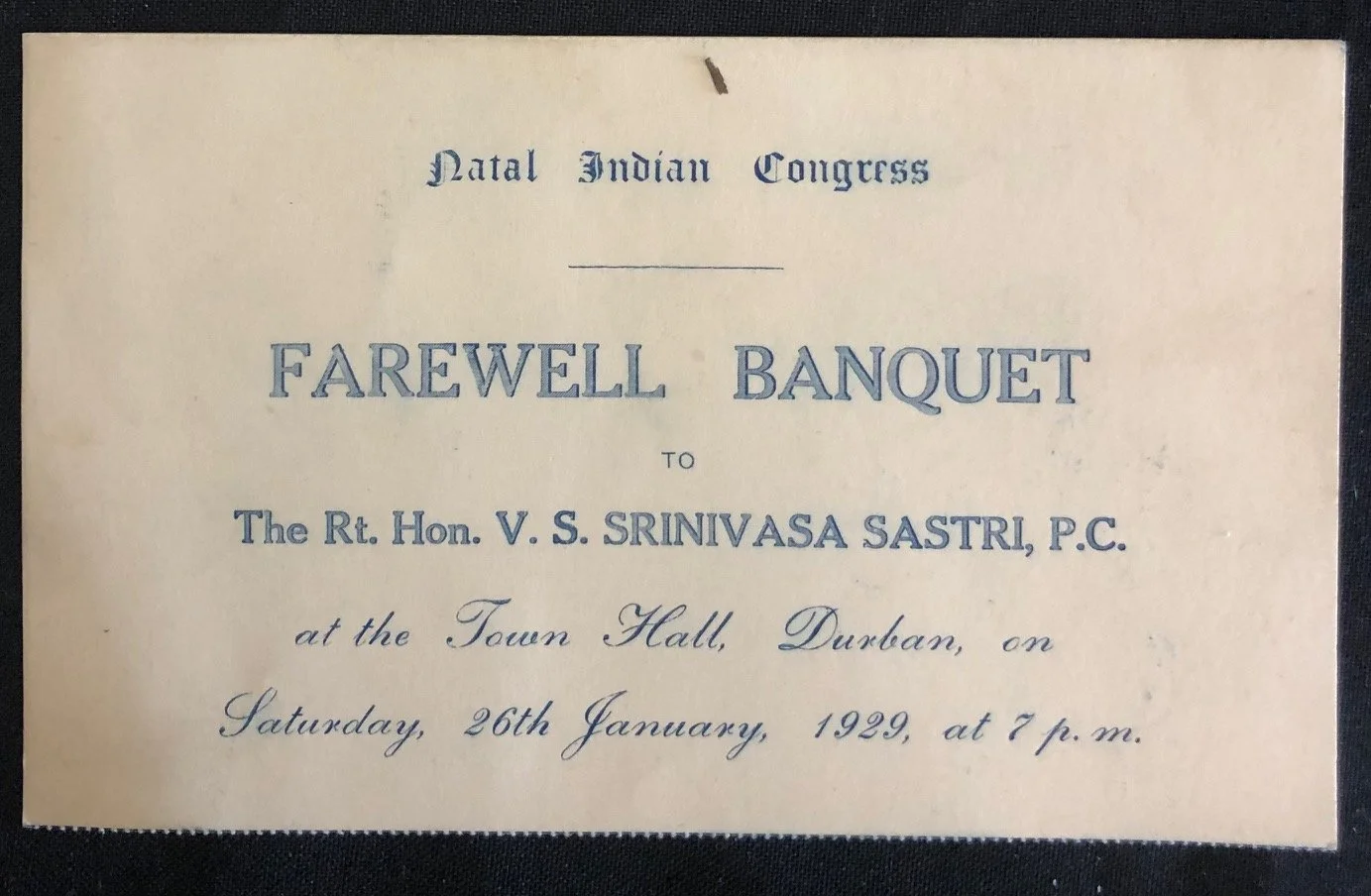
The farewell banquet on Saturday, 26th January, 1929, lists Harold Wodson, Esq. as the Chairman. Wodson was the influential editor of The Natal Advertiser (which later became the Daily News). Having a prominent white newspaper editor chair the banquet was a deliberate strategic move by the NIC to foster liberal white allyship in a deeply segregated Natal.
Rare survivors of a delicate, pre-Apartheid diplomatic experiment that ultimately slowed down segregationist legislation by a couple of decades before the Nationalist Party came to power in 1948.
Various sizes.
All are a little worn, some are smudged.
R1.500